Most teams optimize systems, not how people relate but relationships shape everything. Missed conversations breed resentment; defensiveness kills engagement. The healthiest teams I’ve worked with communicate clearly, repair quickly, give honest feedback, & build trust on purpose.
Some teams are incredibly good at the work.
They hit deadlines
Solve problems fast.
Perform at a high level.
And still
People feel disconnected.
Feedback gets avoided.
Trust erodes quietly in the background.
Because operational & relational excellence are not the same thing.
Deeply appreciative of the engagement, vulnerability, and care the Red, White & Blue Fire Protection District team brought. It’s always an honor to work alongside people who are committed not only to performing at a high level, but to showing up well for each other along the way.
Certainty sounds like leadership.
But it often kills collaboration.
Certainty feels:
Confident.
Decisive.
Efficient.
But it quietly shuts things down.
Curiosity keeps it alive:
“What perspectives are we missing?”
“Who sees this differently?”
“What else could be true?”
This month, one simple shift:
Replace certainty with curiosity.
Most teams don’t fall apart because of conflict.
They fall apart because of judgment.
When curiosity leaves, connection usually follows.
Above the line / below the line doesn’t stop at the office.
It shows up:
• in how we respond to our partner
• in how we react to our kids
• in how we handle hard conversations
Relationships don’t fracture because of mistakes.
They fracture when people stay below the line.
Every team will have moments:
miscommunication
missed expectations
tone that lands wrong
That’s not the problem.
The problem is what happens next.
Most teams default to:
• avoidance
• justification
• quiet resentment
But high-trust teams build a different muscle: Repair
Defensiveness doesn’t just show up loudly.
It shows up subtly—and that’s what makes it dangerous.
Sometimes below the line looks like:
• silence in meetings
• quick agreement with no real buy-in
• side conversations after the meeting
It feels efficient.
It’s not.
Every team lives in two places
Above the line:
Curious. Open. Accountable.
Below the line:
Defensive. Blaming. Protective.
Neither is “wrong.”
Both are human.
But here’s the difference:
High-performing teams don’t avoid going below the line.
They just don’t stay there long.
A group becomes a team the moment it can handle an awkward moment together.
You know the one.
The tension in the room.
The slightly defensive comment.
When the energy shifts and everyone feels it.
But the teams that build awareness into their culture?
They bounce back faster.
The goal isn’t a conflict-free team.
The goal is a team that notices what’s happening — sooner.
Because resilient teams aren’t above the line all the time.
(That would be lovely… but also unrealistic.)
They just get back there faster.
The strongest teams I work with aren’t conflict-free.
They’re just really good at the comeback.
Someone says:
“Okay… that didn’t land the way I meant it to.”
“Hang on — I got a little defensive there.”
“Can we reset for a second?”
And just like that, the room exhales.
Teams take emotional cues from leaders.
If a leader:
• Gets defensive
• Avoids hard conversations
• Blames externally
The team will mirror it.
If a leader:
• Admits when they’re wrong
• Names tension calmly
• Invites dissent
The team will mirror that too.
When one team member goes into self-protection, others follow.
Meetings tighten.
Innovation shrinks.
Real feedback disappears.
The problem isn’t emotion.
It's not naming it and hoping it goes away.
Resilient teams don’t eliminate defensiveness.
They just don't get stuck there.
But the true cost is often unseen.
People start second-guessing what they say.
Energy shifts from solving problems to managing reactions.
Creativity shrinks.
Good ideas stay unspoken.
High-performing teams interrupt that cycle by asking
“What is ACTUALLY happening right now?”
Most teams feel it when the energy shifts…
but no one says anything.
So the awkward moment lingers.
The tension grows.
And a small issue becomes a bigger one.
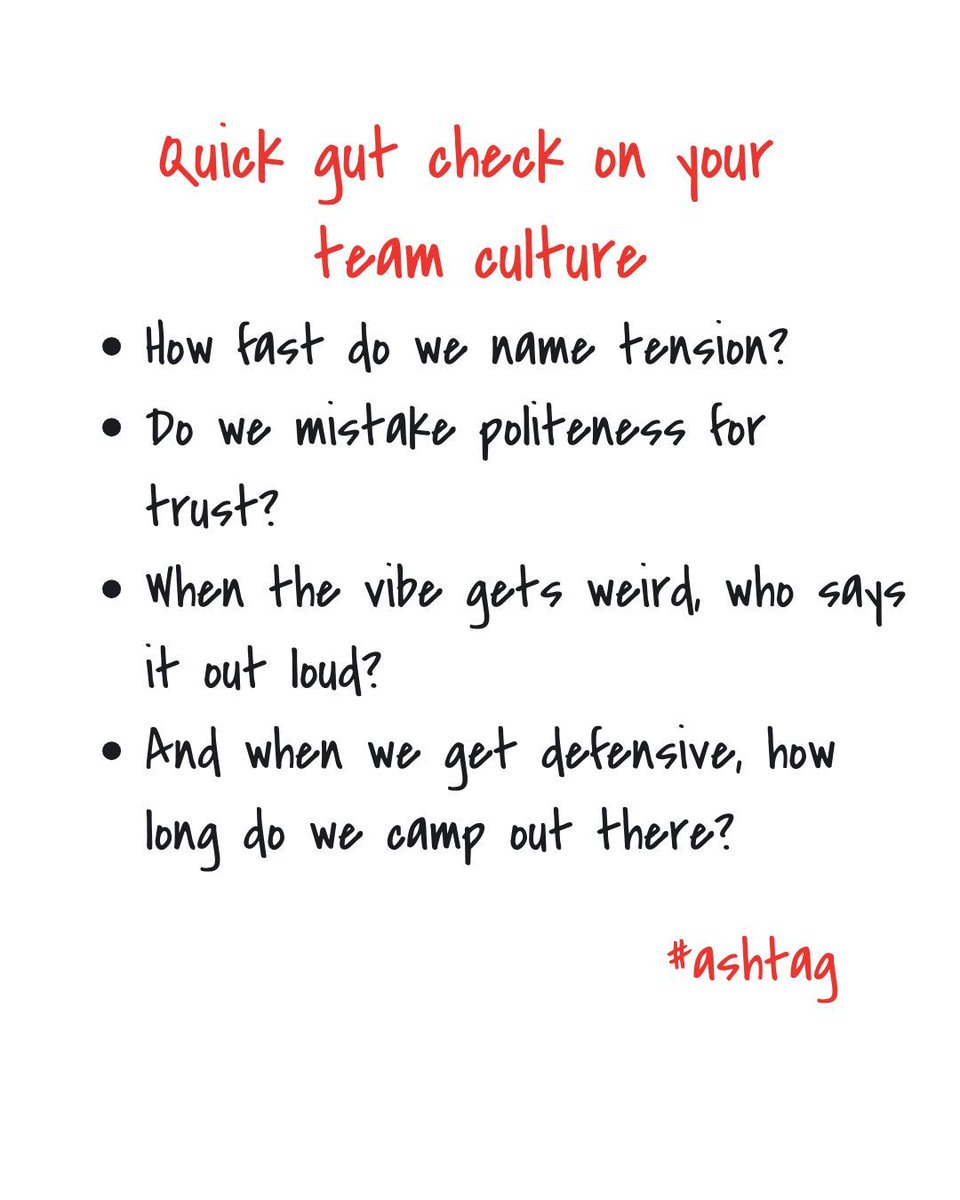
Strong teams don’t pretend awkward moments don’t happen.
They notice and name them sooner.
And they recover faster.
Individual growth is powerful.
Collective growth? That’s where things really get interesting.
You can have a room full of smart, capable, self-aware humans…
and still not have a team.
Teams aren’t built on talent alone.
They’re built on trust.
On clarity.
On shared ownership.
Agency doesn’t mean doing more.
It means choosing differently.
Not pushing harder.
Not tightening control.
But asking yourself:
Where could I let go — and empower someone else instead?