@airindia Wasn’t expecting to say this—but here we are.
Air India, you’ve truly raised the bar.
Lovely new A350 , Great crew, stellar service, and food that actually made me pause and appreciate mid-air.
From check-in to touchdown in London—seamless.
Feels good to see our Indian airlines soar again.
Proud. Grateful.
#AirIndia #ProudlyIndian
@TVKVijayHQ@CMOTamilnadu Went in for a corporation connection today. The officials told us : “We are here to serve. We don’t expect or accept money for basic services. It will be done.”
When something is done right, it should be said.
Hopefully this stays.
We stand on the shoulders or over 200 generations of thinkers, spiritual leaders, builders, warriors and merchants. We have a new chapter to discard the past divise eras and embrace our brothers and sisters of bhāratavarsha in every manner: emotional, cultural, economic. May wisdom and strength guide @tvkvijayhq to this new direction and place TN back on its path of intellectual, economic and cultural leadership in our beloved nation 🇮🇳💕
Tamil Nadu did not become industrious in the last 70 years. It has been industrious for over 2000 years.
Long before modern political movements, Tamil society had already evolved into a deeply specialized and economically productive civilization with clear social, occupational and commercial structures. Whether people like to admit it or not, the region historically functioned through a form of occupational stratification that resembled the broader Indian varna-jati framework adapted to Tamil realities.
The Chettiars became one of the greatest banking and capital networks in Asia. Long before venture capital and modern banking systems, Nattukottai Chettiars financed trade, agriculture and infrastructure across Burma, Ceylon, Malaya, Singapore and large parts of ASEAN. Tamil capital was global before globalization became fashionable.
The Mudaliyars, Pillais, Naidus, Gounders and several trading and agrarian communities built commercial ecosystems rooted in discipline, land ownership, logistics and manufacturing. Communities specialized over centuries and built institutional memory around trade, finance, administration and agriculture.
Tamil kings understood commerce exceptionally well.
The Cholas were not merely warriors; they were maritime strategists. They projected power all the way into Southeast Asia, controlled sea routes and built trading relationships across Srivijaya and ASEAN regions. Tamil ports connected Rome, Arabia and Southeast Asia centuries before modern nation states existed.
Geography mattered too.
Tamil Nadu benefited enormously from natural ports and coastal access. Nagapattinam, Poompuhar, Thoothukudi and several ancient port towns enabled maritime trade and movement of goods, ideas and wealth. A trading civilization naturally creates merchant classes, financial sophistication and manufacturing capability over long periods of time.
At the same time, Brahmins in Tamil society largely optimized for education, scripture, mathematics, administration and preservation of knowledge systems. Whatever one’s modern political lens may be, this educational emphasis created generations of teachers, scholars, administrators and technically inclined professionals. Tamil Nadu’s later strength in engineering, medicine and academics did not emerge from nowhere.
And then there were the temples.
Tamil kings did not merely build places of worship. Temples were economic institutions, cultural archives, employers, landowners, water managers, art schools and centers of civilizational continuity. That is why Tamil Nadu today houses thousands upon thousands of temples, many of which still stand as engineering marvels.
It is not a coincidence that Tamil Nadu alone is home to more than 80 of the 108 Divya Desams of the Sri Vaishnavite tradition. The density of temple infrastructure tells you how much surplus wealth, organizational capacity and artistic ambition existed in the region over centuries.
The deeper truth is this:
Tamil Nadu inherited an extraordinary civilizational flywheel entrepreneurship, trade networks, education, social specialization, manufacturing discipline, maritime access and institutional continuity.
Its success cannot be simplistically attributed to one political ideology of the last few decades.
In many ways, Tamil Nadu grew because its underlying civilizational and entrepreneurial DNA was already extraordinarily strong. The industrial base, educational culture, business communities and global commercial instincts existed long before modern Dravidian politics emerged.
One may argue that later governments expanded welfare, social mobility or political representation. Fair point. But to claim that Tamil Nadu became prosperous because of Dravidianism ignores nearly two millennia of accumulated social capital, temple economies, merchant networks, educational traditions and trading sophistication.
Civilizations compound.
Tamil Nadu is prosperous today because generations before us built institutions, ports, temples, trade routes, educational systems and business cultures that survived kingdoms, colonialism and political movements alike.
You cannot explain Tamil Nadu purely through 20th century politics when its foundations were laid over 2000 years.
Yes, there is absolutely a need for a credible political alternative in the state. But any alternative that succeeds will have to understand and align with the deeper civilizational strengths of Tamil Nadu rather than pretend they never existed.
@TVKVijayHQ may well augur that path forward. But this is not a short game. Any meaningful political shift in Tamil Nadu will require patience, institutional depth, cultural understanding and the ability to achieve escape velocity over time.
And that, ultimately, is anyone’s long game.
My $0.02
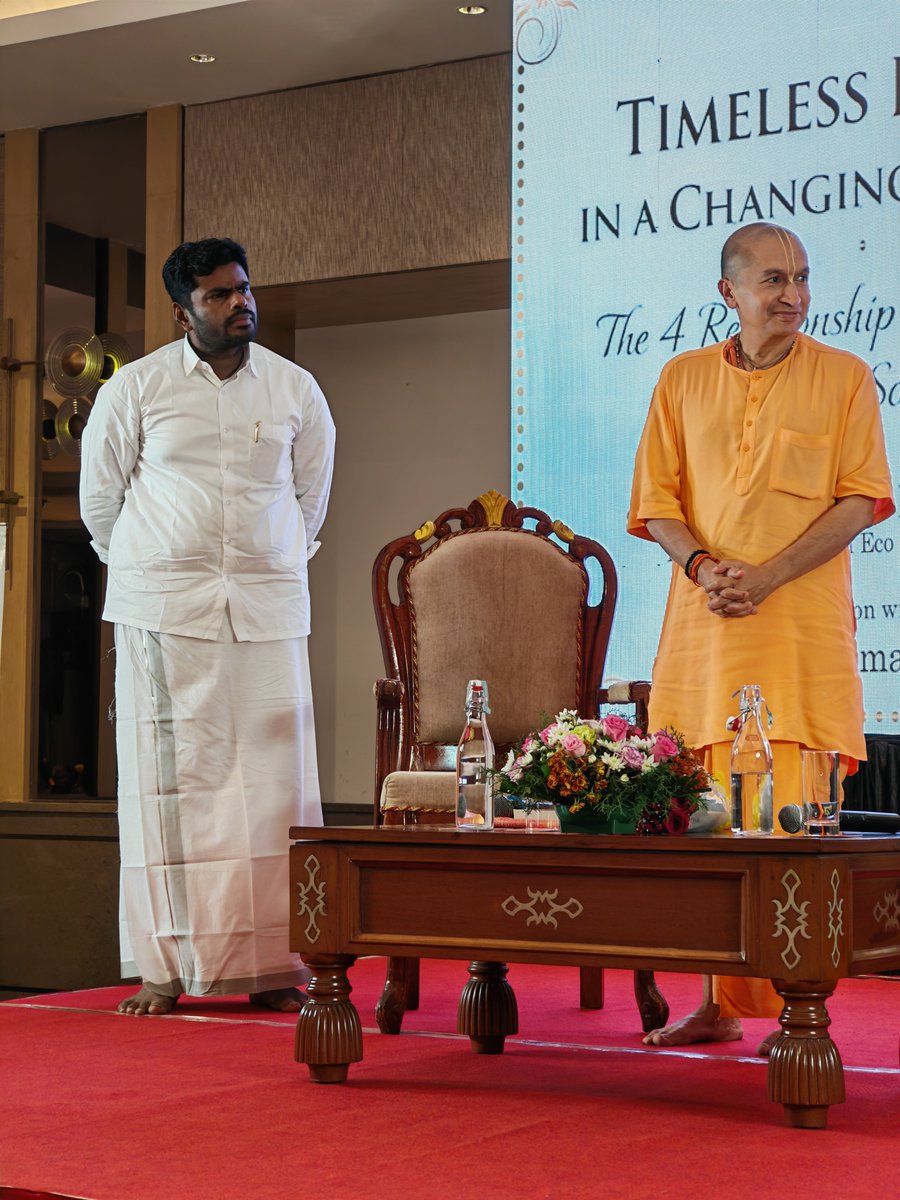
Delighted to have spent this evening in Chennai, in conversation with Swami Gauranga Das Prabhu avl at an event organised by Chennai International Centre. Glad to have listened to Swamiji’s thought-provoking discourse on timeless values, relationships, and the inner journey of a seeker.
The Ramayana reminds us that strength in relationships begins with integrity, harmony between thoughts, words, and actions. The bond of the three brothers of Lord Rama stands as a living example of trust, sacrifice, and dharma. Glad that Swamiji eloquently shared this timeless wisdom during today's discourse.
@GaurangaDas@CIC_Chennai
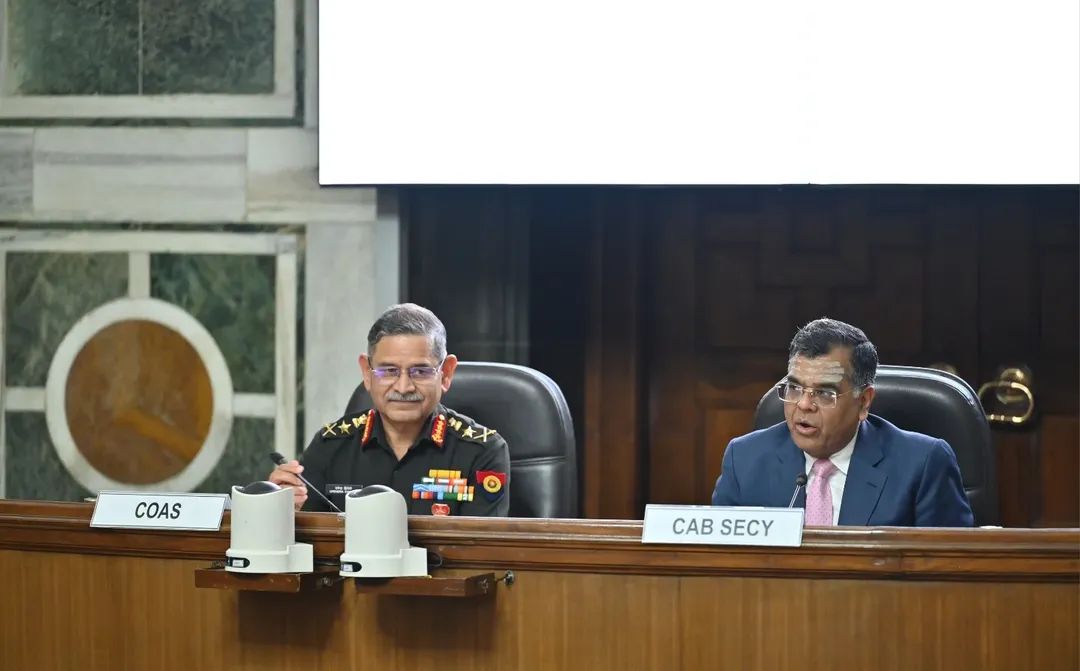
Came across this pictures of Cabinet Secretary, Dr T V Somanathan sir addressing officers in Army Commanders Conference. Felt happy that he proudly displays his Basma (Vibhuti ) on his forehead. It's fine example that even when u reach high level, doing Nityakarma is a must 🙂🙏
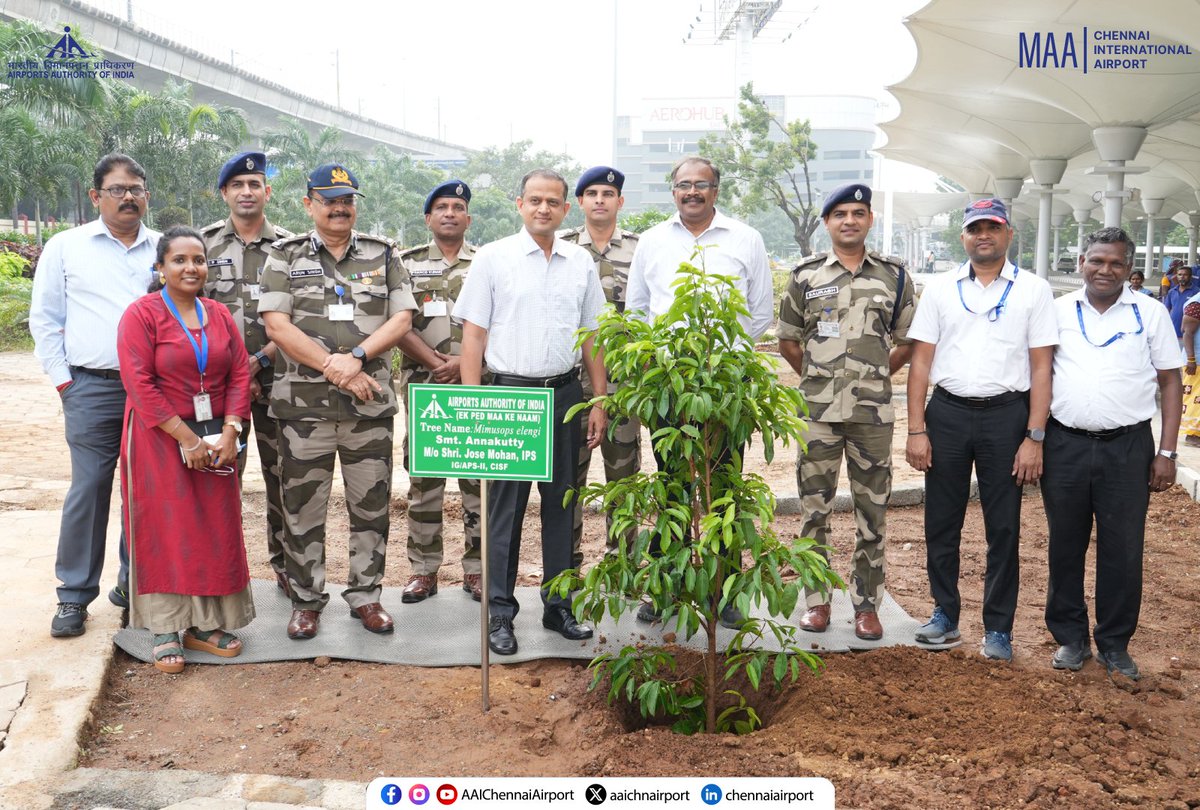
As part of the "Ek Ped Maa Ke Naam" initiative, Sh. Jose Mohan, IPS, IG/APS-II, CISF, planted a sapling at #ChennaiAirport, highlighting the importance of caring for our environment.
@MoCA_GoI | @AAI_Official | @CISFHQrs | @CISFAirport
#WATCH | On his book 'After Me, Chaos Astrology in the Mughal Empire', former MoS MEA, MJ Akbar says, "Facts inspired me to write a book. These facts had been available to everybody. They are lying there in Akbarnama, in Jahangirnama, Shah Jahan nama, in all the texts...But nobody put them together. Nobody sought to understand the meaning of this belief system - what cultural impact it had on the people of India, how much they absorbed from the people of India into their own system..."
@Accor I’ve become such a huge fan of Accor over the years.
For most of my travels, it’s my go-to place.
The Accor app is a benchmark in itself — seamless, reliable, and thoughtful.
As a proud member, I just want to say thank you for setting the bar so high. 🙏
@airindia Wasn’t expecting to say this—but here we are.
Air India, you’ve truly raised the bar.
Lovely new A350 , Great crew, stellar service, and food that actually made me pause and appreciate mid-air.
From check-in to touchdown in London—seamless.
Feels good to see our Indian airlines soar again.
Proud. Grateful.
#AirIndia #ProudlyIndian