How do “fear dictators” become “#spindictators” once societies go online? My new open-access article in
@democ_journal traces how the Lukashenka regime in #Belarus and its bureaucracy have retooled their information control in response to #digital uptake: https://t.co/Qki2pFQDT9
Check out our new open-access article, Autocratic Audiences and Linguistic Complexity, in British Journal of Political Science!
We explore how and why authoritarian elites tailor the complexity of their communication.
🔍🇰🇿 Even in authoritarian parliaments, not all voices speak in unison. My new paper examines possible pockets of rhetorical dissent or "embedded rhetorical contestation" in the Kazakhstani Senate protocols. Thanks to @timothymfrye for the guidance!
Link:
https://t.co/ucBgpgvdD6
I was happy to contribute to Fern's episode on Kim Yo-Jong of #NorthKorea. Seems ironically fitting in the aftermath of March 8. https://t.co/LVJlxvkP5N
The original podcast is available on Unfassbar.
🚨 BREAKING: South Korea is the world's SECOND country to enact a comprehensive AI law - and it's heavily inspired by the EU AI Act! Is the Brussels effect already happening? [HINT: YES] Here's what you need to know:
➡️ South Korea's AI law is called "Basic Law on AI Development and Trust-Based Establishment" and it was approved today by its national parliament with 260 votes in favor, 1 against, and 3 abstentions.
➡️ These are some of the main characteristics of the new law, according to the official summary:
→ It defines AI, high-impact AI, generative AI, AI ethics, and AI business operators (Article 2);
→ AI business operators who provide products or services using high-impact AI or generative AI must notify users of such fact in advance, and when providing generative AI or products or services using such, must indicate the fact that the results were generated by generative AI, and when providing virtual results that are difficult to distinguish from reality using an AI system, must notify or indicate such fact so that users can clearly see it (Article 31).
→ AI business operators must implement matters such as risk identification, assessment, and mitigation to ensure the safety of AI systems where the cumulative computational amount used for learning exceeds the standard prescribed by Presidential Decree (Article 32).
→ AI business operators must implement measures to ensure safety and reliability when providing high-impact AI or products or services utilizing such systems (Article 34).
→ If the Minister of Science and ICT discovers or suspects a violation of the law, he or she may request the AI business operator to submit materials or have his or her public officials conduct the necessary investigation, and if he or she determines that a violation has occurred, he or she may order necessary measures to stop or correct the violation (Article 40).
➡️ Among the main similarities with the EU AI Act, I would highlight:
→ The risk-based approach (with stricter obligations for high-risk/high-impact AI systems);
→ Focus on ethical guidelines/trustworthy AI;
→ Protection of fundamental rights;
→ Transparency obligations (e.g., in the context of deepfakes, anthropomorphism, similar to Article 50 of the EU AI Act);
→ Provisions on standardization;
→ The establishment of oversight bodies and procedures.
➡️ My take: yes, the Brussels effect is, in fact, happening. We should expect more countries to follow suit in 2025.
👉 AI regulation will be absolutely 🔥 in 2025. NEVER MISS my insights: join 43,300+ readers who subscribe to my AI newsletter (link below).
South Korean media have created a table of ministers who would step in one by one as acting president should this impeachment train keep rolling https://t.co/r1V9W3UbL8
Just watched the film. Recommended. Especially the final sequence (future careers of coup supporters) helps understanding the 386 generation's frustration imho.
#OpenAccess -
Why Politicians Won't Apologize: Communication Effects in the Aftermath of Sex Scandals - https://t.co/mIh5cVtlft
- Bence Hamrak (@ceu), Gabor Simonovits (@ceu), Alex Rusnak (@ComeniusUni) & Ferenc Szucs (@Stockholm_Uni)
#FirstView
The King Can Do No Wrong by Scott Williamson - @scottrw630
Examines why some autocrats are better at avoiding blame, and why today's ruling monarchies have been surprisingly resilient.
📚 https://t.co/LiprmOPx8v
"Building on policy-learning, #autocratic regional integration and linkages literature, this note asks the question: How can strong linkages with each other help autocracies achieve high levels of covert #repression?"
New article from @AskMeAboutNort1:
https://t.co/H7gx3C4Ued
Wird #NordKorea bald von einer Frau regiert? Darüber haben wir mit Sophia Wetzke von Simplicissimus Podcast geredet :)
#podcast#NorthKorea
Link: https://t.co/SlVmwU5egi
I just published a research note in @CA_Survey on the role of autocratic linkages in covert repression. There, I propose conceptualizing autocratic linkages as connections between autocracies via channels of goods, services, and policy learning. Read more: https://t.co/LmCLlb3exA
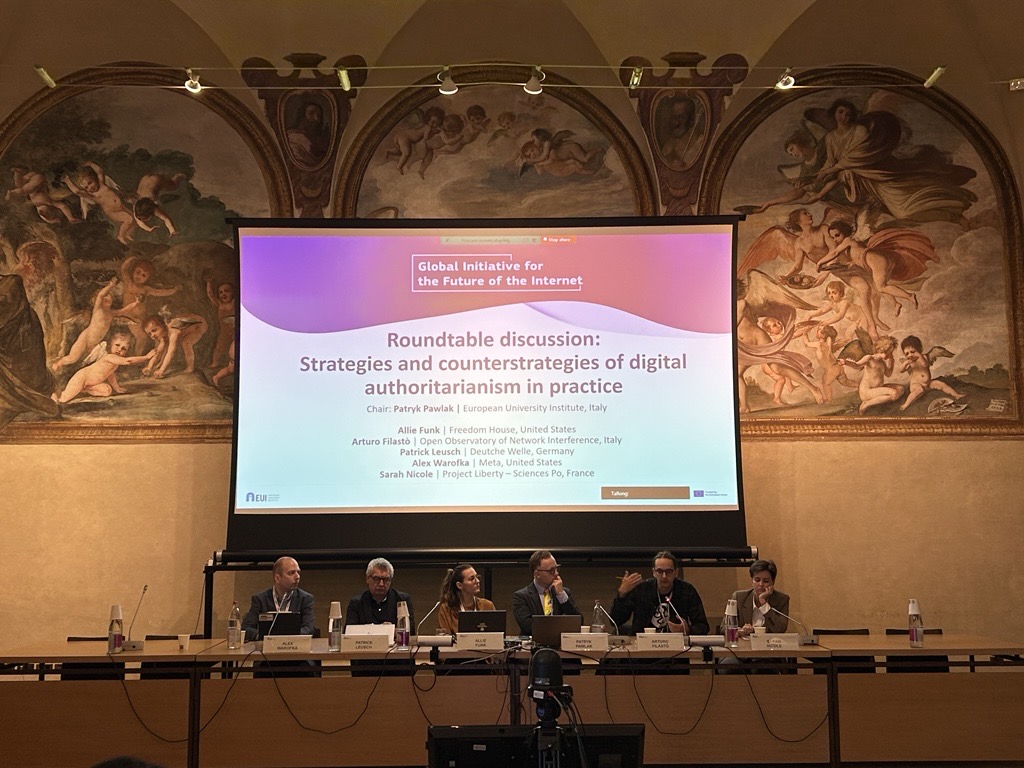
Day 2⃣ of the #GIFI conference has started!
🔍 Experts will examine the global influence of digital authoritarianism—from AI and spyware to internet infrastructure.
↪️ The first panel of the day discusses strategies and counterstrategies of digital authoritarianism in practice.
So, one of the first academic updates: my #article on the relationship between the types of #media consumption and political trust in the #EU is out and available in OA thanks to the support of @ceu. Check it out: https://t.co/NlO1kR88mH
Dear all,
We are happy to invite you to the opening event of 2024/2025 Academic Year on September 26 by Dr. Florentine Maier of the @wu_vienna . More information here: https://t.co/bNkTCxXfBN
With NK spiraling out of control in terms of their aggressive rhetoric and Trump on the horizon, there will be more and more calls in SK to develop their own nuclear weapons (shown by the polls too...)


![LuizaJarovsky's tweet photo. 🚨 BREAKING: South Korea is the world's SECOND country to enact a comprehensive AI law - and it's heavily inspired by the EU AI Act! Is the Brussels effect already happening? [HINT: YES] Here's what you need to know:
➡️ South Korea's AI law is called "Basic Law on AI Development and Trust-Based Establishment" and it was approved today by its national parliament with 260 votes in favor, 1 against, and 3 abstentions.
➡️ These are some of the main characteristics of the new law, according to the official summary:
→ It defines AI, high-impact AI, generative AI, AI ethics, and AI business operators (Article 2);
→ AI business operators who provide products or services using high-impact AI or generative AI must notify users of such fact in advance, and when providing generative AI or products or services using such, must indicate the fact that the results were generated by generative AI, and when providing virtual results that are difficult to distinguish from reality using an AI system, must notify or indicate such fact so that users can clearly see it (Article 31).
→ AI business operators must implement matters such as risk identification, assessment, and mitigation to ensure the safety of AI systems where the cumulative computational amount used for learning exceeds the standard prescribed by Presidential Decree (Article 32).
→ AI business operators must implement measures to ensure safety and reliability when providing high-impact AI or products or services utilizing such systems (Article 34).
→ If the Minister of Science and ICT discovers or suspects a violation of the law, he or she may request the AI business operator to submit materials or have his or her public officials conduct the necessary investigation, and if he or she determines that a violation has occurred, he or she may order necessary measures to stop or correct the violation (Article 40).
➡️ Among the main similarities with the EU AI Act, I would highlight:
→ The risk-based approach (with stricter obligations for high-risk/high-impact AI systems);
→ Focus on ethical guidelines/trustworthy AI;
→ Protection of fundamental rights;
→ Transparency obligations (e.g., in the context of deepfakes, anthropomorphism, similar to Article 50 of the EU AI Act);
→ Provisions on standardization;
→ The establishment of oversight bodies and procedures.
➡️ My take: yes, the Brussels effect is, in fact, happening. We should expect more countries to follow suit in 2025.
👉 AI regulation will be absolutely 🔥 in 2025. NEVER MISS my insights: join 43,300+ readers who subscribe to my AI newsletter (link below).](https://pbs.twimg.com/media/Gfv1YJNWYAA_uZW.png)