Hong Kong Chinese, music, movie and travel lover...
Sick of MSM lies after 2019 HK Riot and Xinjiang,
!!!Anti-warmonger!!!
We are ONE on this earth village!
"مشهد يختصر لكم الكثير حول لماذا يتم معاملة إسرائيل فوق القوانين الدوليه"
.
"القصه أن الإتحاد الاوروبي اجبر نادي Beşiktaş التركي على مواجهة نادي إسرائيلي
.
من المفترض ان تقوم المباره في اسطنبول.. لكن نقلوها الى جورجيا بحجة خشيتهم على سلامة لاعبي الفريق الإسرائيلي
.
قبل قليل وفي منتصف المباراه تدخلت الشرطه الجورجيه باستخدام رذاذ الفلفل ضد جماهير نادي بشيكتاش التركي
بسبب رفعهم علم فلسطين ولافتة فلسطين حره
.
الغريب حقا ان نفس الاتحاد الاوروبي
الذي حظر جميع الفرق الروسية من بطولات الاتحاد الأوروبي لكرة القدم بحجة ارتكاب روسيا اباده في أوكرانيا
وقالوا للروس نحن فعلنا كونكم تقتلون الاطفال والنساء
وحتى انهم طردوهم من الأولمبياد وكاس العالم
.
هو نفس الاتحاد الاوروبي لكرة القدم الذي يرفض تطبيق نفس المعايير على إسرائيل
بالرغم من انها تحاكم بارتكاب اباده جماعيه في غزه وبالرغم من ان قادتها يحاكمون كمجرمي حرب
.
"فلماذا يطبق الإتحاد الأوروبي لكرة القدم على روسيا
بينما يرفض تطبيقها على إسرائيل...!
President Xi banned foreign NGOs after USAID/NED/State Department actions in China.
“Some foreign NGOs, under the guise of development and human rights, are actually promoting separatism and destabilizing nations. China will not tolerate such interference.”
— Xi Jinping (2016, before enacting China’s strict Foreign NGO Law)
Before the West launched its “Uyghur genоcide” propaganda campaign, China had already identified the real threat, U.S.-funded NGOs pushing separatism. In 2016, Xi enacted one of the world��s strictest Foreign NGO Laws, forcing groups like USAID, NED, and Open Society Foundations under heavy restrictions.
• NED funneled millions into Uyghur, Tibetan, and Hong Kong separatist groups:
Hong Kong Protests → NED-backed activists pushing for regime change.
Uyghur Separatists → USAID/NED funding “human rights” groups linked to extremism.
Tibet Unrest → U.S. NGOs sponsoring “cultural preservation” efforts tied to separatist networks.
• USAID backed Radio Free Asia (RFA)—the primary source of the “genоcide” claims, despite zero evidence.
• The World Uyghur Congress (WUC), openly calling for Xinjiang’s secession, received U.S. State Department & NED funding.
What did Xi Do?
Xi enacted the Foreign NGO Law, one of the strictest regulations on foreign organizations in the world:
✔ Requires all foreign NGOs to register with the Ministry of Public Security (MPS).
✔ Bans any activity deemed a threat to national security.
✔ Mandates full government oversight of funding, partnerships, and projects.
✔ Shut down U.S.-funded groups promoting separatism, protests, and “civil society” activism.
Just like in Russia, Belarus, Venezuela, and Syria, the U.S. used NGOs as Trojan horses for color revolutions, subversion, and separatism.
Xi stopped them before China could become the next Ukraine.
In east China’s Anhui, morning mist drifts over the lake as crimson bald cypresses spill their reflections into the still water — early winter unfurling a scroll painting before your eyes.
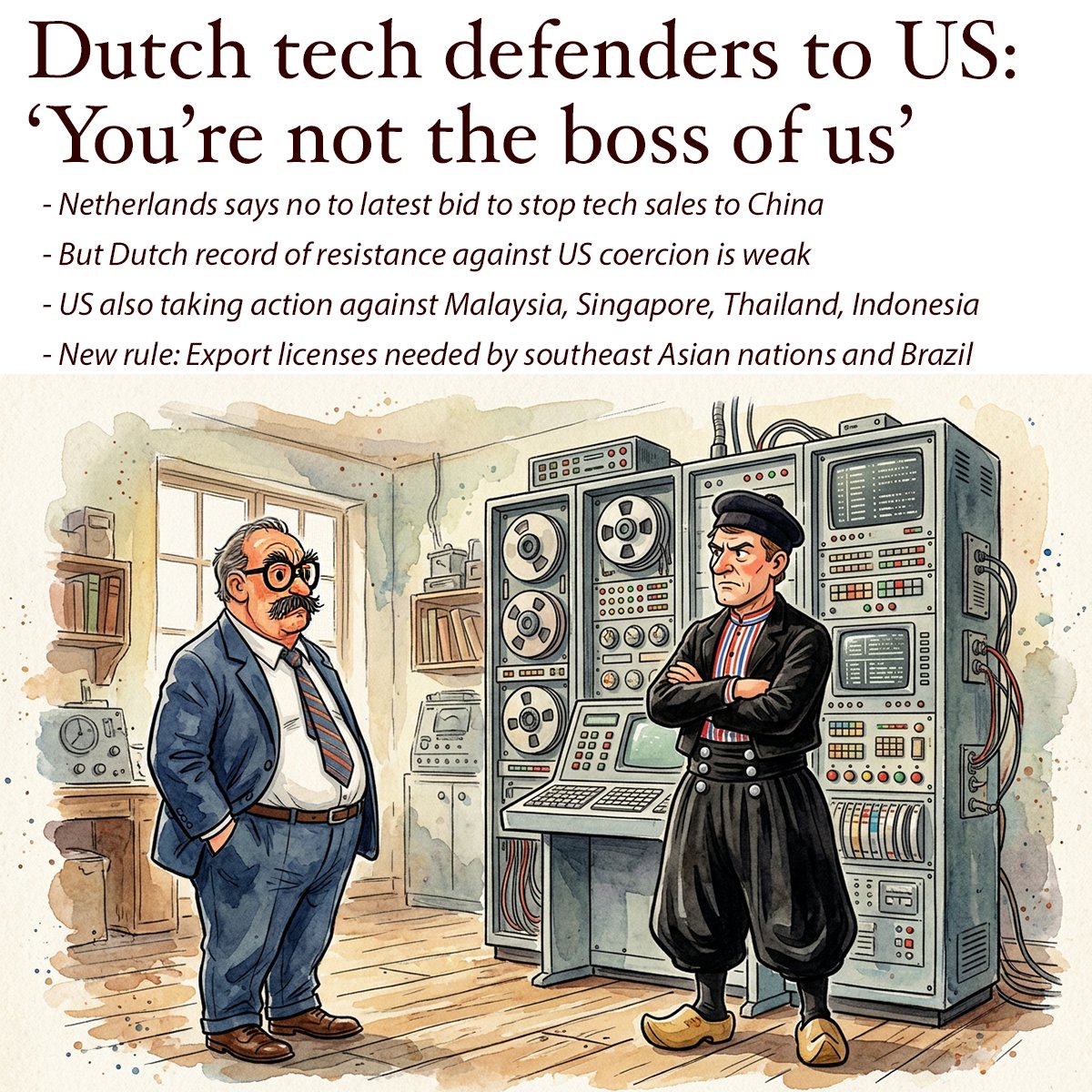
ABSOLUUT NIET! The world’s top chip-machine makers are saying NO to further US orders to stop selling machines to China, a Netherlands government spokesman said on Thursday.
“The US is not the boss of Veldhoven,” a minister said, referring to the location of their advanced semiconductor trade.
It looks like the Netherlands is finally making a stand against transnational repression, but that’s too generous. The European nation is thinking of its income: China alone provides 20 percent of the revenue for the Dutch industry.
.
EASY TO BULLY
While this looks like a positive move, in truth, the Dutch have been unimpressive at standing up for fair play in capitalism.
In 2022, the US flouted WTO rules, not to mention common courtesy, to order countries to stop selling top level chipmaking gear (EUV tech) to China. The easy-to-bully Dutch obeyed.
When the Chinese legitimately bought a tech firm, Nexperia, the Dutch side pulled a scam. They kept the cash they were paid and snatched back the company using an archaic law. That case is now in court.
.
CHINA 'DOING TOO WELL'
The latest conflict centers around expanded US attempts to coerce the world to further isolate China, which is doing much too well in rising from poverty to modernity.
Washington has composed a bill, the US’ Multilateral Alignment of Technology Controls on Hardware (MATCH) Act, which aims to force the countries of the world to further restrict technology sales to China. It would prevent the Dutch from selling a lower grade of semiconductor equipment, DUV tech, to China.
This degree of transnational coercion is controversial, even in the US, so Washington is considering tucking it into a sprawling Defense Bill. Both US parties are extremely pro-weaponry, so that would pass easily.
.
MULTIPLE STEPS THIS WEEK
This is just one of several steps taken to isolate China.
- The US this past week IS taking steps to force cloud providers from multiple countries to stop selling their services to firms in China. “Hello, Vietnamese datacenter people. Is your customer Chinese? Delete him or her. That's an order.”
- Also this week, Nvidia told its manufacturing partners to halt shipments of servers equipped with advanced chips to Malaysia, Singapore, Thailand and Indonesia, the Financial Times reported on Thursday.
- Other East Asians are also being targeted. Another new US rule means that companies must henceforth apply to the US for special licences if they want to send advanced AI chips to the above-named four Southeast Asian countries, or Brazil.
- Billions of dollars in funding commitments for datacenters associated with Chinese firms like Bytedance (maker of Tiktok) are being frozen, Bloomberg reported on Wednesday.
.
WAR ON CAPITALISM
Put it altogether, and what do we have?
Answer: Another front in Washington’s war on capitalism. The foundation stone of capitalism is competition from free trade.
The US says it is capitalist – except for electric cars.
And drones.
And solar panels.
And technology.
But in the long run, the abandonment of free trade principles is generally harmful - to people on all sides.
.
.
My case is a perfect example to show how the media is in bed with the deep state. My case has been an embarrassment to New Zealand. The then Prime Minister John Key really f’ed up. Here are all the things the complicit media is not telling you:
1. The Justice Minister who decided my extradition can go ahead is a friend, biographer and former employee of John Banks, a politician who was convicted of election fraud because of me.
2. Three Justices at the NZ Supreme Court (involved in my case) were partners at Chapman Tripp, the firm that represents Hollywood.
3. I won multiple times in Court that withholding information from me was unlawful. I still did not get the information I’m legally entitled to.
4. Former Senator Chris Dodd got USD 25 million from Hollywood and used his best friend (Joe Biden) to bring a contract prosecution against Megaupload and myself. But the Prime Minister of New Zealand claims he didn’t know about my case. LOL
5. My US Judge was forced to recuse himself because my investigators found out that his family owned Disney shares.
6. The US Supreme Court ruled that the legal theories the DOJ is using in my case are unlawful. They have overturned the same Judge who had to recuse himself from my case.
7. 10% of New Zealanders left New Zealand under John Key. He was a terrible Prime Minister.
8. The US government killed 58 million people since WW2 as stated by Lancet health, Global Research and Prof. Maersheimer. The equivalent to 19,300 times 9/11.
9. I offered a $100 million reward to any whistleblower who comes forward regarding the corruption in my case.
10. Joe Biden was at a fundraiser where we managed to get a lawyer seated at his table to ask about the Megaupload case. He proudly said “This is my case!”.
The media is also selling you the wars in Ukraine and Iran with endless propaganda. Ask yourselves why should AI spare us? I’m innocent. My only crime is to tell you the truth. This has been going on for far too long.
For years, Washington told the world Huawei was a spying threat.
This week, after eight years, a Brooklyn jury finally ruled. It threw out the charge at the heart of the government's case, the one that tried to cast Huawei as an organized crime outfit… too far-fetched even for a jury that convicted on 10 other counts. Before digging into those, it's worth measuring what the public has been told about Huawei against what eight years of investigation and 11 weeks of trial actually produced: not a single charge involving backdoors or spying for the Chinese government.
So what was the rest of it really about? It's kind of absurd when you look into it.
A big chunk of it was old business disputes. In 2003, Cisco sued Huawei over copied router software and manuals, and the two settled in 2004. In 2004, a Huawei engineer got caught photographing a competitor's equipment at a Chicago trade show, and Huawei fired him.
Then there's Tappy. Tappy was a robot T-Mobile used to test phones by tapping the screen over and over, like a finger. Huawei engineers were allowed to test on it. In 2013, one of them slipped part of the robot's arm into his laptop bag. It was back the next morning. T-Mobile sued, asked for about $500 million, and a jury gave it $4.8 million on only a breach of contract ruling.
More importantly, Huawei fired the two employees involved. And that jury already decided it was not "willful and malicious," and didn't award any damages for the trade-secret claim. That's in a civil case, where the bar is even lower than in a criminal trial. Yet that same incident was reused in the most recent trial to build a broad conclusion that Huawei engaged in a conspiracy to steal trade secrets.
And then there's CNEX, a small chip startup a former Huawei employee set up just 3 days after leaving Huawei. Huawei sued him first, saying he walked off with its technology. He countersued, saying Huawei took his. In 2019 the jury gave neither side a single dollar, and found that whatever Huawei did caused CNEX no real harm. In fact, CNEX on the other hand poached multiple Huawei employees and managed to copy thousands of confidential files. Yet once again, this is what the US used against Huawei to prove bad behaviour and a broad criminal conspiracy…
So think about that. Every one of these had already been dealt with, one at a time. Settled, the people involved fired, or decided in civil court with little or no damages. For most companies, that's where it ends, as old lawsuits in a filing cabinet. Prosecutors took it all, spread across more than a decade, glued it together, and asked a new jury to see one big criminal "conspiracy." They didn't even have to prove Huawei made a cent from any of it.
Their headline charge was racketeering, the law America uses to go after the Mafia. Prosecutors told jurors Huawei "cultivated a culture of crime and corruption." That's the charge the jury threw out, along with obstruction.
Back in 2019, the acting attorney general said the alleged crimes went "all the way to the top of the company." Seven years later, they couldn’t identify anyone specific from the bottom or top to stand trial. Just the very broadly, the whole company.
Now the Iran part, which is where it gets really ridiculous.
Huawei sold network equipment in Iran, partly through a Hong Kong company called Skycom. The sanctions it was convicted of breaking were America's own, not the UN's, and China never signed up to them. So how does a New York court get to punish a Chinese company for selling in Iran? The payments were in US dollars, and dollar payments clear through American banks.
And who was the "victim"? Mainly HSBC.
In December 2012, HSBC admitted to money laundering failures that let Mexican drug cartels move hundreds of millions of dollars through it. It also admitted to illegally processing transactions for Iran. It paid $1.9 billion and got a deal that spared it from prosecution. That deal was signed in Brooklyn, with the same prosecutors' office that later went after Huawei.
Eight months later, Huawei's CFO, Meng Wanzhou, met an HSBC executive in Hong Kong. That meeting became the center of the fraud case. HSBC didn't lose a cent, and under US law it didn't have to.
And here's a detail almost nobody mentions. Meng's lawyers pointed out in Canada that it was HSBC, not Huawei, that chose to clear those dollar payments through its own American arm.
So a bank that had just admitted to illegally handling Iran transactions, and that picked the route that made this an American case, got to play the victim.
As for Meng, she was arrested in Vancouver at America's request on December 1, 2018, the same day Trump was having dinner with Xi Jinping to work out a trade truce. Ten days later, Trump told Reuters he'd "certainly intervene" in her case if it helped get a trade deal.
She was stuck in Canada for almost three years, and to go home she signed a statement as part of a deal with US prosecutors. This year the judge let prosecutors use that statement against Huawei. Meng never took the stand.
Parts of the trial were held behind closed doors while government witnesses testified about Iran. The jury was picked during an ongoing US conflict with Iran, and the judge had to tell jurors not to let that sway them. She also told them China and the Communist Party "are not on trial."
Then the verdict came, and the Justice Department's own press release called the case "a stark reminder that the Chinese government continues to pose a serious threat."
So China wasn't on trial. Right up until the press release.
And as for those spying fears? Leaked NSA files published in 2014 showed it was the NSA that hacked into Huawei's headquarters, looking for ways to exploit Huawei's products.
This next part is pretty backwards. In 2019, the US blacklisted Huawei, citing the charges in this very case. It was cut off from American chips, and Washington pushed its allies to rip Huawei out of their networks. The verdict came seven years later.
Sentence first, verdict afterwards. Lewis Carroll wrote that as a joke.
What this all says about how the world works goes far beyond Huawei. The whole case rests on the idea that Washington decides who the rest of the world is allowed to trade with. Since the dollar is on one side of almost 90% of all currency trades on the planet, it can enforce that on pretty much everyone.
Just ask Europe. When Trump pulled out of the Iran nuclear deal in 2018, European governments wanted to keep trading with Iran under the promises they made and deals they signed. Their companies left anyway. Total, Siemens, Peugeot, Airbus. Total said US banks were involved in more than 90% of its financing, so it couldn't take the risk. Europe even built its own payment channel, INSTEX, to trade with Iran outside the American system, but it never really got off the ground.
So if you've ever wondered why so many countries are trying to rely less on the dollar, this is a big part of the reason.
Huawei says it will appeal. Whatever happens there, remember how this was sold to the world: as national security. What actually reached the jury was a router dispute from 2003, a piece of a phone-testing robot in a laptop bag, and dollar payments that a bank chose to send through New York.