Recently accepted by #QJE: “Codification, Technology Absorption, and the Globalization of the Industrial Revolution,” by Juhász (@juhreka13), Sakabe, and Weinstein (@deweinstein): https://t.co/nOdU36sriX
📷
On the latest Economics for Inclusive Prosperity podcast: A sobering and informative talk about technology, the world food supply, and inequality with economists Jacob Moscona of MIT and Karthik Sastry of Princeton.
https://t.co/zTuvsnrKLm
RIP Ned Phelps
Ned Phelps followed his own intellectual journey.
When Keynesians relied on a long-run tradeoff between unemployment and inflation, he showed why this was a weak reed to stand on. Thus was born the natural rate hypothesis (although the coining of the word goes to Friedman, a year after Ned’s paper).
When, later, New Keynesians were focusing on nominal rigidities, he built models of fluctuations where nominal rigidities played no role. When New Classicals were exploring the cyclical implications of competitive markets, he focused on the role of distortions in goods and labor markets, be it efficiency wages, or variable markups.
It would be fair to say that, today, the frontier macro models embody the natural rate hypothesis, and many of the distortions Ned focus on---and, what he did not like, i.e. nominal rigidities.
His style was highly idiosyncratic. He was often a poor expositor of his fundamental insights. He did not listen much to others, pursuing his agenda with focus and passion. But, to use an overused but appropriate expression, he was certainly one of the giants in the field. We often met and sometimes fought, be it on hysteresis or nominal rigidities, but I had infinite respect for him.
Watch: Professor Atif Mian (@AtifRMian), the John H. Laporte, Jr. Class of 1967 Professor of Economics, Public Policy and Finance at @Princeton, defines the economic and institutional significance of peace and the protection of rights on @CERPakistan.
https://t.co/RayBkv2y83
For researchers interested in U.S. banking and finance, we are sharing a new data resource!
It contains information on bank balance sheets, bank runs, and bank failures from the 19th century to the present:
Announcing: @PlatypusEcon — a Substack, YouTube channel, and podcast built around one idea: Economics is one of the most useful, surprising, and weirdly beautiful subjects in the world.
It belongs to everyone — not just the people who happened to take it in college. 🧵
Last night I listened to David Reich’s interview with @dwarkesh_sp on his new Nature paper, “Ancient DNA reveals pervasive directional selection across West Eurasia.”
https://t.co/PE7auH87TW
Reich and his team present a method for detecting directional selection in ancient DNA time series, testing for consistent trends in allele frequency over time. They find that hundreds of alleles have been under strong directional selection, including alleles correlated with measures of cognitive performance.
I have followed David Reich’s work for over a decade now and cite him in my economic history courses all the time. Nothing has changed my view of ancient history as much as his research, and the research his methods have triggered.
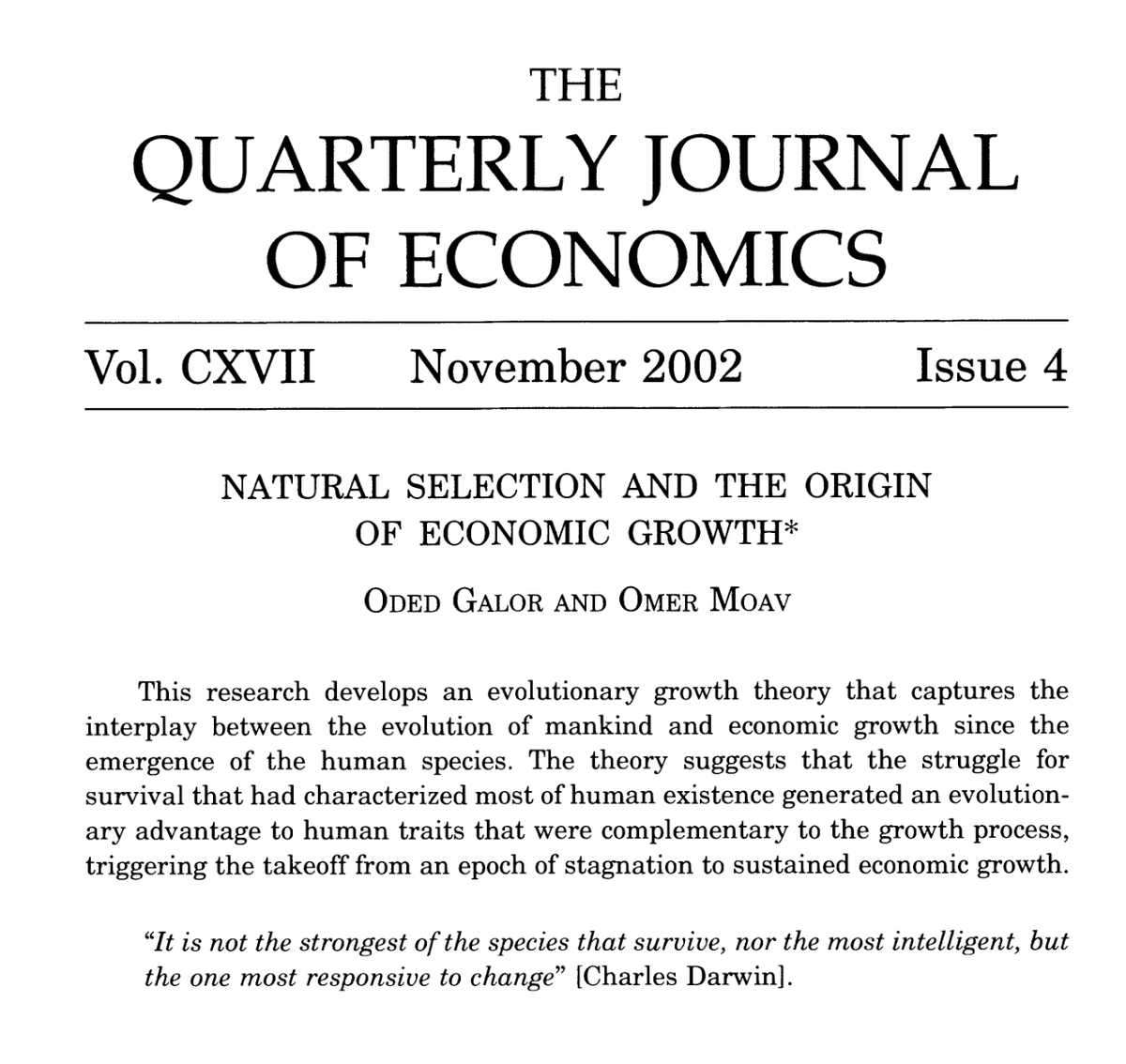
His findings also bear directly on another line of work, “Natural Selection and the Origin of Economic Growth” by @GalorOded and @Omer_Moav at the Quarterly Journal of Economics, which proposes a similar mechanism. Reich’s results give a serious empirical boost to Galor and Moav's research agenda.
Reich returns several times in the interview to behavior related to what economists call the discount rate (without using such a term). The evidence suggests that humans began discounting the future less with the advent of agriculture, because directional selection favored patience.
I’ve long thought modern schooling serves this same function, training people to defer immediate rewards for long-term gains, and that such training is the most valuable trait one can have in daily life. Contrary to the Foucaults and Freires of the world, that schools are boring is a feature, not a bug. I don’t expect anyone at the schools of education to get this.
University of Chicago Professor Steven Durlauf is a renowned scholar of inequality and meritocracy. We had an intriguing conversation about how he says meritocracy can help people from a broad swath of society achieve their full potential. https://t.co/YvvUgBVno4
The NBER Digest features our new paper, “How Do Interest Rates Affect Consumption?” with @JADHazell, Foulis, and Tracey
Two key contributions:
1. New administrative data on spending and debt, plus staggered mortgage refinancing, generate 6M+ household-level interest-rate shocks, allowing clean treatment-effect estimation with household fixed effects
The main finding: spending response to rate cuts is driven to a significant degree by additional borrowing against interest-rate-induced gains in home values
Debt and Asset Prices are central to monetary policy transmission.