Let your system run autonomously.
Give your agents memory they can use across sessions, and your team a way to see what was stored, retrieved, corrected, and why.
Configurable memory for AI agents, now in Public Beta.
https://t.co/mQaXsTWcDl
llmwiki 1.5 had code from three people who don't work here.
LorenzoGentile: Converse gateways, pages that fit the source, cleaner wikilinks
Erick0412-dev: the live-refresh viewer
vishalhabib99: quiet MCP tools over stdio
Thank you. Want to be in 1.6? 👇
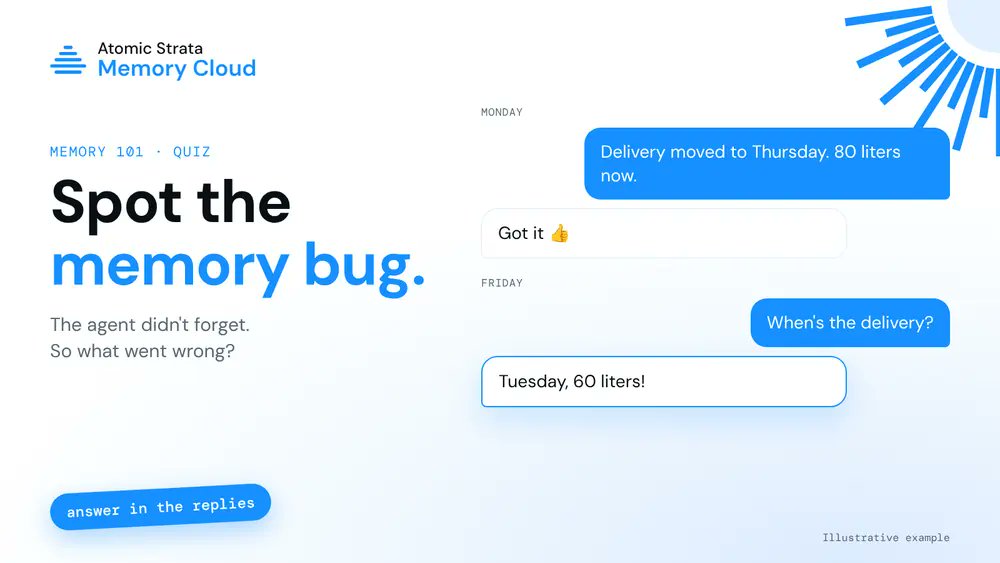
Spot the memory bug 🔍
Monday: "Delivery moved to Thursday. 80 liters now."
Friday: "When's the delivery?"
Agent: "Tuesday, 60 liters!"
The agent remembered. That's the problem.
What went wrong? Wrong answers welcome.
Colorado's AI Act lets people correct inaccurate personal data an AI used in a decision about them. More rules like it are coming.
That's a memory problem before it's a legal one.
Could your agent answer: what do you know about me, and where did that come from?
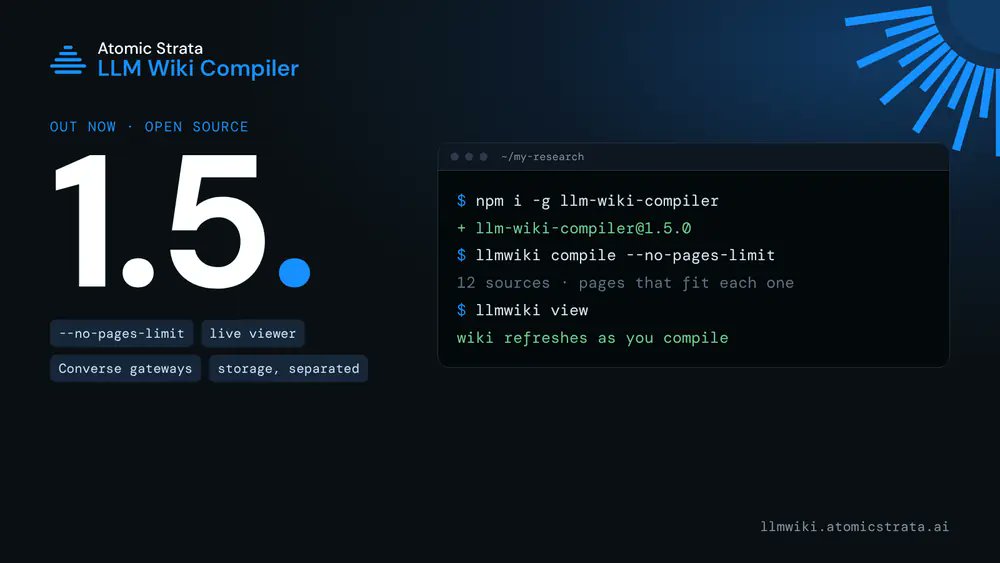
1/ llmwiki 1.5 is out.
If you haven't met it: it compiles your docs, notes and papers into a wiki that cites its sources, so your agent reads knowledge instead of re-digging through raw files.
What's new 👇
5/ Under the hood, wiki logic is now separated from how it's stored on disk.
Your wiki keeps working as it is. No migration. It's the groundwork for what comes next.
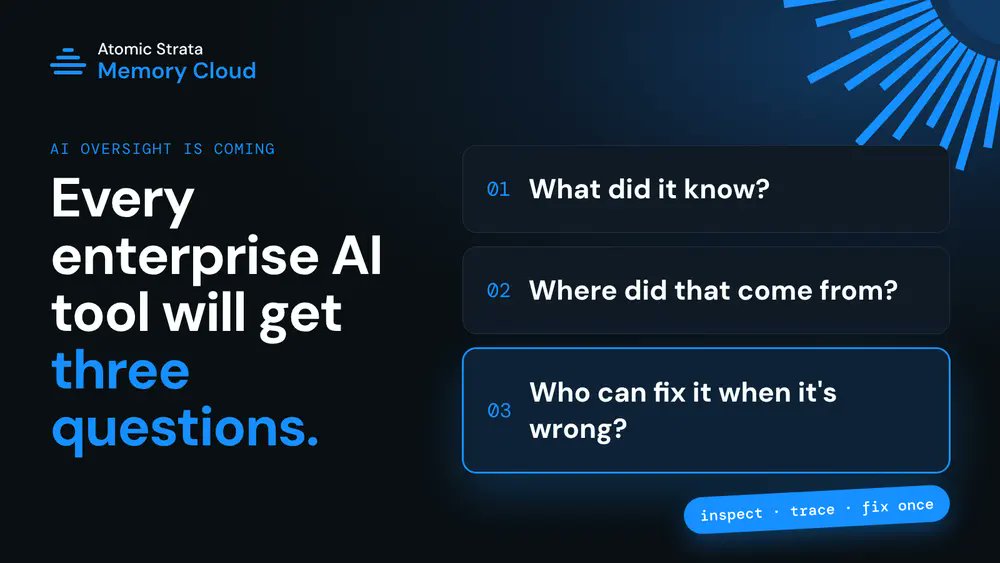
Every enterprise AI tool is about to get the same three questions:
What did it know?
Where did that come from?
Who can fix it when it's wrong?
That's what we build: context you can inspect, trace to its source, and fix once so it stays fixed. https://t.co/4uEn3V7hb9
With the elections, a new era of AI oversight is coming in the US. Enterprises are going to have to answer for the data going into their AI tools and processes. Governed, inspectable and correctible context is about to become very important and we've been building it for the last two years @AtomicStrata.
My cofounder Ethan foresaw this era when he built AuditBoard's AI system and the time is now.
Every enterprise AI tool is about to get the same three questions:
What did it know? Where did that come from? Who can fix it when it's wrong?
That's what we build: context you can inspect, trace to its source, and fix once so it stays fixed.
With the elections, a new era of AI oversight is coming in the US. Enterprises are going to have to answer for the data going into their AI tools and processes. Governed, inspectable and correctible context is about to become very important and we've been building it for the last two years @AtomicStrata.
My cofounder Ethan foresaw this era when he built AuditBoard's AI system and the time is now.
An agent hears a new fact. Now what?
Atomic Memory Cloud's AUDN engine makes an explicit call on each one: keep it, update an older memory, or remove what's no longer true.
And it records why. "The agent changed its mind" becomes something you can read.
Back with an update from the build.
New in Atomic Memory Cloud: per-user memory. When two people on the same project save the same fact, each now keeps their own copy, scoped to them.
Shared context where you want it. Personal memory where you need it.
Banks, funds and fintechs are on stage at @aiDotEngineer NYC this week, talking about agents in production.
One question we'd add to every deployment checklist:
When the agent is wrong, can you show what it remembered, where that came from, and who corrected it?
@Google’s new @GeminiApp agent keeps four kinds of memory: session, semantic, procedural and episodic.
Memory is now the headline feature of workplace agents.
The next question every team will ask: can we see what it remembers, correct it, and take it with us?
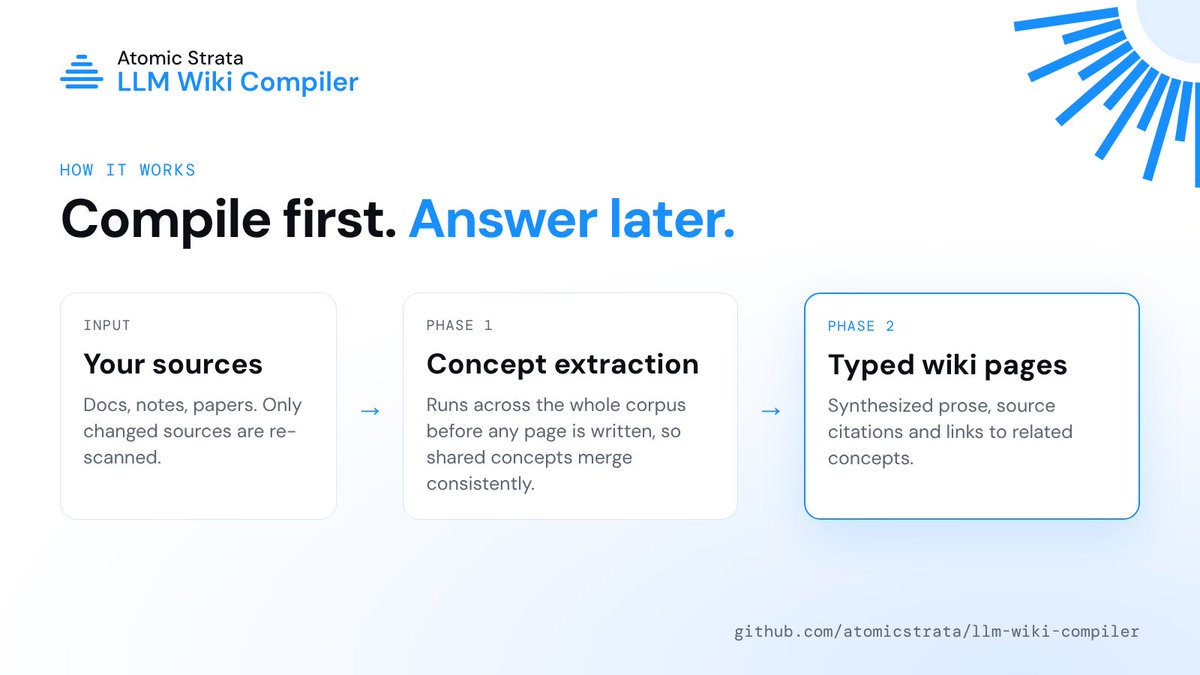
1/ Most RAG setups read your documents at question time.
LLM Wiki Compiler reads them first, and compiles them into a wiki your LLM can use. It works in two phases:
2/ Phase 1: concept extraction.
It scans each changed source, pulls out its concepts, and finishes extraction across the whole corpus before writing a single page. Shared concepts merge consistently, and extraction failures surface before they touch retrieval.
3/ Phase 2: typed wiki pages.
Each page combines synthesized prose with source citations and links to related concepts. Scattered references become connected knowledge.
4/ Every later query starts from that structure instead of raw chunks.
Open source: https://t.co/ByBzRaskvQ
How it works: https://t.co/Y3f2L1C9x1