Title insurance is one of the main things that drives up closing costs for home purchasers. What most people don't know is that title insurers pay out almost nothing, add consumers have little ability to shop around. It's a case study in rent-seeking.
https://t.co/YfWq4wLcU6
@SteveThunderfan Agreed. Also, generally speaking, more intricate rules are relatively better for more sophisticated management (in any industry). It creates more management game to play.
The crazy train is getting crowded.
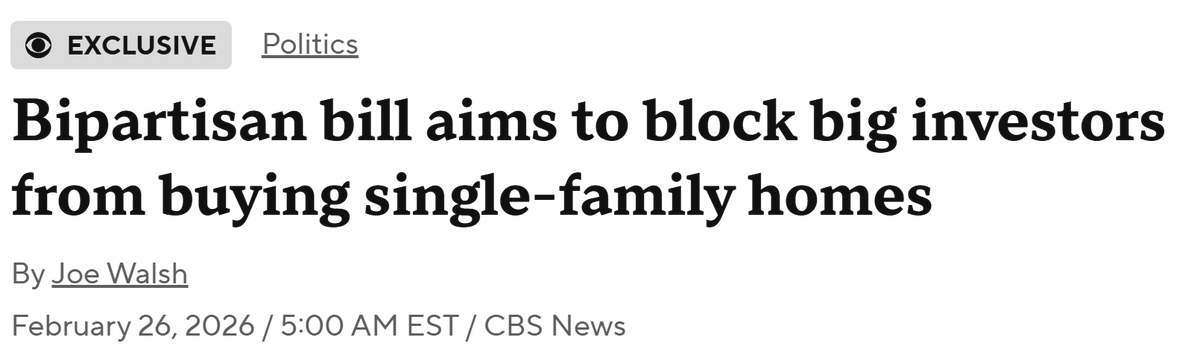
We now have a bipartisan Senate bill to block large investors from buying houses. The entire premise is based on misinformation, which I'll lay out here:
STATEMENT 1: One co-sponsor, Sen. Hawley, shared his rationale this way: "Families deserve to be able to buy their own homes and achieve the American dream without competing with big investment companies that irrevocably drive up housing prices."
FACT CHECK: Freddie Mac research showed, at the height of home price boom in 2022: "What may surprise you is that investors don’t make our list of top drivers" of home price growth. Nearly all research suggesting investors materially impact home prices is based on the GFC era in early 2010s, when investors were buying up vacant homes out of foreclosure.
STATEMENT 2: The bill's other co-sponsor, Sen. Merkley, said this: "As corporate investors invade the housing market nationwide, we need action to protect hardworking Americans achieving the dream of homeownership."
FACT CHECK: Research from Harvard's Joint Center for Housing Studies, John Burns Research, and Redfin all show that SINCE 2016, INVESTORS ARE SELLING FAR MORE HOMES THAN THEY'RE BUYING. We have >1m FEWER single-family rental homes today than we had a decade ago.
And a third FACT CHECK: The U.S. homeownership rate today (65.7%) is ABOVE the long-term average of 65.3% and even further above the long-term median of 64.8%, according to Census data. And if you exclude the subprime lending decade of the 2000s, the long-term average drops to 64.7%.
REALITY CHECK: Yes, we do have a severe housing affordability issue in the U.S. But we can't solve the problem without correctly diagnosing the problem.
Banning investors will do nothing to help solve that root issue: Most renters today cannot qualify for a mortgage (low credit scores), cannot come up with the cash for a down payment and cannot afford the >$1k in additional monthly costs of owning a single-family home versus renting one.
Therefore, any effort to further reduce single-family rentals (already down 1m+ since 2016) will inevitably result in worsened inequality and worsened affordability challenges -- as those families then have fewer options at higher rents. Furthermore, it would become harder for middle-income families to access better neighborhoods (and better schools) where they can't afford to buy.
Vibe-based policy will exacerbate inequality and affordability challenges. Let's focus on what works and make it easier to build a lot more housing of all types.
Facts > Narratives.
It’s important that you understand what happened last night.
Last night, Stephen Colbert interviewed Democratic Texas Senate candidate James Talarico, a candidate who, by all accounts, is on track in the polls to flip Texas blue.
In response, Trump’s FCC reportedly threatened CBS if the interview aired.
CBS caved and pulled the segment, citing “financial reasons.”
In modern American history, no president has been more hostile to free speech than Donald Trump.
But censorship always backfires.
Here’s the full segment Trump didn’t want you to see.
@EllliotttB I mean… this is a SF pre-covid to post-covid story. Yes, an anecdote worth remembering, but this is an edge case in the field of “major metro 10-yr hold MF investments”, right? For every one of these, you’re going to find 10 with the opposite result. Just a hunch.
@drmoneymatters Why not partner with RE pros and sit shoulder to shoulder with them in the capital stack? On the front end of this, if the doc had partnered with a developer, he would have mitigated significant risk, saved time, and had a pro built facility. No?
@iononrecourse The buyer with the tenant in tow (good luck)! This is similar in healthcare RE right now even for OCCUPIED 10-20 year old buildings. Half the cost psf of new construction after TI’s.