Morning. The last 48 hours of Codex and ChatGPT Work have been intense! Three important updates:
- Temporarily removing the 5 hour usage limit restriction for all Plus, Business and Pro plans
- Rolling out changes that will make GPT 5.6 Sol more efficient across the board and that will be reflected in less usage being used so that it can take you further. Exact impact to be quantified and shared
- We hit 6M active users, and are landing a usage reset in the next hour
Go do things
I have said it countless times, and I’ll continue to say it for those who care to listen. I like women a lot. You may not understand the depth to which I like them, but every chance I get, I’ll continue to list reasons why.
Today, I like women because of how ruthless they are when it comes to choosing themselves. Women put themselves first, unapologetically. They are insensitive in situations that require empathy, privacy, or genuine respect for the person affected.
Last year, a guy replied to a tweet in which he said he broke up with his then-girlfriend because she has PCOS, and hell broke loose on this app. Women called him a misogynist, an incel, and every sort of demeaning and disgusting name for his CHOICE.
To make it worse, there were also men who tried to make him feel bad, gaslight him, and insult him for that same CHOICE. That tweet has over 5 million impressions because they kept dragging him for that single CHOICE.
Go through the comments and quotes on this tweet: it is filled with “valid” from women especially, and they don’t see anything wrong with it. In fact, I respect that about them, because, just like I said earlier, I like women a lot. And one of the things I like about them is how unapologetically ruthless they are when making decisions, especially regarding men and dating.
There’s no scenario where a woman wouldn’t put herself first. Whether it hurts you or not is irrelevant. Men should learn from them.
This man stole a country from his own father and spent the next 18 years buying the West with gas money.
- He deposed his own dad in a palace coup and left him in exile for nearly a decade
- He founded the news network that aired Osama bin Laden's tapes
- He built America's largest military base in the Middle East and charges no rent for it
- He bought Harrods, the Shard, Canary Wharf, Paris Saint-Germain and 17% of Volkswagen
- He won the 2022 World Cup for a country with no football history
Sheikh Hamad bin Khalifa Al Thani died this morning at 74.
Here's how bought the world:
In June 1995, he waited for his father to leave the country, then took the throne. The coup was bloodless. His father spent nearly a decade in exile.
Qatar is about one third the size of Belgium, and its population was barely two million, most of them foreign workers.
But it was sitting on one of the LARGEST natural gas reserves on Earth.
He bet everything on liquefied natural gas. Qatar became the world's biggest LNG exporter and one of the richest countries alive per person.
Then he hit the problem every commodity business hits:
Gas is gas, anyone with a tanker can sell it, and a tiny country with no army and that much money is a snack for its neighbours.
So he bought two things nobody else in the Gulf thought to buy...
The first was the world's attention.
In 1996 he issued a decree and Al Jazeera was born. Within a few years it was the most influential news network in the Arab world.
He owned the loudest microphone in the region and never had to speak into it himself.
The second was the American military.
In 1996, Qatar spent over a billion dollars building an air base at Al Udeid, outside Doha. It got the longest runway in the Gulf and shelters for nearly a hundred aircraft.
Qatar's air force only had about a dozen fighter jets.
In 1999 he reportedly told US officials he wanted 10,000 American servicemen stationed there permanently.
Then 9/11 happened, and they came.
The genius part:
Al Udeid is now the forward headquarters of US Central Command and the largest American base in the Middle East, with roughly 10,000 troops.
Qatar charges no rent.
He built the asset before the customer existed, handed it over free, and bought the one thing cash cannot: The US military parked permanently between his gas and everyone who wanted it.
The network broadcasting bin Laden and the runway flying America's war sat in the same tiny country, paid for by the same man.
Then he went shopping...
He set up the Qatar Investment Authority in 2005:
- Harrods
- The Shard
- Canary Wharf, London's largest property owner, bought with Brookfield for 2.6 billion pounds
- 17% of Volkswagen
- Paris Saint-Germain
All his.
In 2017 the Telegraph ran the headline "Qataris own more of London than the Queen."
Then 2008 arrived. Barclays needed billions or the British government was going to own it. Qatar wrote the cheque and its stake climbed to 12.7%. Barclays was later charged over how it disclosed that Qatari money.
In 2010, FIFA handed the 2022 World Cup to a desert country with NO football history. Corruption allegations shadowed the bid for over a decade, and the treatment of the migrant workers who built it drew brutal criticism.
Yet he walked into the opening match in 2022 and the stadium gave him a standing ovation.
Every other Gulf state was selling the same molecule at the same price. Hamad spent his money on a newsroom, a runway, a football club and half of London.
A country of two million now brokers hostage deals and hosts American presidents.
He built all of it in 18 years, and he took the throne from his own father to start.
Truly an unmatched legacy.
One of the worst models adopted by online newspapers in Kenya and beyond is pay-walling articles. Now these kids don't read shit, don't know how to bypass paywalls, so they just rely on 60 second tiktoks for news. This is why conspiracism is so rife among the gen-zers.
At this point, the moat in software industry is sales. I have ceased writing code and designing and I'm going all in on selling. My Youtube search history is testament to this.
This is kinda sad because it means people don't read long form articles anymore. They rely on AI generated summaries and short videos which are not enough to help one understand intricate technical issues
Coding used to be free. Generating images used to be free. You just needed to learn the skills and use your brain power to do it. Now you pay AI to do it. A foreboding of what the future holds. You will pay for artificial intelligence since human intelligence will atrophy
This is what I meant when I say the Kenyan consumer is retarded:
Wamekuwa charged 85 bob more than the cheapest retail outlet on some rice now they want daddy government to step in & implement price caps or some shit.
Now imagine a spesho funds taking a 7% annual drawdown
The proposed 1,050-megawatt coal-fired power plant in Kwasasi, Lamu County by Amu power should have gone through. It was a great setback to our energy independence that it was stopped. Kenya needs a right wing movement to counter the climate organizations.
I've been carefully following tweets from our Kenyan TL doctors and it justifies why we have many patients who ended up being amputated on the wrong leg.
Though she's a socialist, she has one the finest brains I have ever seen. I used to read her blog in campus years after she had stopped writing it. It's still online. If she had chosen to remain in the US and gone to wall street/silicon valley she would be a billionare today.
The Architecture of Defiance: How Ory Okolloh Broke the Gates of the Savannah
The myth of the Silicon Savannah is built on a comfortable lie: that a clever line of code, wrapped in a polished pitch deck, can cleanly leapfrog the jagged edges of institutional rot. But the narrative of Ory Okolloh does not belong to the folklore of tech evangelists. Hers is a story of calculated warfare against systemic friction.
It is the trajectory of a hyper-analytical sovereign operator who realized, through blood and corporate attrition, that before you can challenge an empire, you must first master the architectural levers of its power. Her journey—from the volatile transportation corridors of a contracting Nairobi middle class to the apex of multinational big tech and sovereign boardrooms—stands as a masterclass in institutional defiance.
I. The Madaraka Genesis: Forged in the Moi-Era Crucible
Long before she commanded international policy tables or held a Harvard Law Juris Doctor, Ory Okolloh’s foundational lens was aggressively shaped by the economic anxieties of the late Moi era. Raised in Nairobi’s iconic Madaraka Estate, she occupied a ringside seat to the slow, brutal contraction of the Kenyan middle class.
The domestic ecosystem was defined by volatile precarity. Her father, an accomplished professional in the airline industry, was struck down twice by the unforgiving blade of corporate downsizing and redundancy—a textbook casualty of a suffocating macroeconomic environment.
In a display of raw Kenyan survivalism, he pivoted directly into the chaotic, high-risk trenches of the informal public transport sector, purchasing and driving a matatu to anchor the family’s survival. Yet, the systemic failures of the state would soon deliver a terminal blow.
When her father passed away from AIDS-related complications during her youth, the sudden erasure of financial stability exposed a darker, structural truth: in an environment devoid of institutional transparency, functional public health infrastructure, and equitable medical access, ordinary households are left entirely defenceless against tragedy.
This exposure to raw, unchecked structural hardship did not induce apathy; it ignited an unyielding, aggressive drive for academic self-determination. Okolloh was an exceptionally brilliant mind, weaponizing her intellect to earn admission into Moi Girls' High School, Nairobi—a historic national powerhouse governed by ruthless academic discipline and elite performance metrics. In the hyper-competitive trenches of Moi Nairobi Girls, she systematically refined a sharp, cold analytical processing capacity and a permanent, lifelong zero-tolerance approach to mediocrity.
II. The Ivy League Escape Velocity and the Digital Insurgency
Academic brilliance became her ultimate vehicle for global escape velocity. Okolloh crossed the Atlantic, working her way through the University of Pittsburgh to secure a Bachelor of Arts in Political Science in 2002. But rather than settling into a comfortable, sanitized corporate existence in the West, she aimed her sights directly at the absolute engine of global institutional power: Harvard Law School. Graduating with a Juris Doctor in 2005, she didn't just earn a degree; she constructed an elite intellectual moat. She forensically mastered the architecture of constitutional frameworks, international law, and corporate governance—the very levers she would later deploy to dissect African state bureaucracies.
The standard path was neatly laid out: a lucrative lifetime of billable hours as a corporate lawyer at the prestigious white-shoe firm Covington & Burling in Washington, D.C. But the sterile, risk-averse world of corporate compliance quickly chafed against her. She recognized that advising multinationals on regulatory filings was an inefficient use of her strategic leverage. Africa was bleeding from a total information asymmetry, and Okolloh chose to build the digital scalpels.
In the mid-2000s, while still at Harvard, she launched Kenyan Pundit, a pioneering political blog that rapidly mutated into a vital, decentralized node for raw civic critique and real-time governance analysis. It bypassed traditional media gatekeepers completely. By 2006, she returned to Nairobi permanently and co-founded Mzalendo alongside technologist Conrad Akunga. Mzalendo was a direct, digital assault on the deep-seated culture of government secrecy.
Enraged that Members of Parliament operated under a de facto veil of anonymity, Okolloh and Akunga spent grueling, unpaid hours manually extracting verbatim transcripts from the Parliamentary Hansard records. They translated dense legislative jargon into public, searchable MP performance scorecards. Her core early-career thesis was proven: before you can reform a broken system, you must build the open-source infrastructure required to expose its cracks.
III. The Ushahidi Firestorm: When Code Confronts the Soil
That operational blueprint faced its ultimate, blood-soaked test in December 2007. Following a deeply contested presidential election, Kenya imploded into unprecedented post-election violence. As urban informal settlements erupted into chaos, the state responded with a heavy-handed information chokehold, banning live TV broadcasts and imposing strict media censorship. Rumors and targeted ethnic violence weaponized the dark, unmonitored corners of the country.
From her vantage point at the center of the digital resistance, overwhelmed by desperate field reports flooding her blog, Okolloh published a historic, kinetic call to arms: “Any techies out there willing to do a mashup of where the violence is occurring?”
The response was immediate. Within days, a ragtag coalition of local software engineers and digital activists—including Erik Hersman, David Kobia, and Graeme Tremain—constructed Ushahidi (Swahili for Testimony). It unbundled traditional top-down journalism by putting the power of reporting directly into the hands of citizens on the ground via real-time SMS crowdsourcing mapped onto a public interface.
Yet, as Ushahidi scaled globally to over 160 countries—tracking the 2010 Haiti earthquake and civilian casualties in the Gaza Strip—it brought Okolloh face-to-face with a sobering, painful frontier reality: software cannot fix human failure. A perfectly accurate, geo-targeted pin on a digital map was completely useless if the local police force was corrupt, if emergency vehicles lacked fuel, or if state institutions intentionally chose to ignore the data. Technology was merely a diagnostic tool; it could expose where the system was bleeding, but it did not hold the scalpel to heal it.
IV. The Institutional Leap: Commanding the Levers of Capital
To truly shift the power dynamics of the continent, Okolloh recognized she needed to step away from the keyboard and move directly into the macro-arenas where global policy was written and heavy capital was allocated. In 2011, she executed a massive tactical pivot that shocked the grassroots activist community: she stepped inside the machine, accepting the role of Google’s Policy Manager for Sub-Saharan Africa. She joined an elite cohort of homegrown Kenyan intellectual titans—including Joe Mucheru and Isis Nyong’o—who were picked off by the global tech giant to steer its continental expansion, before
By trading the precarious, grant-to-grant existence of non-profit activism for the infinite resources and diplomatic weight of Google, Okolloh transformed from a localized digital agitator into a continental power broker. She weaponized Google’s immense institutional weight to dismantle paranoid state regulatory friction, push for progressive data privacy laws, and fight the infrastructure wars for cheaper, high-velocity undersea fiber-optic pipes.
By the mid-2010s, her trajectory evolved past corporate execution into the realm of sovereign capital allocation. Taking the helm as Managing Director for Omidyar Network and Luminate Group in Africa, she directed millions in impact investments into critical governance initiatives. Today, her boardroom footprint is immense, commanding the top tier of regional industry: guarding infrastructure as an Independent Director on the board of Safaricom, steering the financial rails of Stanbic Holdings Plc alongside Joshua Oigara, and bending manufacturing giants toward transparency at East African Breweries PLC (EABL).
V. The Sovereign Unifying Blueprint
Ory Okolloh’s professional maturation mirrors the necessary death of early-2010s techno-optimism. The illusion that a clever app could cleanly bypass state corruption has died. Her current trajectory represents a profound, hard-nosed realization: the true, systemic battles on the African continent are not won through elegant user interfaces; they are ground out in the unglamorous, highly resistant trenches of public governance, macroeconomic policy, and board-level risk mitigation.
Today, her blueprint seamlessly bridges elite boardroom intellect with raw physical execution. Through her highly influential digital salon, the "Sunday Reads," she continuously hammers home the thesis that Africa’s intellectual class must actively read, process, and map out its own sovereign economic frameworks rather than consuming foreign development templates. Concurrently, her grounded "farming chronicles" reject romanticized agritech illusions, forcing a daily baseline of operational survival
Her historic trajectory proves a definitive frontier rule: true public service does not require a government paycheck or an official state appointment. True power belongs entirely to the sovereign operators who possess the elite legal, financial, and regulatory literacy required to command legacy infrastructure and dictate capital distribution at the highest levels.
@kenyanpundit
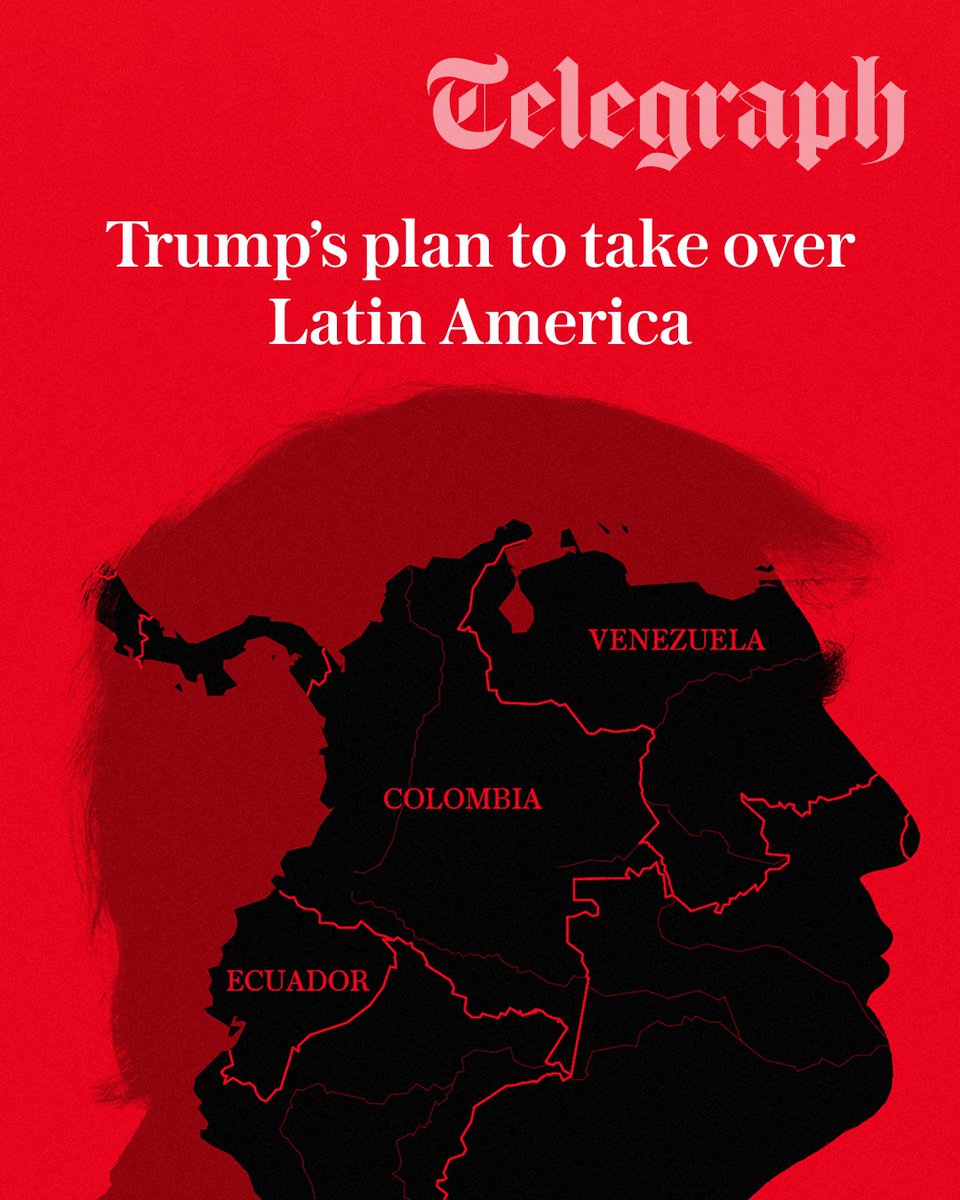
Donald Trump’s king-making has proved to be the kiss of death to decades of Left-wing rule across much of Latin America, with all seven presidential elections won by his allies since he took office.
But why does Trump want to dominate the continent so much? Find out here ⬇️
https://t.co/OGL8FnMPa6