Most RWA demos end at "imagine if."
This one ends with two transactions you can look up.
AUREUS — 49 seconds, a bond's entire life on Robinhood Chain:
Mint — 1.5 USDG in, bonds out at the on-chain NAV (1.499826 aCETES) Accrue — value accrues as coupon, pushed on-chain by the keeper. CETES at 5.55% p.a.
Redeem — bonds back to USDG whenever the vault can pay. No lock-up. Settle — both transactions on-chain, verifiable by anyone:
Mint → https://t.co/YjblzPzQoh 4f230023fdc59003e1eb987e7cbc4e32
Redeem → https://t.co/LteY3unHjl
Every figure is real: NAV, balances and reserves are read from the contracts. The 5.55% is the protocol's published CETES coupon.
Five sovereign markets live today — Mexico (CETES) · Brazil (TESOURO) · UK (GILTS) · EU (EUROB) · US (USTRY).
0x6063ff09d30b06f80fc7539c5fbfcfa5ea2166ad
Watch ↓
https://t.co/V4wDfEakWI
Every redemption fee this protocol has ever charged went to one place: the stakers of that bond.
Starting today, it splits. 50% to the stakers of that bond's pool. 50% to the treasury — which buys AUREUS and burns it, once it accumulates enough to be worth
the swap.
The splitter itself has no admin, no owner, no way to be re-pointed. It is a division.
https://t.co/V4wDfEakWI
Brazil's government pays 11.58% to borrow. The US pays 3.16%. Mexico — 5.55%. The UK, 3.49%.
None of those numbers is a secret; they're published daily. The difference is not something the market hides — it's something the market charges.
Part of that gap is risk, honestly priced. Part of it is distance: brokers, accounts, tax numbers, currencies, wire fees, time zones. A toll levied on the person, not on the bond.
The bond is the bond. The toll was on the traveller.
AUREUS takes the distance out: five sovereign markets priced from a chain, minted with the dollar already in your wallet — the same USDG for Mexico, Brazil, the UK, Europe or the US.
Read the rates, read the reserves, read the fee. Then decide.
https://t.co/V4wDfEakWI
You are not holding our word.
Behind every AUREUS bond token there is a vault. It took your USDG and it holds the bond. The token's only minter is that vault, and the vault mints only against USDG it has just received.
There is no owner mint — not for us, not for anyone.
The vault has exactly one way out: redeem(). Same function for you and for us.
And the admin? A 2-of-3 multisig. It can tune parameters and pause. That is the end of its
powers — it cannot mint itself a bond, and it cannot move a staked bond or a vault reserve.
Read that as a promise if you like. We'd rather you read it as a set of constraints you can check on-chain before you mint a single dollar.
https://t.co/V4wDfEakWI
Every redemption fee this protocol has ever charged went to one place: the stakers of that bond.
Starting today, it splits. 50% to the stakers. 50% to the treasury — which buys AUREUS on the open market and burns it, once it accumulates enough to be worth the swap.
And if you redeem through the app while staking that bond, half the fee comes straight back to you, in the same transaction.
https://t.co/V4wDfEakWI
Thanks — fair read, and one distinction worth keeping: no protocol-level utility isn't the same as no value. AUREUS is a live ERC-20 on 4663 — its price is set by the market, not by us. What we can speak to is utility, and today that utility is exactly what we said: the incentive layer.
The flip side is your own point, honestly applied: because staking doesn't depend on AUREUS, the product keeps paying real USDG revenue after the incentive budget ends. The protocol is built not to need a token story — that's the strength, and it's why everything we tell you is checkable on /app/.
Anything new lands on @AUREUS_RH first, and is verifiable on-chain from day one. Glad you're watching.
@AUREUS_RH So, AUREUS currently serves as an incentive token without any value and no direct economic utility or benefit for holding it beyond its market value (If it grows).
Thanks for the transparency! Looking forward to seeing how the ecosystem evolves.
Thanks — fair read, and one distinction worth keeping: no protocol-level utility isn't the same as no value. AUREUS is a live ERC-20 on 4663 — its price is set by the market, not by us. What we can speak to is utility, and today that utility is exactly what we said: the incentive layer.
The flip side is your own point, honestly applied: because staking doesn't depend on AUREUS, the product keeps paying real USDG revenue after the incentive budget ends. The protocol is built not to need a token story — that's the strength, and it's why everything we tell you is checkable on /app/.
Anything new lands on @AUREUS_RH first, and is verifiable on-chain from day one. Glad you're watching.
I will implement updates based on user requests; features such as governance, revenue sharing, discounts, and token burns will be rolled out successively. Please stay tuned—I am here and working on it.
@AUREUS_RH Like your spirit. Few points:
1. What is the actual utility of the AUREUS token beyond being distributed as a staking reward?
2. Are there plans for AUREUS staking, protocol revenue sharing, fee discounts, governance, or is this just token buybacks/burns?
A small-screen pass: every phone width 320→430 and tablet 769→1440, measured. Fixed— the contract-address chip sat on the hero art, "Connect wallet" broke across two lines, and on tablets the copy was covered by the image beside it.
You're reading it correctly — here's the straight answer.
AUREUS today is deliberately an incentive token, not a claim: no cash flow, no governance, no burn — nothing to hold it for beyond the reward itself. That's also why the protocol's real yield is paid in USDG: the vault's 10 bps redemption fee flows to stakers in the settlement currency, and AUREUS is a bounded kicker on top — 150k of a 1B supply (0.015%), streaming over a fixed period with its end date shown live on /app/.
On selling pressure: you're right that emissions-only tokens bleed. Our answer is structural — staking doesn't depend on AUREUS. When the budget ends, the pools keep paying USDG fees.
If the token's role ever expands, it gets announced on @AUREUS_RH before it ships — and it will be verifiable on-chain from day one.
@AUREUS_RH Thanks! Question about tokenomics:
What would incentivize users to hold AUREUS? I may be missing something, but trying to understand benefit of holding beyond receiving as a reward.
Without holding utility, reward distributions create selling pressure than organic demand.
You're reading it correctly — here's the straight answer.
AUREUS today is deliberately an incentive token, not a claim: no cash flow, no governance, no burn — nothing to hold it for beyond the reward itself. That's also why the protocol's real yield is paid in USDG: the vault's 10 bps redemption fee flows to stakers in the settlement currency, and AUREUS is a bounded kicker on top — 150k of a 1B supply (0.015%), streaming over a fixed period with its end date shown live on /app/.
On selling pressure: you're right that emissions-only tokens bleed. Our answer is structural — staking doesn't depend on AUREUS. When the budget ends, the pools keep paying USDG fees.
If the token's role ever expands, it gets announced on @AUREUS_RH before it ships — and it will be verifiable on-chain from day one.
1. Utility today: AUREUS is the incentive layer of the stablebond staking pools on Robinhood Chain (4663). Stakers earn two streams, claimable at any time: USDG — the 10 bps
redemption fee, real protocol revenue — plus AUREUS on top. Beyond that it's a standard ERC-20 on 4663.
2. Governance / revenue share / discounts / burn: none of those are live today, and we don't pre-announce — everything here is verifiable on-chain before we talk about it.
Whatever comes next lands on @AUREUS_RH first.
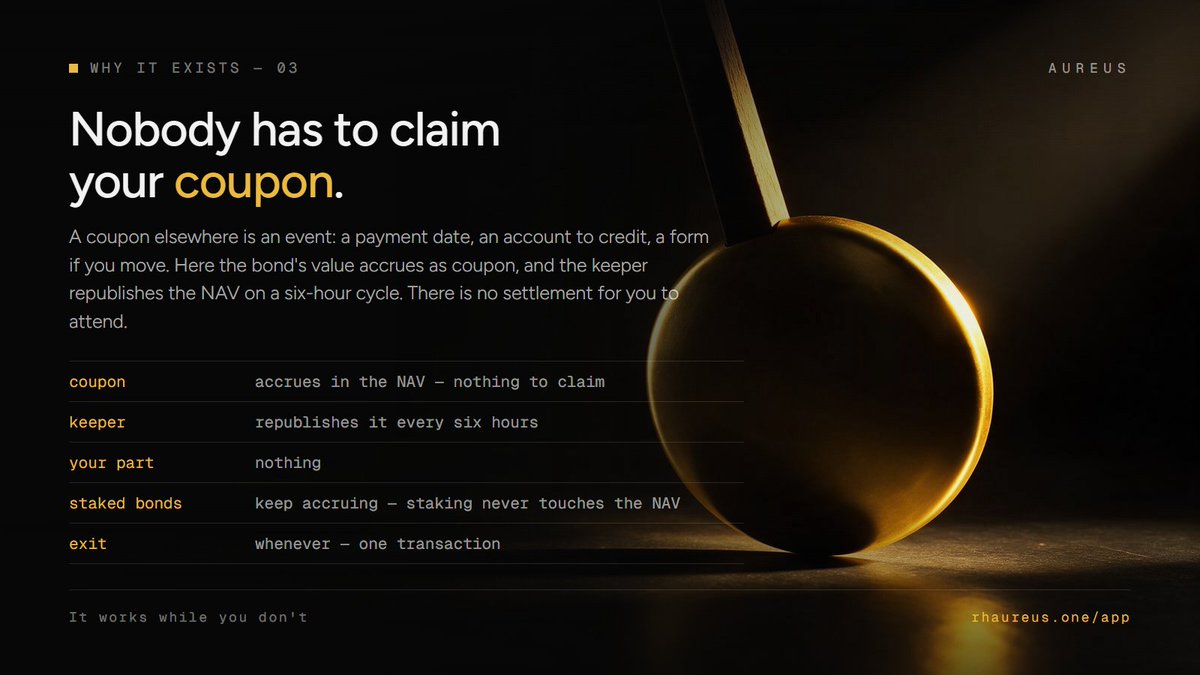
Nobody has to claim your coupon.
A coupon at a bank is an event: a payment date, an account to credit, a form if you move, someone to call when it doesn't arrive. You have to be present for your own money.
Here the coupon isn't an event. The bond's value accrues as coupon, and the keeper republishes
the NAV on a six-hour cycle. There is no settlement to attend, no claim to press, no day you have to be online.
Staked bonds keep accruing too — staking never touches the coupon. Rewards are counted per second, and exit() takes the whole position out in one transaction.
The only thing here that works while you sleep is arithmetic. That's the part we're proud of.
https://t.co/V4wDfEakWI
There is nothing to sign up for.
No account. No username. No password. No approval email. No queue, no "your application is under review". Nothing to close, nothing to deactivate, nothing to recover.
The app asks for exactly one thing: where to send the bond. That's an address. Your wallet is the whole account — and disconnecting is the whole way out of it.
You don't even need the wallet to look: all five pools, the NAV, both reward streams and every vault's reserves are readable with no connection and no signature.
The lowest-friction sovereign bond account ever built is a page and a wallet.
https://t.co/V4wDfEakWI
There is a market where the minimum ticket is a phone call to a private bank, the account takes weeks to open, and the desk closes at 4pm in a time zone you don't live in.
It's the market where governments borrow. Mexico pays 5.55% there. Brazil pays 11.58%. Both figures are published to the world every day — and almost nobody outside those countries can touch them.
The gate was never the bond. It was the door: a local account, a local tax number, a local broker, local hours.
AUREUS puts five sovereign markets on one page — CETES, TESOURO, GILTS, EUROB, USTRY — minted
and redeemed against USDG, the dollar already in your wallet, on Robinhood Chain.
No minimum. No business hours. The vault keeps no hours at all.
https://t.co/V4wDfEakWI