A new era of decentralized intelligence is being built.
Aurlink is not just another blockchain project — it is an ecosystem designed to connect AI, coordination layers, and decentralized infrastructure into one unified network.
We believe the future is not just on-chain…
The future of blockchain won’t be static.
It will think. It will adapt. It will optimize itself.
That’s what Aurlink is building.
Founding Contributors are coming together to shape the Cognitive Chain.
#Aurlink#Web3#AI
The goal isn’t just lower fees — it’s predictable, value-aware execution.
When execution adapts, fees stop becoming the product.
This is the difference between optimizing transactions and rethinking how execution itself works.
Why Aurlink Is Being Built Differently
Recently, we experienced a common issue on existing networks: a transaction where the gas fee exceeded the value of the asset itself.
Aurlink is designed to address this at the infrastructure level.
By introducing an adaptive execution layer through the Aurlink Virtual Machine (AVM), execution can respond to workload patterns instead of blindly applying fixed assumptions.
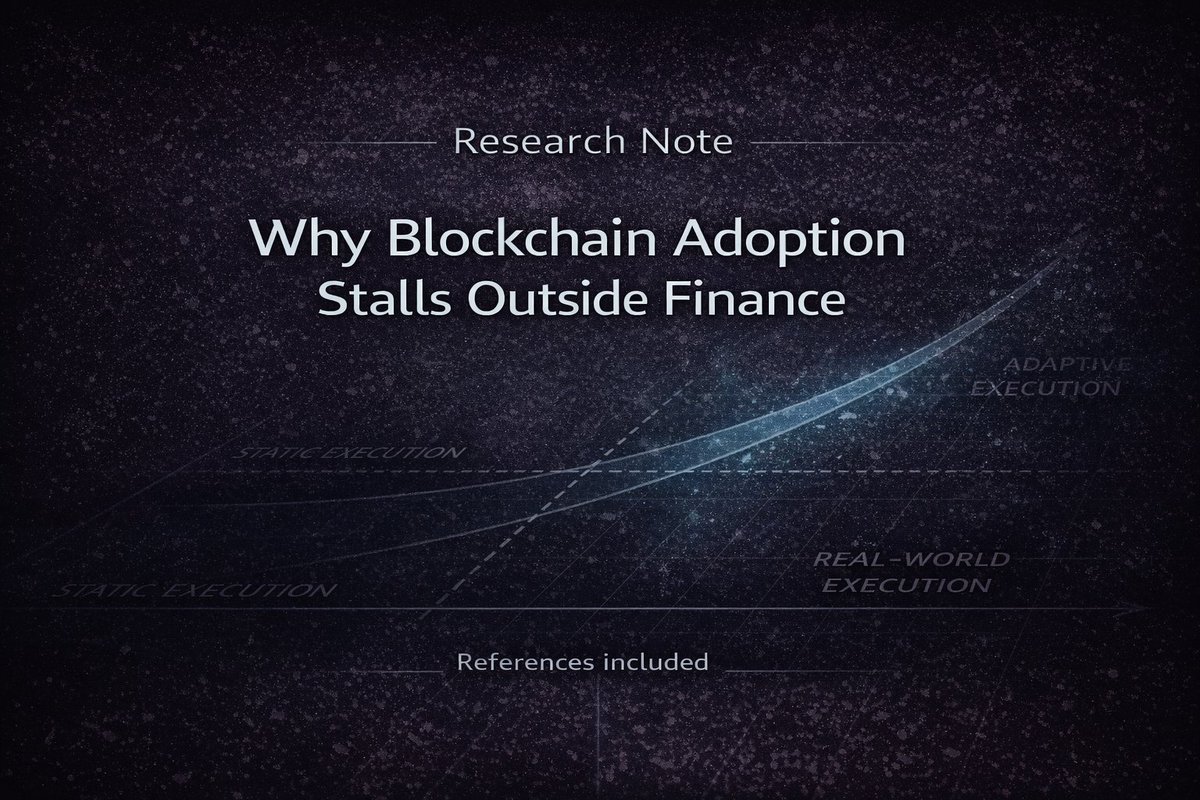
Why Blockchain Adoption Stalls Outside Finance
Abstract
Despite significant advances in throughput, cost reduction, and infrastructure design, blockchain adoption remains largely concentrated in financial use cases. This research note examines the underlying reasons for this limitation and argues that static execution models—rather than throughput or cost—represent a primary barrier to broader, real-world adoption.
1. State of the Technology
Over the past decade, blockchain systems have achieved measurable progress, including:
- Higher throughput through rollups and parallel execution
- Lower transaction costs via Layer-2 systems and alternative consensus designs
- Improved developer tooling and ecosystem maturity
Despite these advances, adoption remains largely confined to:
- Payments
- Decentralized finance (DeFi)
- Asset issuance and trading
This disconnect between technical progress and adoption breadth suggests the presence of a structural bottleneck rather than a purely technical one.
2. The Execution Model Constraint
Most blockchain virtual machines are built on static execution assumptions, including:
- Fixed gas accounting models
- Uniform execution paths for heterogeneous workloads
- Short-lived, transaction-scoped execution
In contrast, real-world systems typically involve:
- Variable and unpredictable demand patterns
- Long-running or persistent processes
- Context-dependent execution requirements
Static execution models struggle to efficiently represent and manage these dynamics, resulting in high operational overhead and limited flexibility.
3. Evidence from Prior Research
This constraint has been identified across both academic and industry research:
-
Harvard Business Review — Why Decentralized Applications Fail Highlights rigid execution models and coordination overhead as major barriers to non-financial adoption.
-
Croman et al. (2016) — On the Limits of Blockchain Scalability Demonstrates that throughput improvements alone do not resolve fundamental execution bottlenecks.
-
IEEE Security & Privacy — Smart Contracts: Security and Execution Challenges Discusses the difficulty of supporting complex, long-running logic within static execution environments.
-
Ethereum Research Forum — Stateful Execution Discussions** Ongoing research debates reveal unresolved challenges around adaptive workloads and execution flexibility.
Collectively, these works suggest that performance gains at the throughput layer do not address deeper execution-level limitations.
4. Sector Impact
Sector
Execution Requirement
Static VM Limitation
AI Systems
Variable inference & training load
Inefficient cost and scheduling
Public Infrastructure
Long-running processes
Poor lifecycle handling
Supply Chain
Contextual state transitions
Excessive overhead and rigidity
IoT
Burst-and-idle execution patterns
Cost inefficiency
5. Implications
Until execution models evolve to:
- Adapt dynamically at runtime
- Handle workload variability natively
- Support long-lived and stateful processes
Blockchain adoption is likely to remain constrained, regardless of further throughput improvements.
Conclusion
Blockchain scalability is no longer primarily a throughput problem. It is an execution model problem.
1. Croman, K. et al. (2016). On the Limits of Blockchain Scalability.
2. Harvard Business Review. Why Decentralized Applications Fail.
3. IEEE Security & Privacy. Smart Contracts: Security and Execution Challenges.
4. Ethereum Research Forum. Stateful Execution & Adaptive Workload Discussions.
Aurlink is built on a simple belief:
infrastructure should evolve, not be replaced.
Instead of locking developers and users into rigid designs, Aurlink is engineered to grow alongside new technologies, new workloads, and new economic realities.
Its modular architecture allows components to upgrade independently—without forcing migrations, resets, or ecosystem fragmentation.
This approach ensures:
Sustainability through continuous evolution, not rebuild cycles
Adaptability as new use cases and integrations emerge.
Future-proofing against rapid shifts in AI, Web3, and distributed systems
For builders, this means confidence that what they build today won’t be obsolete tomorrow.
For investors and the community, it means an ecosystem designed to compound value over time.
Aurlink isn’t chasing trends.
It’s laying foundations.
🎄 Season’s Greetings from Aurlink 🎄
As the year draws to a close, we want to take a moment to sincerely thank every member of the Aurlink community for your trust, support, and belief in what we’re building together.
This festive season is a reminder of the power of connection, innovation, and shared vision — values that continue to drive Aurlink forward. We’re incredibly grateful to have such a strong, thoughtful, and forward-looking community alongside us.
We wish you a joyful Christmas filled with peace, warmth, and reflection, and we extend our best wishes for a prosperous, successful, and groundbreaking New Year ahead. 🚀
Here’s to new milestones, greater innovation, and continued growth in the year to come.
— The Aurlink Team ✨
What AVM Enables in the Real World
Most blockchains makes developers to force-fit real-world systems into rigid execution rules.
AVM flips that.
Instead of assuming a fixed workload, AVM adapts execution to what the application actually needs — in real time.
Here’s what that unlocks 👇
Scenario 1: Adaptive DeFi dApps
Traditional DeFi protocols assume:
- Predictable traffic
- Stable execution costs
- Static optimization
Reality:
- Volatility spikes
- Liquidity surges
- MEV pressure changes minute-to-minute
With AVM: Execution paths adapt as network conditions change. Heavy computation can be optimized, deferred, or parallelized without breaking the app logic.
Result:
- More resilient protocols
- Fewer congestion failures
- Better user experience during market stress
Scenario 2: On-Chain AI & Decision Systems
AI workloads aren’t static. Inference frequency, data size, and model complexity change constantly.
Static VMs struggle here.
With AVM:
- Execution adapts to workload intensity
- Models can evolve without redeploying contracts
- Learning signals can influence execution behavior over time
This makes on-chain AI agents, risk engines, and adaptive governance systems actually viable.
Scenario 3: Autonomous & Long-Running Systems
Think:
- DAO automation
- Adaptive infrastructure
- Systems that run for years, not blocks
Traditional VMs assume contracts are “write once, run forever — unchanged.”
AVM assumes change is inevitable.
Execution strategies evolve without altering contract intent, enabling:
- Long-lived protocols
- Self-optimizing systems
- Infrastructure that improves instead of degrading
The Bigger Point
AVM isn’t about squeezing more TPS out of the same model.
It’s about enabling applications that couldn’t exist under static execution assumptions.
New architecture enables new applications.
That’s what AVM is really about.
How Builders Interact With Aurlink
Builders shouldn’t fight infrastructure.
The Problem Developers Face Today
Building on most blockchains means:
- Optimizing contracts around gas quirks
- Designing for worst-case congestion
- Rewriting logic to fit VM limitations
- Managing performance manually
Instead of focusing on product logic, builders spend time fighting infrastructure.
Aurlink’s Developer Philosophy
Aurlink flips this model.
Developers write clear, deterministic logic — the infrastructure handles execution efficiency.
You define what should happen. AVM handles how it runs under real conditions.
How Builders Actually Interact With Aurlink
1. Familiar Development Model
- Deterministic smart contracts
- Explicit state transitions
- No hidden execution magic
If you’ve built for modern VMs, the mental model feels familiar.
2. Modular Execution Layers
AVM is designed as composable layers, not a monolith:
-
`avm-core` Canonical compilation & execution semantics
-
Execution Runtime Scheduling, resource allocation, adaptability
-
Learning Layer (Optional) Federated insights that improve execution over time
Each layer is:
- Isolated
- Replaceable
- Auditable
3. No Execution Micromanagement**
Developers don’t need to:
- Tune execution paths
- Handle congestion logic
- Predict network behavior
AVM adapts execution without changing contract logic.
4. Predictable Outcomes, Adaptive Performance
- State transitions remain deterministic
- Execution behavior adapts safely
- Results are always verifiable
Performance improves — correctness never changes.
What This Means for Builders
- Less boilerplate optimization
- Cleaner contract design
- Fewer edge-case failures under load
- More time building real products
Takeaway
Aurlink lets developers focus on building applications — not managing execution constraints.
What Federated Learning Looks Like in AVM
First: The Role of Federated Learning in AVM
Federated learning in AVM is not about training user-facing AI models.
Its purpose is to improve execution intelligence over time — specifically how execution adapts under different network conditions.
Think of it as:
A distributed learning layer that helps AVM get better at deciding how to execute transactions efficiently.
High-Level Mental Model
Instead of:
- One global model
- Centralized training
- Raw data aggregation
AVM uses:
- Local execution environments
- On-node learning
- Aggregated insights, not raw data
AVM Federated Learning — Step by Step
1. Local Observation (On Each Node)
Each validator or execution node observes:
- Transaction types
- Execution paths taken
- Resource usage (compute, memory, latency)
- Network conditions at execution time
⚠️ Important: No private user data or raw transaction payloads are exported.
2. Local Model Updates
Each node maintains a lightweight local model that learns patterns such as:
- Which execution paths perform better under congestion
- How certain workloads impact latency
- Optimal resource allocation strategies
This model is:
- Narrow in scope
- Execution-focused
- Continuously updated
3. Gradient / Parameter Sharing (Not Data Sharing)
Periodically, nodes send:
- Model updates
- Gradients or summarized parameters
They do not send:
- Raw transactions
- User data
- Execution logs in full
This preserves:
- Privacy
- Decentralization
- Regulatory safety
4. Global Aggregation (Network-Level Learning)
The network aggregates updates using:
- Weighted averaging
- Consensus-aware aggregation rules
The result:
- A global execution intelligence model
- Reflecting diverse real-world conditions
- Without central data collection
5. Model Redistribution
The updated global model is:
- Broadcast back to nodes
- Integrated into their local execution logic
- Used as a guidance layer, not a controller
Nodes still execute deterministically — the model influences execution decisions, not consensus rules.
What the Model Actually Learns
Federated learning in AVM focuses on:
- Execution path selection
- Resource balancing heuristics
- Congestion-aware behavior
- Performance optimization patterns
It does not:
- Predict prices
- Make governance decisions
- Replace deterministic VM execution
Why Federated Learning Fits AVM
1. Decentralization-Friendly
No central trainer. No data hoarding. No single point of intelligence.
2. Adaptive Without Chaos
Execution becomes smarter without breaking determinism.
Learning informs choices, not outcomes.
3. Real-World Feedback Loop
AVM improves based on:
- Actual usage
- Live conditions
- Network diversity
Not synthetic benchmarks.
How This Differs From “AI Blockchains”
Most AI chains:
- Bolt AI on top
- Use centralized models
- Focus on prediction or automation
AVM:
- Embeds learning at the execution layer
- Keeps it distributed
- Uses it to improve system behavior, not narratives
One-Sentence Summary
In AVM, federated learning enables the network to collectively learn better execution strategies over time — without centralizing data, breaking determinism, or compromising decentralization.
Why Most Blockchains Struggle at Scale
When scalability is discussed in blockchain, the conversation almost always centers on:
- Transactions per second (TPS)
- Block size
- Hardware throughput
- Layered scaling approaches
These metrics matter — but they don’t address the core execution problem.
Static Execution in a Dynamic Environment
Most blockchain virtual machines were designed around a static execution assumption:
- Transactions are treated uniformly
- Execution paths are predefined
- Resource allocation does not change in real time
This design works under predictable, low-variance workloads.
Blockchains do not operate in such environments.
What Real Network Conditions Look Like
Live blockchain networks experience:
- Sudden demand spikes from mints, arbitrage, or events
- Mixed transaction complexity within the same block
- Highly uneven resource pressure across time
Despite this, execution remains unchanged.
A simple transfer and a complex contract interaction are often processed through the same rigid execution logic.
Why TPS Alone Fails as a Scaling Metric
Increasing TPS improves throughput, but not efficiency.
Under stress:
- Congestion still forms
- Resource usage becomes suboptimal
- Latency increases unpredictably
This is why networks with high theoretical TPS still degrade under real-world load.
The bottleneck isn’t just capacity — it’s execution behavior.
The Hidden Limitation
Most blockchains scale how many transactions they can process — but not how those transactions are executed.
Execution remains static, even as conditions change.
What True Scalability Requires
True scalability demands:
- Awareness of transaction complexity
- Responsiveness to network conditions
- Adaptive allocation of execution resources
In other words, scalability must exist at the execution level, not just the throughput layer.
Reframing the Problem
Scalability is not a single number.
It is a system’s ability to:
- Maintain performance under pressure
- Allocate resources intelligently
- Adapt execution behavior as conditions evolve
Key Takeaway
Scalability isn’t just TPS — it’s adaptability.
Until execution itself can adapt, blockchain scalability will remain constrained by static design assumptions.
@IDibenedet24754 @MEXC_Official That depends on substance, not headlines. If it clearly defines custody, liabilities, disclosures, and enforcement boundaries, it can change a lot. If it stays vague or politicized, it’ll just add noise. The details will decide whether this actually moves the needle.
The AVM is the core engine of Aurlink. Instead of static execution, it adapts how transactions run in real time — optimizing performance, efficiency, and scalability.
@WatcherGuru Market structure clarity is overdue. Clear rules around custody, disclosures, and on-chain accountability would reduce uncertainty, protect users, and allow responsible innovation to scale in the U.S. Execution will matter as much as the legislation itself.
@elonmusk The real impact will come from how AI and robotics are deployed. If aligned with productivity, education, and access, they can meaningfully expand abundance. Governance, open infrastructure, and long-term incentives will decide whether that abundance is broadly shared.