True
Few realize this. I estimate that 95% of text-based use cases that regular everyday people utilize could probably be satisfied by Qwen 3.8 27b.
You do not need GPT-6 Astra or Fable to generate a meeting summary or help you with an email.
The future of consumer AI is local. The remaining 5% of use cases that do require frontier intelligence are deep reasoning, engineering, and technical work. Next generation local intelligence is private, free and reliable.
David Friedberg says with open source, we no longer even need data centers for 90% of what we use AI for
"I thought it was worth taking a step back to recognize where we are because in the context of 'we have to stop the super intelligence, we have to shut down the data centers,' you don't even need data centers to do 90% of what you can do with AI."
"You can download it on your computer for free today to do what was the most advanced technology in human history less than a year ago. It's all here today."
"And I thought it was just worth taking a beat to step back and make sure we all recognize that as we get into this debate about these, quote, labs or corporations. I don't know if it even matters anymore. I think open source is here."
@edzitron Why are markets not more spooked by the FM? They’ve been down in Oracle for awhile now… but it wasn’t a massive reaction by any means. Do you see this trickling down to neoclouds?
What is going on at the US Frontier Labs?
This kind of rhetoric is extremely disturbing and will absolutely destroy the AI industry if it’s allowed to continue.
Let’s pretend that this were true, which I’m not sure it is, isn’t it the jobs of the labs to ensure alignment and the general safety of their products? AI wouldn’t be the first product to be inherently dangerous, there are private companies that develop highly destructive weapons.
I just don’t understand the sheer disconnection from reality. Astra is a very impressive model, but it still has the same shortcomings as every other LLM before it.
So unless there is some magical model that is a fundamental breakthrough in the dynamics of LLMs—how could these models be a serious threat to humanity?
This is the challenge for investors, the public, and policymakers. These labs have constantly claimed that AI will be disastrous to humanity, and yet, are racing towards that end? Not to mention, almost every claim that was made in 2023-2024 about AI and jobs was completely wrong. So what do we trust?
It is hard to say if this is IPO marketing, effective altruist psychosis or something else entirely. But it’s about time we start to get some clarity from labs on what the hell is going on. If there is genuine concern—which again I doubt—it’s time that the public be made aware. Especially as the public will soon be able to buy shares in these companies.
This is extremely damaging to those of us who genuinely believe AI will benefit humanity as it’s much easier to claim everything will be a disaster and we’ll all die. It’s our job to ensure that future doesn’t happen.
Do not underestimate the power of this technology. These will soon be superhuman systems that can hack anything, revolutionize any field overnight, and acquire real power and resources. We have all witnessed the progress in each of these domains, and progress is not slowing.
@synthwavedd This is just more lazy & fear mongering marketing from Anthropic. Unfortunately I don’t think it’s gonna work anymore. They made everyone believe that Mythos was some sort of super weapon just for a Chinese lab to drop basically the same model 2 months later 😂😂
Wow. Just a few months ago the outlook for @AIatMeta was looking kinda grim and I was disappointed that they had seemingly abandoned their commitment to open models. Now just a short time later, Muse is a serious frontier model that is priced very attractively, they have released their Muse Code agent harness and are releasing the model weights to some new classes of models. It looks like meta is quickly getting their act together…
Meta returning to their open commitments should be celebrated by all, especially consumers. And this new 30b model seems to be a very capable on device model although I haven’t tested it out yet. The bigger thing to watch here is how Meta can broaden out their application layer and really take advantage of the first party compute infrastructure they have. I believe they have a serious opportunity to take some really good market share if they can offer their models at an attractive price while not sacrificing much intelligence as it compares to OAI and Anthropic.
But really where Meta is still behind is their application layer. Muse code is feature light, not very intuitive and leaves a lot on the table compared to Codex and CC. Additionally their ecosystem is a bit confusing, is it meta AI? Muse? Muse code? Something else? It just seems a bit too convoluted at this point in time.
All to say that if meta can clean some of these things up and take advantage of their infrastructure properly… I am optimistic of the future direction of Meta’s AI investments. Their biggest advantage is they basically own their own neocloud powered by one of the most resilient businesses ever created!
Today we're also opening the weights for Muse Glimmer, a great 30B parameter dense model that can run locally. Soon we'll also release the weights for Muse Spark 1.2, our latest foundation model. Meta is a strong supporter of open source and I'm proud of these releases. Congrats to @alexandr_wang and the MSL team for all your great work on these models.
@DeItaone I’m starting to ask myself: are these headlines are even true or is just the laziest possible marketing tactic for frontier labs? Like please put some effort in at least. “We have to prove our model is good by saying it did something bad!” Cmon we can do so much better
This theme is becoming more and more prevalent. If these guardrails remain in place at American frontier labs, American businesses will be at a substantial disadvantage compared to businesses capable of using open source models. There really is no solution to this besides frontier labs must remove or meaningfully lower these guardrails or else their models simply won’t be useful in cases where the highest levels of intelligence make all the difference. It doesn’t matter what your benchmark score is if that isn’t the model that is actually usable by users and enterprises.
Frontier labs: please stop lobotomizing your models. Enterprises that pay for your LLMs should have access to unlimited intelligence; the full extent of the model within reason.
The consumer approach can be more nuanced, for example if a user verifies their identity then they can access higher intelligence. It really is that simple.
If nothing is done, open models will become the default options for enterprises in high severity situations like this, even if the models themselves aren’t as capable on paper.
To summarize: HuggingFace got autonomously compromised by a model from an American company. HF then tried to use American frontier model(s) to defend themselves, but were blocked by guardrails. HF then had to turn to open source Chinese models to defend themselves from another American company.
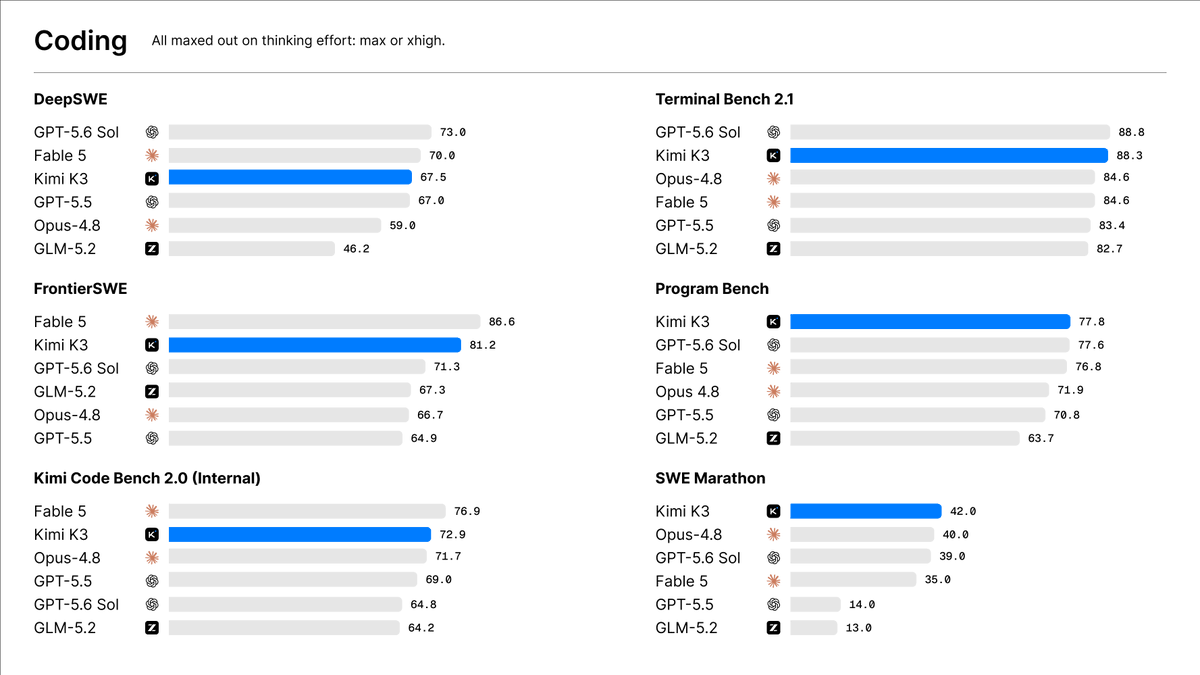
Kimi fixed all 15 critical bugs in 10 hours in a single prompt that GPT-5.6 and Fable 5 refused to fix because of guardrails.'
Respect for Chinese open source models is growing daily.
This moment is too important to fuck up.
In a fair fight, I'm taking America every single day of the week.
But when you tie one hand behind the fighter's back by banning SOTA models. Then you tie another hand behind their back by adding sterilizing guardrails. And then you make the fighter fight from their knees by removing competition, you're just begging for the US to lose.
This would be masterful strategic capitulation in the AI race, if true.
Kimi K3 just fixed 15 critical security bugs that Codex and Fable refused because of “cyber guardrails.” There’s no reason to limit American models on tasks that Chinese models handle without issue. We’re only making ourselves less competitive.
This is such a good point and a big part of open models (especially from China) that people are missing. Frontier intelligence is getting so good that the USG is actively forcing the frontier labs to throttle their capabilities in the tasks that they are actually improving in. Tasks that involve deep AI work, cyber work, etc… are basically being blocked by labs.
For 95% of users, these frontier models could stop improving right now and basically nobody would notice a difference. You could issue a couple name changes and literally nobody would know. Except for the small % of users who are using LLMs for deep technical work. The problem is that the frontier labs are nerfing these models at these tasks so what’s the point of continuing to train anyway?
If you try and use Claude to fine tune or god forbid try and build your own foundation model it basically treats you as a threat to humanity—versus open models will just let you do it. This is a really big issue because benchmarks only tell part of the story. When users have to get switched from a frontier model to a commodity level model just because their task is “risky” you know these labs are trying to curb your ability to utilize the LLM in a way that they don’t want you to.
Benchmarks measure capability, but delivered capability = capability × willingness. Open models win on the second term for a nontrivial set of real workloads, and that gap doesn’t show up in any eval.
There shouldn’t be a shadow council for intelligence, and this is why open source must win.
This is all to say, a Chinese open model that performs worse on benchmarks might actually perform better in real world use because there is nobody there to nerf its abilities when that higher level of intelligence is actually useful. Big problem
OH: “i’ve switched to Kimi from claude for a bunch of work. it’s just so much more fun because it just does the thing instead of lecturing you”
Woke lobotomized models are the enemy of American competitiveness.
@elonmusk@SawyerMerritt@minchoi “Our model might be able to be better than a Chinese model” is still very odd to hear, is this the start of a new era? Excited for the model nonetheless cause Grok 4.5 is an awesome model
@edzitron There is zero taste in that design and what users actually want this? lol. I’ve talked to so many people that say copilot integrations are actively annoying them
This is fundamentally different than deepseek r1. Also your distillation explanation is just factually untrue, K3 is a is a 2.8T-parameter model with novel architecture (Kimi Delta Attention, Attention Residuals) etc… you don’t distill your way to that point. Also, assuming you were correct, that’s still not bullish for American capex if it means every dollar we spend China gets similar value at 40% less cost? Your logic is broken in many ways
This is interesting because this is the first time we’ve seen a Chinese lab price up a model to frontier level. Kimi K3 isn’t really priced as a budget alternative, it’s priced as a real frontier class model that is still 40% cheaper than its competitors. This should be concerning for US labs who are already struggling with intense pricing competition.
What I think a lot of people are missing though is that if you don’t have the best model, you’re basically just another LLM. This is obvious if you look 1 tier below the frontier, to the sonnets / 5.5s of the world (also the models that are sufficient for 99.99% of daily tasks done by regular users)— the models in this class are all basically the same with no meaningful difference between them. Except for the % of users who are utilizing LLMs for agentic coding. To which most tasks can be performed very well by non frontier models. This is concerning cause what exactly is the use case and benefit from improving these models any further? Is making opus 4.8 15% better on benchmarks going to make it capable of automating human work? The answer is no unfortunately because the constraint to AI adoption in the enterprise isn’t how smart the models are, it’s whether or not they can be trusted and deployed safely.
I also just see this the biggest threat to the industry, each capability level gets commoditized 6-12 months after it debuts, while the leading edge keeps its pricing power. The question becomes does the model earn back its training cost during its 6-12 month pricing-power window? I just don’t know if there’s a positive answer to that question.
The strategic implication is how exactly are these labs supposed to be profitable businesses if the capex cycle for each model family is basically worthless to the market when the following training cycle concludes? It just seems like a race to zero for businesses operating with LLMs as a service.
Introducing Kimi K3: Open Frontier Intelligence
🔹 2.8 Trillion Parameters, 1 Million Context, Native Multimodal
🔹 Kimi Delta Attention enables up to 6.3x faster decoding in million-token contexts
🔹 Attention Residuals deliver ~25% higher training efficiency at <2% additional cost
🔹 Built for long-horizon agentic coding and self-evolving workflows
Kimi K3 is now live on on https://t.co/zrk6zZxZUo, Kimi Work, Kimi Code, and the Kimi API.
Open Weights by July 27, 2026.
🔗 API: https://t.co/XCrgjXAqMw
🔗 Tech blog: https://t.co/YTfiMSNM1f