My new book on retrospective voting w/@jsmatthews99 is now out from @CUP_PoliSci!
And it's *free* to download until June 14!
Excited to share some key findings and contributions
https://t.co/585hZrfORn
Opinion: J.D. Vance has a bunch of weird views on gender. Chauvinism is the unifying thread of his GOP, writes political theorist Laura K. Field. https://t.co/GtcA7ZL9j5
Prospect Theory's famous “S-shaped” value function is a cornerstone of behavioural economics. Surprisingly, more than 40 years after its inception, there seem to be a lot of remaining puzzles about it.
Or... perhaps not anymore. A 🧵that may change your view on Prospect Theory.
Was all set to launch a new experiment...
and my @amazonmturk account is locked, defunct, dunno, but I can't get requester access. Also can't access old records.
Did they kill everyone's acct, or am I just lucky?
Registration is open for the 2023 Toronto Political Behaviour Workshop, Sep 29-30, hosted by @munkschool. We have a great lineup of papers and posters and hope to see you there! https://t.co/P7vQuelABY Please share widely. @PeejLoewen@caitlineandrews
Important to note that neither set of experiments ask AMT workers to generate text, but they do ask for obs and evaluation of streams of info, tasks that chatGPT and the like could perform.
Still useful in thinking about bots, LLMs, and the MTurk worker pool in the past decade
Important piece on the use of LLMs like ChatGPT among Amazon MTurk workers.
Focus is on tasks that require workers to write high-quality summaries of technical abstracts. Still a provocative piece for those using AMT for surveys and survey experiments.
One of our key sources of human data is no longer fully “human"!
We estimate that 33-46% of crowd workers on MTurk used large language models (LLMs) in a text production task - which may increase as ChatGPT and the like become more popular and powerful.
https://t.co/SJfKjDM6gX
Would the same apply to survey experiments common in poli sci?
I compared data from my 2023 book with @jsmatthews99 against data from Huber, Hill, and Lenz (2012). Similar framework, manipulations, & recruitment on AMT, but pre-post LLMs.
Very similar response functions
🚨 The deadline for the 3rd Nordic Workshop for Political Behavior is today 🚨
Two days in beautiful Copenhagen, September 21-22, with a full hour devoted to each paper in the workshop.
Be sure to submit your abstract: https://t.co/tVKCqSyDWM
Essentially, Trump kept documents revealing how to successfully attack the United States at its weakest points, and then documents revealing how the United States might retaliate after such an attack. This is beyond serious. 🤯
@ErikVoeten@HaillieLee Cool paper! Thanks for sharing.
Interesting (for me) to connect the attribution story to retrospective voting debates on interdependence/spillover, e.g., Kayser & Peress (2012), Campello & Zucco (2020), Hart & Matthews (2022)
Don’t miss your chance to read new Cambridge Element Quality Control by Austin Ray Hart and J Scott Matthews Free access available until 14 June
https://t.co/wvPQCdkKTB
#cambridgeelements#politics
My new book on retrospective voting w/@jsmatthews99 is now out from @CUP_PoliSci!
And it's *free* to download until June 14!
Excited to share some key findings and contributions
https://t.co/585hZrfORn
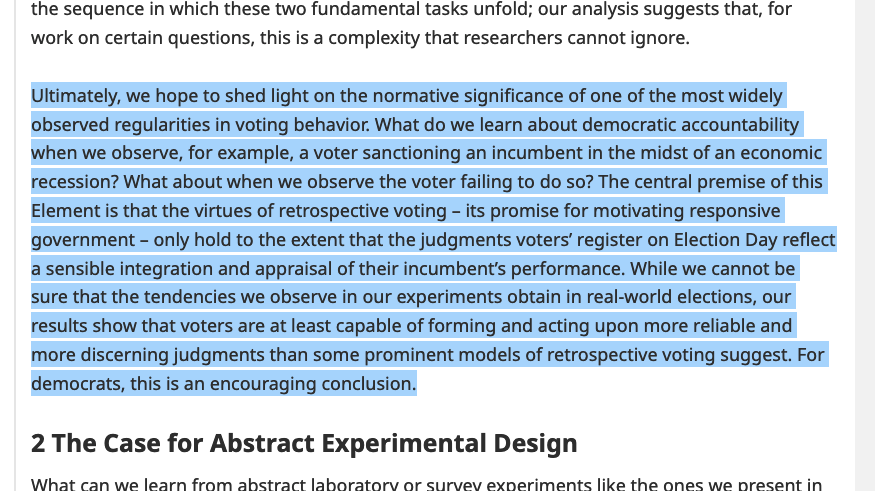
Overall, contra some research suggesting voters are blindly retrospective, we find retrospection to be reasonable (though not optimal). Our participants were quick to appraise and capable of integrating over variable, confounded streams of performance information.