One hour out.
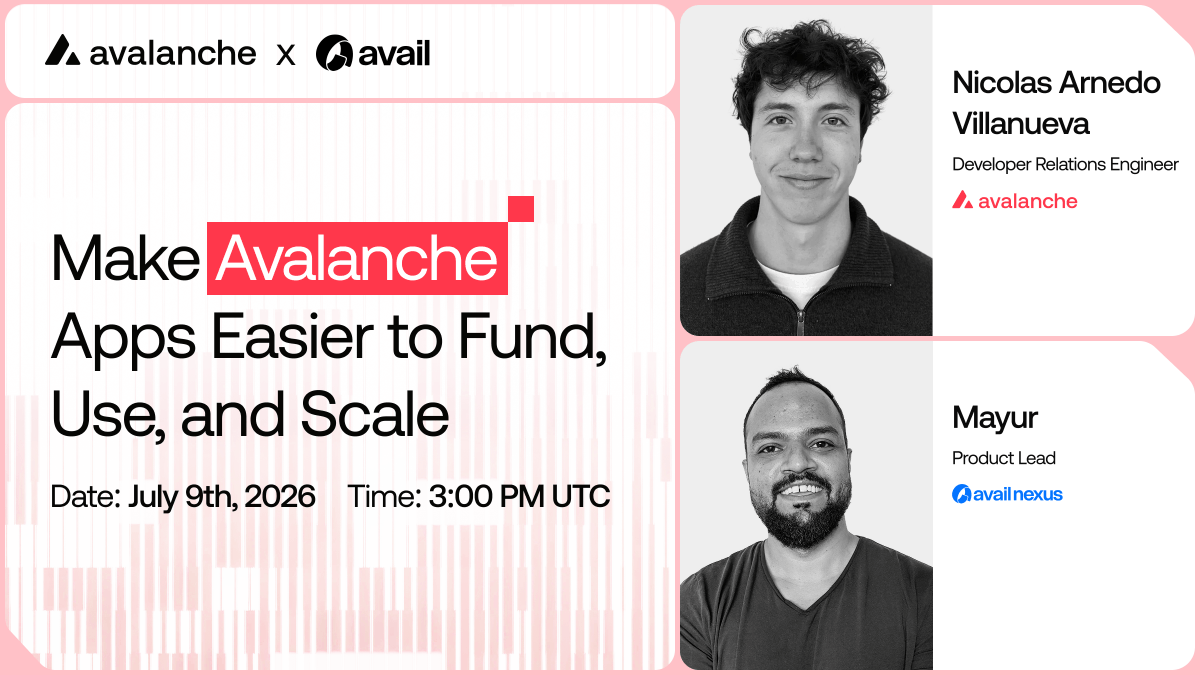
@AvailProject Nexus workshop for @avax builders — live here at 3pm UTC. Watch the deposit demo, then bring your integration questions straight to the Avail team.
Join: https://t.co/C0FzSPqgbg
Tomorrow, 3pm UTC — Avalanche x Avail builders workshop, live on this account.
The @AvailProject team demos Nexus: one-click, gasless deposits into your Avalanche app from any major EVM chain. Routing, bridging, and gas handled by the SDK.
30–40 min, live Q&A after.
Set a reminder: https://t.co/kqBJs61Ffp
New on Builders Hub: Ecosystem Careers.
Open roles from teams across the Avalanche ecosystem, in one place. Filter by role, seniority, and location — apply on the company's site.
Hiring? Post your team's roles in minutes.
Building? Find opportunities.
https://t.co/KMWHvO2chr
Excited to share something I worked on with the team.
Ecosystem Careers is live on Builders Hub — every open role across the Avalanche ecosystem in one place, connecting passionate builders with the teams hiring them.
https://t.co/Ceilk15LNM
Missed the ACP-285 community meeting on reducing the minimum consumption rate? Catch up now 👇
We covered the proposed update to Avalanche's staking reward curve, how changes will be implemented, & what they mean.
Recording: https://t.co/SgwPDVIw2o
To the Avalanche community:
Yes. I've been quiet. Quiet isn't idle. I understand why the two look the same from the outside, and closing that gap is on me.
So here's what the quiet actually held.
We put forward three ACPs aimed at validator economics and how the network rewards the work of securing itself. We built more precise ways to measure the chain's economic activity, and shared early results. Behind that, we tightened how the team runs day to day. Less visible, but it's why the rest moved, and why it moves faster now. I recognize the frustration, because this work isn't always visible from the outside. But the work happened, and it's happening. I did a poor job telling you what we could. That's my communication failure, not a work failure. I've written a piece that lays out the exact economic reasoning behind the recent proposals and the direction they point, and it goes out with this letter.
Now the part I want to be straight about: tokenomics is not a solved problem. Not here, not anywhere. I'm not interested in patches that look good for a cycle and unwind in the next one. I'm interested in fixes that compound. And compounding is slow before it's fast.
We're being deliberate about the order. You can't design how a network captures value until you've defined what value it actually produces, and that "what" has been loosely defined across this industry for years. So we started there.
Think of it the way an economy tracks more than one number. There's the value produced on the chain, the revenue protocols earn because they build here, which is what our gross chain product metric captures. And there's the value that accrues to the people using it, the activity that exists only because the chain does. We're building measures for both, to see value from enough angles to form a cohesive picture. Measure the "what," then design the "how." Get it backwards and you optimize for the wrong thing. That design could eventually include new transaction types or new primitives at the platform level, conveniences worth paying for. That can only come once measurement tells us what's worth building.
How we find the "right" design is by experimenting.
Short term, that means taking parameters that have sat as static constants since launch and letting the network set them dynamically, measured and adjusted on purpose, so we can watch how the system responds to small changes. ACP-283 is one example: it's about learning empirically where fees begin to dampen on-chain activity, so the network can stay well below that line instead of guessing at it with a number set years ago.
Everyone contributes here. Validators decide whether these changes activate, and where the fee floor sits over time. My job is to make the case in the open and show the work, not hand down an answer.
I'll also be honest about the limits. There's only so much we can test without risking the robustness of the chain, which is exactly why these initial changes are small. Every data point we can gather safely matters. Each one is a hint about whether the long-term design holds, or whether it's time to go back to the drawing board.
The answer won't be identical for every chain. It can't be. But the process I trust is the same everywhere: measure honestly, design deliberately, ship, observe, adjust.
I know patience is thin and the doubt is real. I'm not going to narrate it back to you; you and I both live in it. What I'll say is that my confidence comes from the work I see every day, from people who could be somewhere easier and aren't. They stay because the hard problems are the ones worth staying for.
One thing I want understood because it's the whole point. In proof of stake, security isn't a feature you ship. It's a bill an attacker has to pay, denominated in the network's own token. The economic weight behind that token isn't incidental to security. It *is* the security. And it sets a ceiling: no serious institution settles more value on a chain than it would cost to compromise it, because past that line the attack stops being a tail risk and becomes a trade.
Getting the economics right is what keeps that ceiling above the value the chain carries, even as that value grows. That's not a vanity exercise. That's the work, and it's why I prioritize it.
So yes, AVAX matters.
On communication: you'll see the detail behind the ACPs and the metrics, not just letters like this one. Hold me to that.
I came here to be a compounding force in this ecosystem. That's a slow way to start and a hard one to stop 🔺
Builder workshop: One-Click Multi-Chain Deposits for Avalanche Builders.
The @AvailProject team joins us to demo how Avail Nexus turns cross-chain deposits into one click for your app.
July 9, 3–4pm UTC.
Register 👇
https://t.co/eNdw7yaKVi
⏰ Reminder: the next Avalanche Community Proposal Meeting is this upcoming Tuesday, 6/30 at 9:30 AM ET.
We’re digging into ACP-285, reducing the minimum consumption rate – every duration under a year earns a lower rate, the 365-day APY is unchanged, and the duration premium widens. Whether net emissions fall depends on how validators respond, and that's what we want your take on.
Register to join 👇
https://t.co/w6dfVwYuc5
ACP-285 lowers AVAX emissions (the 365-day APR doesn't budge) and widens the duration premium. The emissions part is locked in. What it does to validator behavior is the open question, and we want your take.
We'll also quickly cover ACP-236 (continuous staking) and ACP-273 (a lower minimum staking duration) on the same call.
The next Avalanche Community Proposal Meeting is coming up! Register to join us next Tuesday, 6/30, at 9:30 AM ET as we dig into ACP-285 (Reduce Minimum Consumption Rate) ⤵️
https://t.co/w2eOfEtw9h
ACP-285 lowers AVAX emissions (the 365-day APR doesn't budge) and widens the duration premium. The emissions part is locked in. What it does to validator behavior is the open question, and we want your take.
We'll also quickly cover ACP-236 (continuous staking) and ACP-273 (a lower minimum staking duration) on the same call.
Safe multi-sig wallet support just got a major upgrade on Avalanche 🔺
@ash_avax has been supporting over 10 L1 teams in mainnet for treasury and admin operations for nearly two years.
Today that expands to the Avalanche C-Chain.
Builders don't grow ecosystems alone.
Team1 connects developers, founders, creators, and community leaders across 40 countries with grants, bounties, and paid opportunities for those who deliver.
If you're building, creating, or organizing, this is your opportunity to plug in.
Team1 Applications Are Open 🌎
Team1 is a global network of builders, developers, creatives, & community members who grow Avalanche.
- 450 members across 40 countries
- 6 official regional chapters with more coming
- 600 events with 75k luma subscribers
- 130 university collaborations
- 30+ jobs created
- Bounty opportunities for creators
- Grants and support for builders and members
You can now apply to join Team1 as a collaborator and build your career in blockchain while directly contributing to the growth of Avalanche. Collaborators who deliver value to the ecosystem will then be invited to become members.
Team1 is a platform that empowers the community to grow Avalanche from the bottom up. Have an idea to grow our ecosystem and support the community? We will fund it and support you to lead it.
We are looking for event hosts, founders, content creators, designers, BDs, university students, marketers, developers, country leads, and more.
You will directly contribute to the growth of Avalanche and the blockchain industry. Paid positions are available to those who lead, deliver value, and take initiative to grow certain regions or verticals.
Join Team1, grow your career, fund your project and build Avalanche.
Applications below 👇
Grants are structured across three milestones over 12 months. Researchers keep full IP rights and can publish freely.
If this is your work, or someone you know, apply by June 1 → https://t.co/z1tFwhqHVR
You build on Avalanche. You know how staking mechanics, validator incentives, and fee dynamics shape the network every day.
Now the Avalanche Foundation is funding the research underneath it all.
The Avalanche Foundation is offering grants of up to $50K for original research in two areas:
→ Cryptoasset pricing and valuation: what actually drives value in decentralized networks?
→ Validator economics and network security: how should staking incentives be designed for long-term sustainability?
Better economic models mean better protocol design, better tooling decisions, and a more resilient network for everyone building on it.