“We ran a survey of 50 data center procurement leaders (~40% hyperscalers, ~60% colos / neoclouds / enterprise DCs) making purchase decisions for North American projects... Double ordering seems to be a phenomenon for ~50% or more of the respondent set.” 👇🏼
https://t.co/XgJUVW5blM
The US 10-year REAL bond yield's rise is fast approaching the 75 bps 'danger level' increase that cracked the stock market in 2018, 2022, and early-2025. MONITOR THIS CHART VERY CLOSELY.
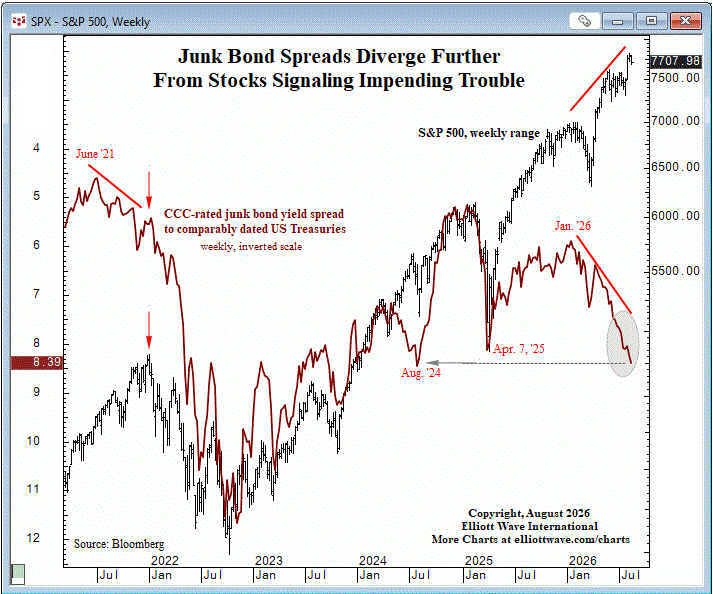
One of the stock market's most important warning signs is getting louder.
Junk bond spreads and equities usually move together.
When they don't, pay attention.
CCC-rated spreads have been widening for eight months while the S&P 500 has continued climbing to new highs.
A similar divergence preceded the 2022 market peak.
Credit markets may be flashing a warning that stock market bulls can't afford to ignore.
See our analysis and outlook for stocks, gold & silver, forex, interest rates and more: https://t.co/BDR0ZpxGc9
What the government is doing now is the equivalent of holding a 30-year mortgage at a 3% interest rate and refinancing it into a 4% one-year adjustable-rate mortgage.
In other words, you are replacing longer-term, lower-cost debt with shorter-term, higher-cost debt.
Now apply that to trillions of US dollars.
That is effectively what the US Treasury is being forced to do as long-term yields surge.
Unfortunately, the Treasury is largely playing the hand it has been dealt.
The next phase of the US deficit spending crisis began today.
Hidden AI-related commitments are skyrocketing among Big Tech companies:
The top 9 US tech firms have ~$3 trillion in off-balance-sheet commitments, including leases for data centers and power infrastructure that have not yet commenced, as well as purchase commitments for AI-related equipment and services.
This is roughly triple the amount that these firms report on their balance sheets in leases and long-term debt.
This also compares to ~$600 billion in CapEx reported over the last year.
Alphabet, $GOOGL, alone posted an increase of more than +800% YoY in off-balance-sheet obligations, more than 7 times its YoY increase in CapEx.
This was followed by Meta, $META, which reported an increase of more than +750% YoY in such obligations, more than 9 times the increase in CapEx over the same period.
AI infrastructure is driving one of the largest corporate investment waves in history.
Just one more to go, bears. We now have 15 Hindenburg Omens in the last 3 months. The 2nd highest since at least 1970.
The record was 16 in 2018. The S&P 500 $SPX peaked just 6 days later and went on to suffer a 19% drawdown over the next 3 months.
Friendly reminder... this chart below is why Anthropic's ARR disappointed, and why they're rushing to dump the IPO onto retail bagholders
It's also why Jensen Huang is backstopping $500B in bagholder loans to new GPU buyers
The great AI Commodification is officially here
SPX/VIX Ratio did it - Updated chart
The ratio convincingly reversed and hit the middle Keltner, signaling at least an interim top in $SPX
$SPY $ES $VIX $VXX $VX
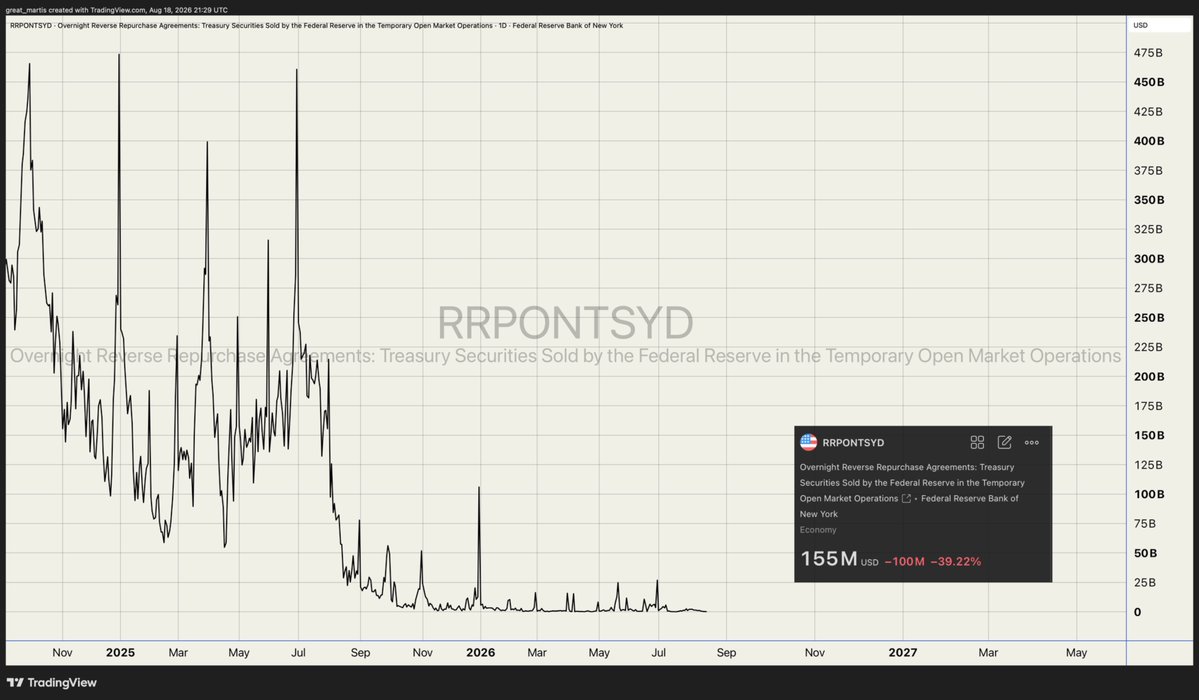
🚨 The $2 Trillion Shield is Gone. The Bond Market is a Loose Cannon.
For two years, the Fed’s Reverse Repo (RRP) facility acted as Wall Street’s hidden shock absorber. It peaked at $2.5 trillion, allowing money market funds to swallow up massive government debt and artificially suppress interest rates.
Now?
That ammunition is practically zero. The safety net has left the building.
The Only Good News:
🏦The Treasury General Account (TGA) the government’s checking account ...is approaching $1 trillion. This cash pile helps the government pay its immediate bills, buying the plumbing a little time.
The Bad News:
⚠️The TGA is just a temporary band-aid. The underlying reality is that the bond market is now a completely free agent.
Without the RRP absorbing the pressure:
-New debt must be funded by draining actual commercial bank reserves.
-The raw laws of supply and demand are back, pushing primary market yields higher. (Hence the more severe erosion of late)
-The financial plumbing is completely exposed to instability, dysfunctions, and sudden rate spikes.
The era of artificial liquidity suppression is officially over.
Welcome to the free market bond reality.
The pain trade has entered the building.
For one's private perusal.
Enjoy.
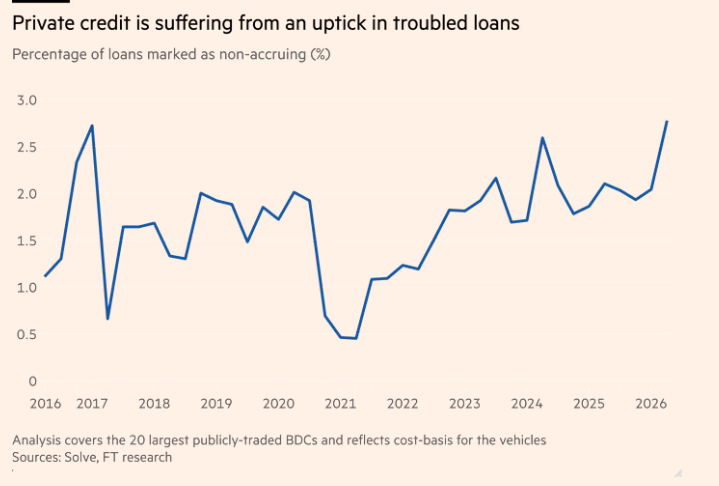
Strain is spreading across private credit portfolios, with some of the largest funds taking writedowns and warning about problem loans as the industry faces its biggest challenge in almost a decade.
The value of troubled loans held by some of the biggest private debt investors has reached levels last seen in 2017. (FT)
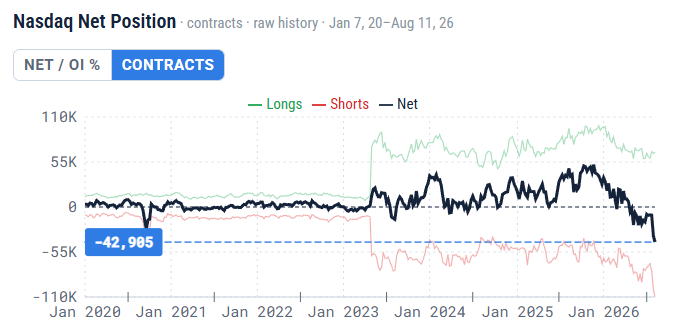
Nasdaq large-spec gross shorts just hit a five-year extreme, even as the bull trend holds.
Are funds betting against AI, or hedging massive tech exposure?
Read the charts for yourself: https://t.co/uihoqWYRnY
The more the CNY collapses v. gold (USDCNY*gold, below), the LOWER Chinese govt bond yields fall.
At some point, western policymakers will figure out why the same would also hold true for their bonds.
You'll want to own gold before western policymakers finally figure this out.
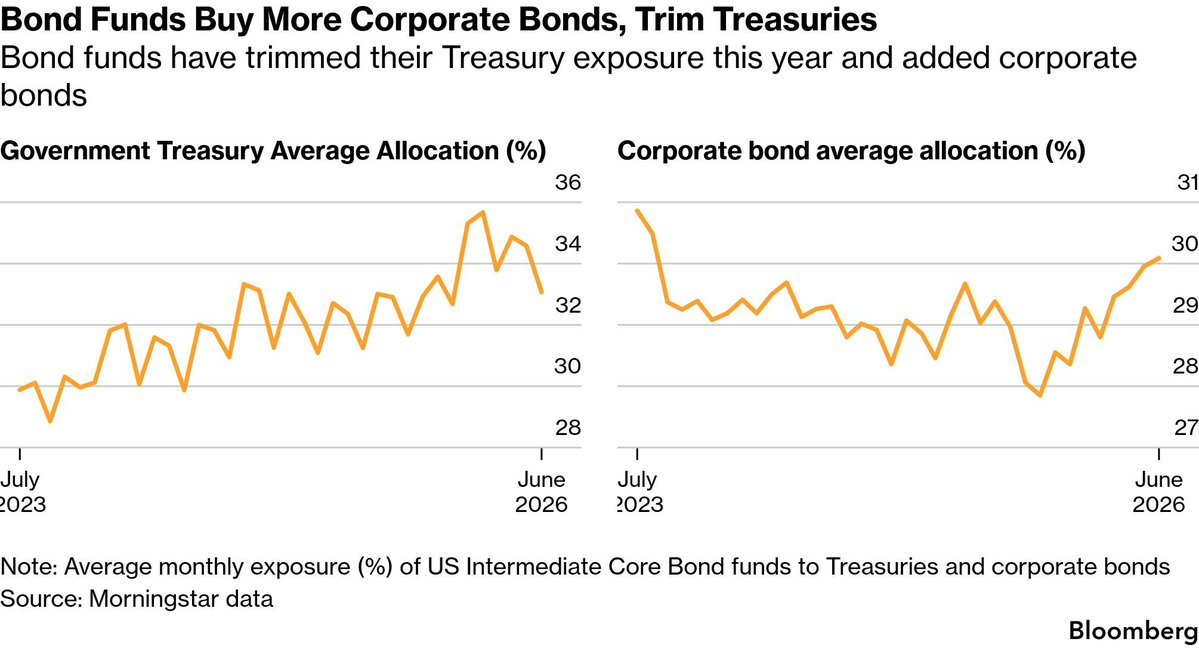
🦔AI companies have borrowed so much money this year that they're pushing up interest rates for the entire economy. Nomura estimates tech borrowing alone now equals 25% of what the US Treasury issues in bonds, five times more than last year. Bank of America says the surge has added about 0.3 percentage points to the 10-year yield. Bond managers are selling Treasuries to buy AI corporate debt instead because it pays more.
My Take
AI companies are now competing with the US government for the same pool of lenders, and the lenders are picking the corporate bonds. Alphabet's 30-year pays 6.4%. A Meta data center bond pays over 7.5%. At those rates, a 5.2% Treasury loses the fight for capital every time. That's one of the reasons long-term rates have stayed so stubborn even as the Fed tries to bring them down.
JPMorgan expects $5.5 trillion in AI infrastructure spending through 2030, and most of it will be borrowed. That borrowing raises the cost of money for everyone, the government, your mortgage, small businesses trying to get a loan. The AI buildout has reached the scale where it moves rates for the whole economy, and most people paying higher borrowing costs have no idea that a data center arms race is one of the reasons why.
Hedgie🤗
Perilous Postponement.
The bond market is starting to sniff out the consequences of delaying tightening because a given month's data merely falls short of expectations. In the 1990s, they had already started.
Passive easing continues daily.
https://t.co/cfI4yFxgee
AI spending among US companies is accelerating:
The top 1% of US businesses spent a record median of $7,400 per employee per month on AI in July, according to Ramp.
This compares to a record $650 per employee for the top 10% of businesses and $11.95 per employee for the median firm.
Over the last several months, AI spend per employee has more than tripled for all these groups.
The surge is widening the gap between categories, with the top 1% now spending more than 600 times as much per employee as the typical company.
To put this into perspective, the top 1% of US businesses were spending less than $1,000 per employee per month on AI in early 2024.
AI investment is becoming increasingly concentrated among a handful of companies.
Additionally, we are now well past peak Treasury issuance and have reached the point where issuance will begin to decline steadily into September, with a few weeks of paydowns before issuance ramps back up in October. The cumulative T-bill issuance charts had been working very well until two weeks ago, when the gamma squeeze hit the markets. There is still plenty of T-bill liquidity draining that could reassert itself with a 12-day lag.
DeepSeek raises model prices 4 times. As we had observed last week, an interesting trend in AI model layer is that open models are becoming more expensive while closed frontier models are becoming cheaper with successive price changes from ChatGPT, Grok and Muse Spark not to mention price “per intelligence”.