Too much time is spent searching for quality security CPD/CPE, and not enough time actually learning.
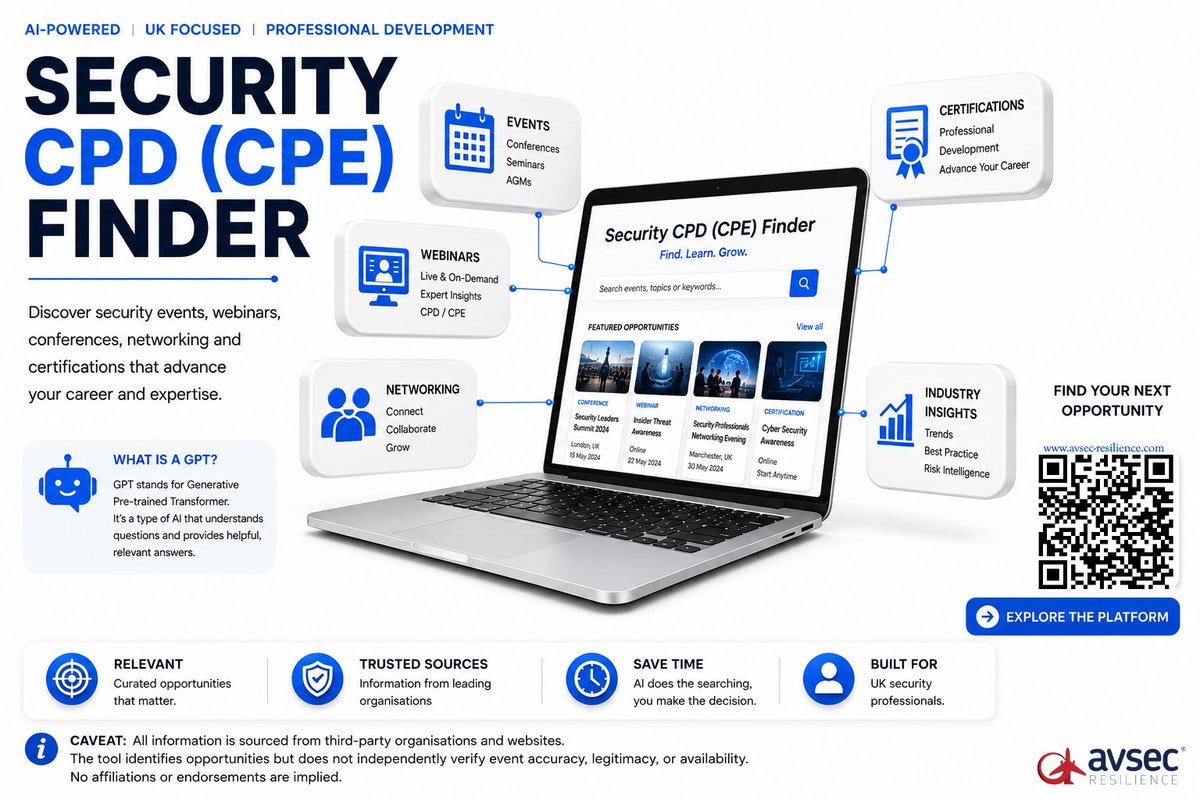
That’s why I’m sharing the Security CPD (CPE) Finder GPT designed to let AI handle the heavy searching across UK conferences, webinars, networking events, certifications, and industry activities, while security professionals decide what’s actually worth their time.
Yes, you could build your own GPT… but most people could also bake their own bread.
Link to the GPT tools: https://t.co/VJc20ROUVv
Why free? Because security professionals should spend time learning, not endlessly searching.
⚠️ Caveat: All information comes from third-party sources. The AI tool identifies opportunities but does not independently verify event accuracy, legitimacy, availability, or affiliations.
A GPT is an AI-powered assistant designed to help with specific tasks, knowledge areas, or workflows through natural conversation.
#Security #CPD #CPE #ProfessionalDevelopment #SecurityProfessionals #RiskManagement #CSyP
One domino stopped can prevent a thousand falling. 🁢
Major incidents rarely begin as major incidents.
They often start with a single overlooked vulnerability, missed warning or unchecked risk.
Effective security leadership isn't just about responding to the final domino it's about identifying and stopping the first one before momentum builds.
Small interventions today can prevent significant consequences tomorrow.
The greatest security successes often begin with one decision made at the right time.
#SecurityLeadership #RiskManagement #SecurityManagement #Resilience #SecurityCulture #Leadership
**Great conductors aren't always noticed.** 🎼
The audience applauds the performance.
Few notice the conductor who kept everyone in time.
Security leadership is much the same.
Its role isn't to be centre stage it's to bring people, processes and decisions together so operations run safely, smoothly and effectively.
When coordination works, it often goes unnoticed.
**The best security leaders don't seek the spotlight they ensure everyone else performs at their best.**
#SecurityLeadership #Leadership #SecurityManagement #SecurityCulture #Resilience #RiskManagement
Good forecasts are criticised because they worked. 🌦️
"We prepared for the disruption... and nothing happened."
That's often the biggest compliment a forecast can receive.
When organisations act on timely intelligence, strengthen their resilience and reduce their exposure, the predicted event may have little or no impact.
Ironically, that success can lead people to question whether the warning was ever necessary.
The same is true for security.
The best forecasts don't predict the future—they help shape a better one.
#SecurityLeadership #ThreatIntelligence #RiskManagement #Resilience #SecurityManagement #Leadership
Quiet maintenance prevents noisy failures. ⚙️
The most effective security improvements rarely make the news.
-Updating procedures.
-Testing plans.
-Reviewing risks.
-Maintaining systems.
-Developing people.
-Learning from exercises.
They're quiet, routine activities—but they prevent the loud, costly failures that everyone notices.
The strongest security programmes aren't built during a crisis. They're built through consistent maintenance long before one occurs.
The work nobody applauds today may prevent tomorrow's headline.
#SecurityLeadership #SecurityManagement #RiskManagement #Resilience #ContinuousImprovement #SecurityCulture
Calm seas don't prove the lighthouse unnecessary. 🌊
When nothing goes wrong, it's easy to question the value of preparation.
But calm waters don't mean the lighthouse isn't needed—they often mean its guidance has done its job.
The same is true for security.
Threat intelligence, planning, governance and preparedness rarely make headlines, yet they quietly reduce risk every day.
The absence of incidents isn't evidence that security isn't working—it's often evidence that it is.
#SecurityLeadership #RiskManagement #Resilience #SecurityManagement #Leadership #SecurityCulture
The safest flights are coordinated before take-off. 🛫
Passengers see a smooth departure.
What they don't see is the coordination behind the scenes:
• Intelligence sharing
• Risk assessments
• Operational planning
• Security screening
• Airspace monitoring
• Cross-functional collaboration
Safe flights don't happen by chance—they're the result of countless decisions made long before the aircraft leaves the ground.
The best security isn't measured by the incidents you respond to, but by the journeys that remain uneventful because of the work you did beforehand.
#AviationSecurity #SecurityLeadership #RiskManagement #AirlineSecurity #AirportSecurity #Resilience #SecurityManagement
Strong security starts with unseen foundations. 🏗️
People notice the visible measures.
They don't always see the foundations that make them effective:
• Leadership
• Governance
• Intelligence
• Risk management
• Training
• Security culture
• Continuous improvement
Like any building, strength isn't determined by what stands above ground—it's determined by what was built beneath it.
Invest in the foundations, and the structure will stand when it's tested.
#SecurityLeadership #SecurityManagement #SecurityCulture #RiskManagement #Resilience #Leadership
Most security lies below the surface. 🧊
People see the guards, cameras and access controls.
They rarely see the intelligence, planning, partnerships, governance, exercises and security culture that prevent incidents from happening in the first place.
Like an iceberg, the visible measures are only a fraction of the whole picture.
The strongest security programmes are built on the work nobody notices.
#SecurityLeadership #SecurityCulture #RiskManagement #Resilience #SecurityManagement #Leadership
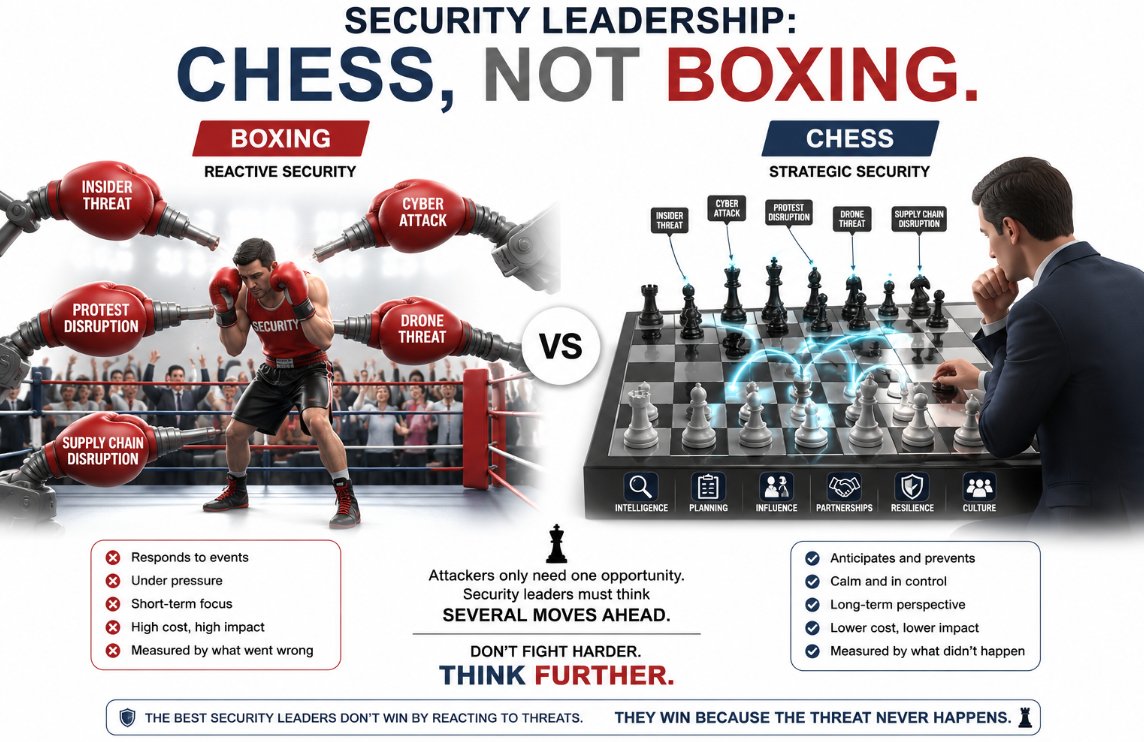
Security leaders play chess, not boxing. ♟️
Boxing is about reacting to the next punch.
Chess is about anticipating the next move.
The best security leaders don't wait for incidents to happen—they think several moves ahead, influence outcomes, and prevent problems before they become crises.
Don't fight harder. Think further.
#SecurityLeadership #RiskManagement #Security #Leadership #Resilience
Firefighting has an audience. Foresight doesn't.
Security leaders are often judged by the incidents they respond to.
The best security leaders are judged by the incidents that never happen.
Effective leadership isn't just about managing today's risks—it's about anticipating tomorrow's threats, influencing decisions early, and preventing problems before they become crises.
When prevention works, it's often invisible.
When foresight succeeds, there may be no applause.
That's the paradox of security leadership:
Your greatest successes are often the ones nobody notices.
What examples have you seen where proactive security prevented an incident before it reached the headlines?
#SecurityLeadership #RiskManagement #SecurityManagement #Leadership #Resilience #AviationSecurity #CorporateSecurity #BusinessResilience #SecurityCulture
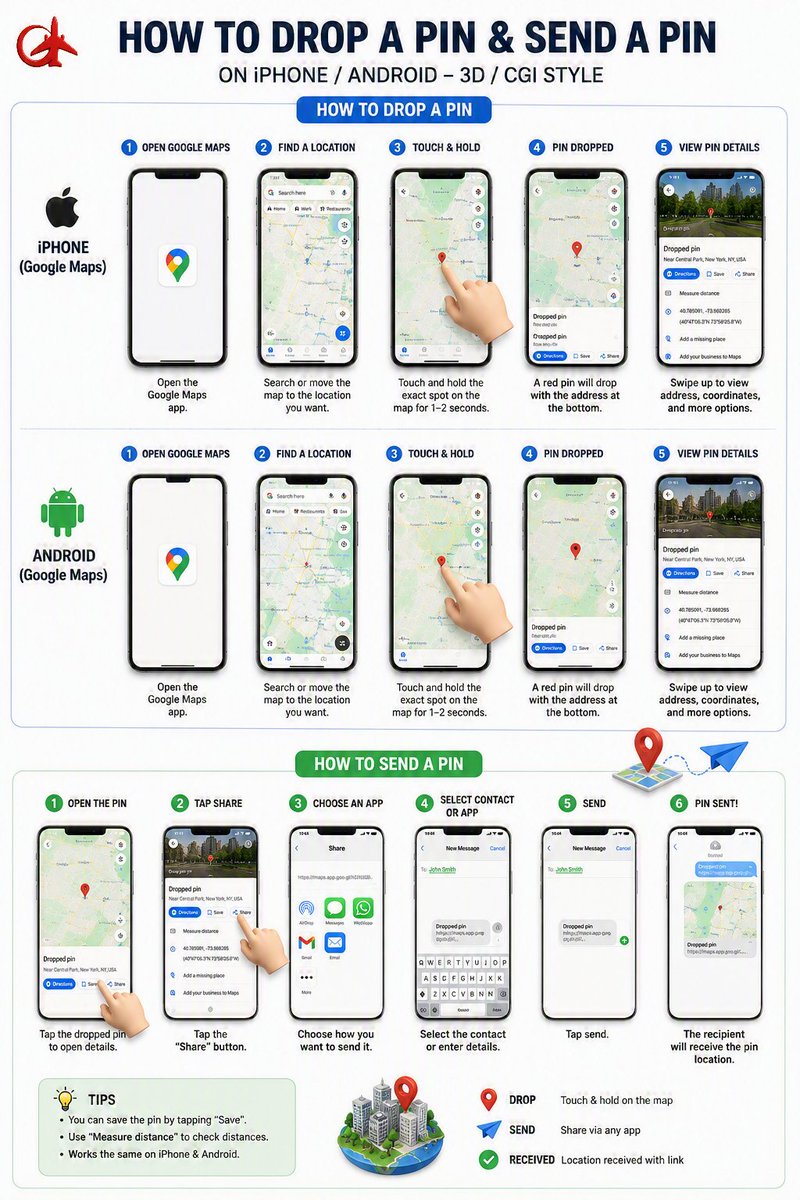
📍Know how to drop a pin before you need one.
Whether you're reporting an incident, directing emergency services, meeting colleagues, or sharing a point of interest, knowing how to accurately drop and send a location pin is a simple skill that can save valuable time.
Our latest infographic provides a quick, step-by-step guide for both iPhone and Android users.
Simple. Practical. Essential.
#GoogleMaps #iPhone #Android #EmergencyPreparedness #TravelTips #Security #AviationSecurity #OSINT #SituationalAwareness #AvGeek
Why do we resist change... until we can't imagine life without it?
💡 Electricity was once considered dangerous.
📺 Colour TV was seen as an unnecessary expense.
📱 SMS was dismissed as having little business value.
Today, they're part of everyday life.
Successful change isn't just about introducing new technology—it's about building trust, explaining the why, reducing uncertainty, and giving people the confidence to adopt something new.
The next idea we dismiss today could become tomorrow's standard.
What's the biggest change you've seen people resist—only for it to become indispensable later?
#ChangeManagement #Leadership #Innovation #Technology #BusinessTransformation #DigitalTransformation #SecurityManagement #ContinuousImprovement #Learning #FutureOfWork
KYC confirms identity.
AML identifies risk.
A customer can pass KYC (known Your Customer)… and still trigger major compliance concerns through:
⚖️ Sanctions
👁️ Watchlists
🏛️ PEP exposure
Modern financial crime prevention is not just about verifying people, it is about understanding risk before it enters the system. #AML #KYC #Compliance #FinancialCrime #RiskManagement
Power does not disappear when structure disappears.
Groups that claim to have “no hierarchy” often create hidden, informal, and unaccountable leadership instead.
Clear roles, transparency, and accountability are not bureaucracy, they are what prevent chaos.
#Leadership #Governance #OrganisationalCulture #BoardLeadership #Management #SecurityLeadership
Small environmental changes can have a major impact on security.
This before-and-after transformation shows how Crime Prevention Through Environmental Design improves safety through:
• better lighting
• cleaner sightlines
• controlled access
• maintained spaces
• territorial reinforcement
• layered security
The goal is not just to secure a house but to shape behaviour, reduce opportunity, and create an environment that feels visibly safer.
Good security starts long before alarms or incidents.
It starts with design.
#CPTED #HomeSecurity #SecurityDesign #CrimePrevention #PhysicalSecurity #UrbanDesign #Architecture #EnvironmentalDesign #LayeredSecurity #RiskManagement
There is no single “perfect” organisational structure.
The right model depends on:
• size
• culture
• speed of decision-making
• innovation needs
• accountability
• collaboration requirements
From hierarchical to flat, matrix to networked, each structure changes how power, communication, and responsibility flow through an organisation.
#Leadership #Governance #Management #Business #OrgDesign #OrganisationalStructure
Real power isn't always the loudest voice in the room.
Look beyond job titles and meeting dynamics:
👀 Who do people look at?
🔁 Whose ideas get repeated?
📞 Who gets the call when it matters?
📚 Who knows the real history?
✅ Who makes the final decisions?
Influence is visible. Authority is often hidden.
#Leadership #Influence #DecisionMaking #Governance #ExecutiveLeadership #SecurityLeadership #OrganisationalCulture #ManagementTips
“Once in a blue moon” is one of those phrases we use without thinking about where it came from. 🌕🔵
Originally, it meant something impossible… then evolved into meaning something extremely rare. Today, it’s even linked to astronomy and the second full moon in a month.
Language evolves just like society, technology, and risk.
#BlueMoon #DidYouKnow #Language #History #Astronomy #Infographic