@KingKong9888@Dioclet54046121 I wonder if the Fed is actually able to define what ‘ample-reserves’ constitutes.
Depending on context it could be enough to stave off a crises to adequately keep the rates within limits.
@moving_charlie@Room36544 I’m afraid the system as currently structured is unable to course correct.
Question is if the territorial integrity of the country remains or the malcontent catches up sooner to break the union.
@EzMid22@BankerWeimar Those with “Actual Careers” in the financial space have not demonstrated an understanding of the mechanics behind what’s happening right now.
At least so far as their income is predicated on not understanding it.
Baron’s an exception and Eric has been brilliant.
@Dioclet54046121 Tbh I’ve tried looking up how a paper to physical ratio at the Comex-LBMA axis that’s touted to be 300:1 has even been determined for silver or whatever the number is for gold.
Aside from assertions, I’m yet to see the maths or evidence behind this ratio.
@LukeGromen “Flyover country?!”
Nope.
It’s a warning label for the coastal financiers and software developers for what the loss of USD Fx hegemony and AI may yet do.
Washington can be as committed as it wants for continued financialisation.
The game now is for the production, engineering of physical matter and the things that are needed to build them.
Re-shoring in other words which they’ve given up on seemingly.
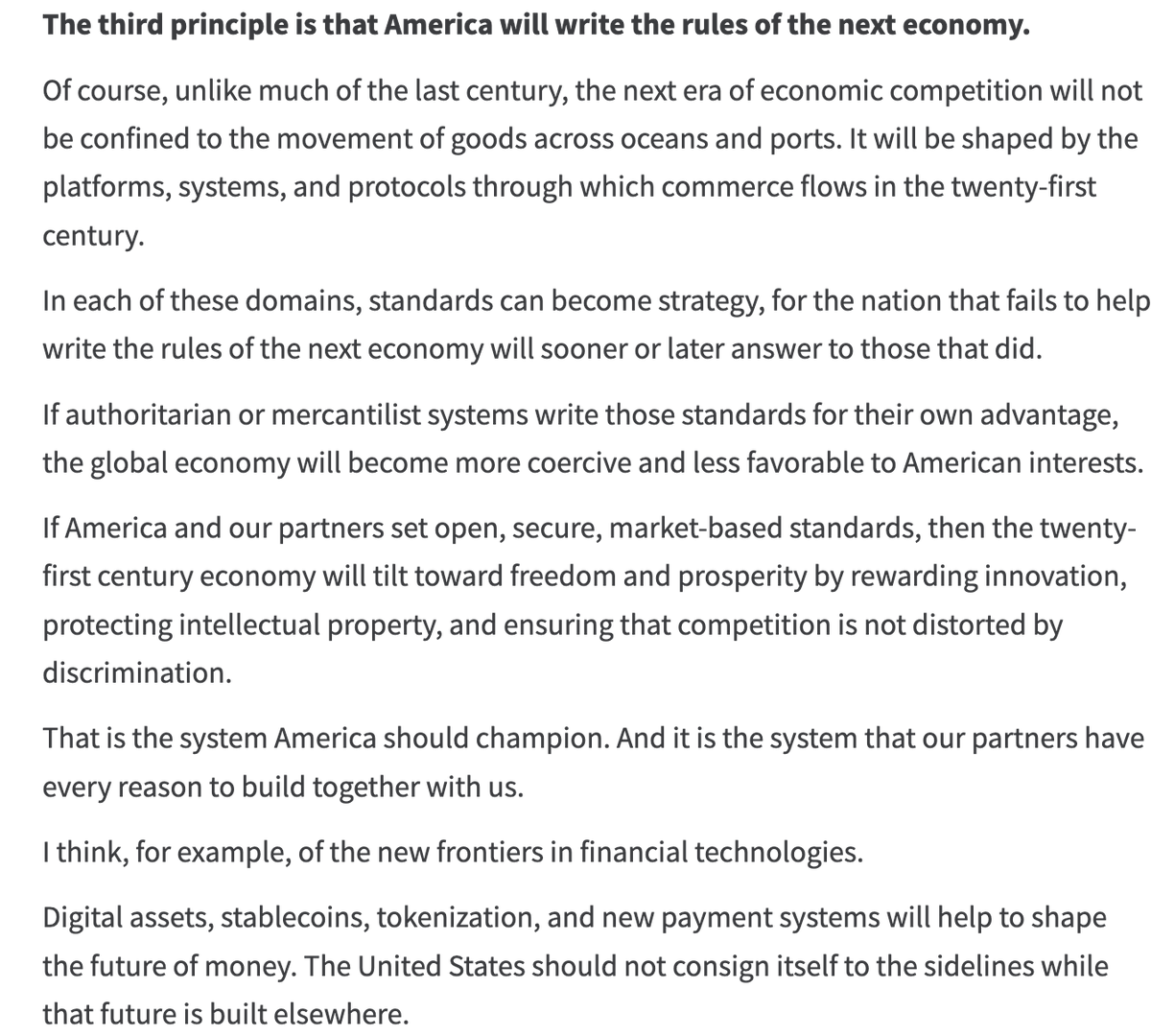
Spent my morning reading this recent speech from @SecScottBessent. It lays out a new and defining vision for America's role in the economy for the next 100 years. @elerianm calls it a "remarkably important speech."
Bessent organizes his vision around five principles. Principle 3 is, "America will write the rules of the next economy." He gives one example of what this means:
"Digital assets, stablecoins, tokenization, and new payment systems will help to shape the future of money. The United States should not consign itself to the sidelines while that future is built elsewhere."
If you've wondered how committed Washington is to making crypto succeed in the US, that tells you something.
@moving_charlie Cutting spending will blow the yields.
Increasing taxes will disincentivise productivity which will then blow the yields.
But a quick 🩹 rip off will not happen. Goal will be to see if the Can is kicked down the road until the next elections are due.
@MacroAlphaHQ Or like Turkey, constantly collateralise and ‘re-hypothecate’ bullion ‘sales’ to raise USD’s whilst not actually letting go of the physical.
Ingenious, almost.
@shivender@ankitatIIMA@aravind BTC is the first cryptocurrency. Anyway it’s a stupid idea. It’s not a ‘store of value.’ It’s not ‘proof of work.’ It’s not ‘decentralised money.’
It’s a liquidity decoy for the USD designed to distract from Gold & Silver.
1/20 PROVING THAT BITCOIN IS A LIQUIDITY DECOY WITH SIMPLE DIFF EQUATIONS.
“HODL” on to your socks. (a bit technical)
ALSO The Fed is semi-lying, in fact, about “We would lose control of interest rates without IOR.”
https://t.co/aaTXKHhkD4
@investinguab Fed rates matter globally until the UST are in demand globally in keeping with the store of value function.
I care about Central Banks being net buyers rather than sellers as in 1970’s and the noghties.
It’s part of the monetary transition now.
For Japan to be "intervening" in the JPY, the Japanese banking system would have to be a net seller of USD for either say for Gold ( like in CHina) or for other FX, which is not happening, the Japanese Commercial banks hold those dollars that the MOF just sold to cover the liabilities in Yen. I will show the mechanics tomorrow. From the standpoint the MOF, the higher the price of the UST sold for USD then Yen then the better to cover the liabilities.
What is happening though is that the Japanese banking system is net net SHORTENING its duration in UST, since the assets that the commercial banks re-buy in the Treasury market with the USD they just got because the MoF selling its long duration Treasuries are short duration UST.
So who is absorbing this duration?
Well, the hedgies doing a basis trade, with extreme leverage. And that's a problem.
Data from the Bank for International Settlements (BIS) and recent Federal Reserve research confirm that hedge funds' gross Treasury exposure has exploded to a massive $4.0 trillion. Strikingly, hedge funds absorbed roughly 37% of all net issuance of longer-dated Treasury notes and bonds.
@Kens505@HealthRanger Yeah the decision makers in America would not truly want EV to flourish as the incentive structures aren’t aligned.
Technology exists to do what you want. But it wont be made available to you in America.