Life gets put into perspective sometimes. I was in a terrible mood heading to a red eye this morning because my original flight was canceled and I was out a few hundred dollars after rebooking. I sit down on the plane and the family next to me is
I rowed for 4 years at Harvard. It was one of the hardest, but most rewarding experiences of my life.
Recently, I've noticed that a lot of ex-athletes I talk to have the same issue I had 1-2 years into the workforce.
here's what it looks like:
they're coming off a great college athletic career. They absolutely killed it in the classroom and on the field/water/pool/track etc.
They landed a role at a brand-name firm in consulting/banking/S&T/big tech and have been in the seat for 1-2 years, grinding away.
However, in the back of their mind, they know they are capable of more. It's not that they aren't trying in their current job (odds are they're actually doing really well) it's just that they know from their time as an athlete that there's another level of output that they can hit.
Here is where the problem comes in: that next level of output? It is really only attainable if they actually believe in the company/mission/team. Hard work for the sake of hard work isn't sustainable. There has to be something deeper that the work is for.
And so, they keep going to the office day in and day out, knowing that their heart isn't really in it, but also too unsure of what the right next step is to make a move.
When I found myself in this place, I decided to take a big leap and join a startup as an SDR. In retrospect, it's the best decision I ever could have made. I'm not saying that's what everyone in this position to do, but sometimes the bigger risk is not doing anything.
I met a 93 year old artist this weekend at a show in NYC.
She told me
1. She still paints regularly
2. She refuses to paint sitting down
I’m not a longevity guy but there’s gotta be something to that.
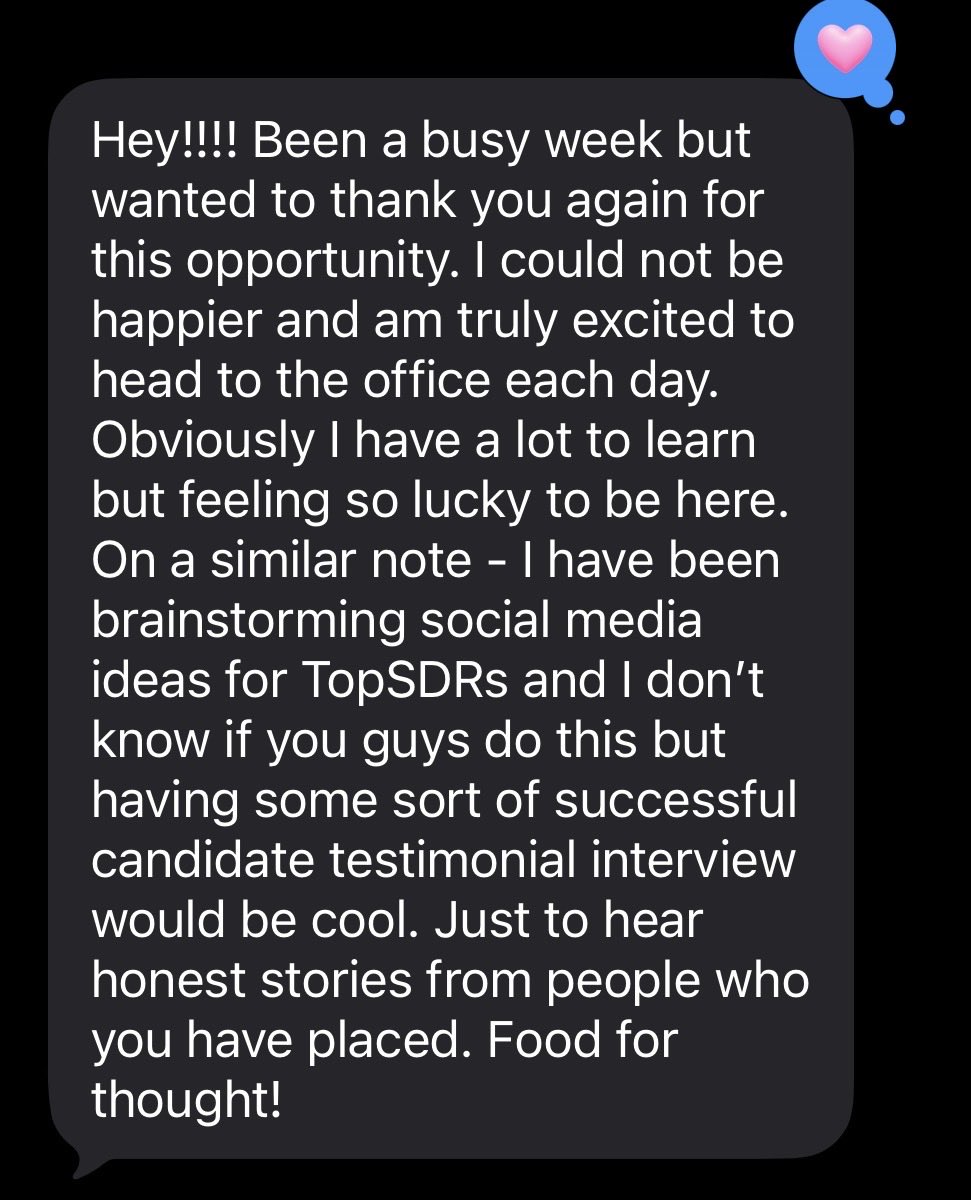
The best texts to get. This is a candidate we placed last month. She was Harvard —> traditional path and then we helped her pivot into sales at a tier 1 startup in NYC.
And YES we will be doing an interview w her soon per her suggestion!
@BoringBiz_ 100%. Also this isn't something you learn once and then do forever. The key is consistently seeking discomfort because the things that were once embarassing/uncomfortable become comfortable with time, so you have to continuously push!
a top three trait that elite startups hire for (particularly with young talent): coachability.
I often hear from sales hiring managers that when they run mock cold call exercises they don't care if a candidate is a 4/10 on round I.
What they really care about is can the candidate take feedback in real time and make round II an 8/10.
9 times out of 10 this person will get the job over the person who comes in HOT but doesn't appear to be coachable.
I quit my finance job the day I got my bonus.
March 2022. I was 2.5 years into a job at a big bank.
Good title. Good pay. Good people. On paper, everything looked right.
But I knew in my gut it wasn’t the thing.
I had rowed for 4 years at Harvard. I knew what it felt like to be completely all in on something, to wake up excited, to push through pain because the mission actually mattered to me. I wasn’t feeling that anymore. Hadn’t felt it in a while.
So I made the decision. Waited for bonus day, watched the money hit, and walked into my boss’s office that same morning.
I left to join a Series A startup as an SDR.
From the outside, it looked like a massive risk. I was walking away from a brand-name firm to make cold calls at a company most people had never heard of.
But internally? I didn’t doubt it for a second.
@jonbrosio My first side hustle consulting contract was $1k/month…within 8 months I quit my full time job and was running my own biz. Haven’t looked back since
@thedankoe Early on in building a business I looked at my wins and losses and found most of my losses immediately succeeded a win. I’d get complacent and let my guard down. This awareness has been a huge help for me in the years since
I was speaking to a candidate the other day who was considering two job offers, for different roles at different companies.
My biggest advice to her:
Pick the company not the role.
In early stage environments things move so quickly and there is so much mobility that the job you sign up for can and will look very different within a matter of months.
Not only that, there is also MUCH more opportunity to move into other functions once you prove yourself in one seat that you won’t be siloed into the role started in.
As such, what should move the needle in making this kind of decision is the company itself, and to be more specific, the talent density. The people you surround yourself with every day will become your network and will shape how you develop during your time there.
@matthias_mrc I’m still constantly shocked at how bad the writing output is from these models. I uploaded a ton of LinkedIn posts the other day and asked it to write one in my voice and it just wasn’t it tbh
@ankurnagpal Where would you build now if you were starting over? Is it just all about distribution? I think it’s interesting to see how distribution isn’t actually EVERYTHING in other commoditized spaces (ie celebrity tequila, skincare, clothing brands)
@katiekirsch Speed of learning is also essential. You can almost see in real time when someone is genuinely comprehending what you're telling them. It feels like a superpower to have a quick learner on your team.