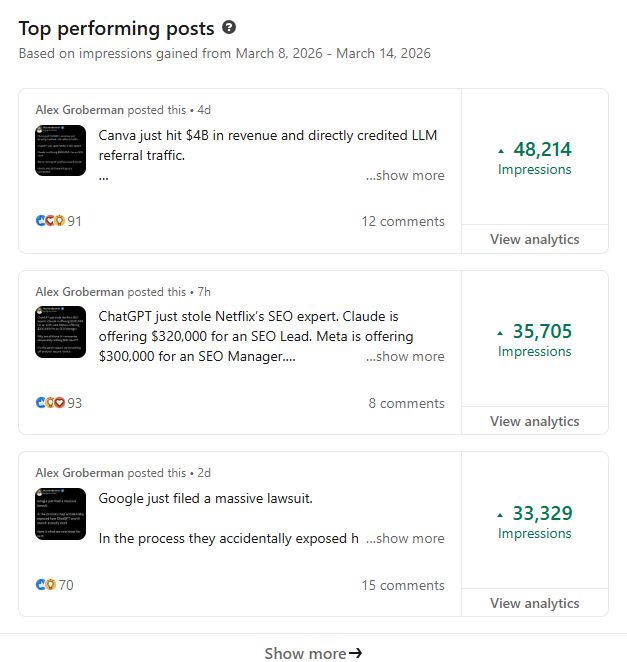
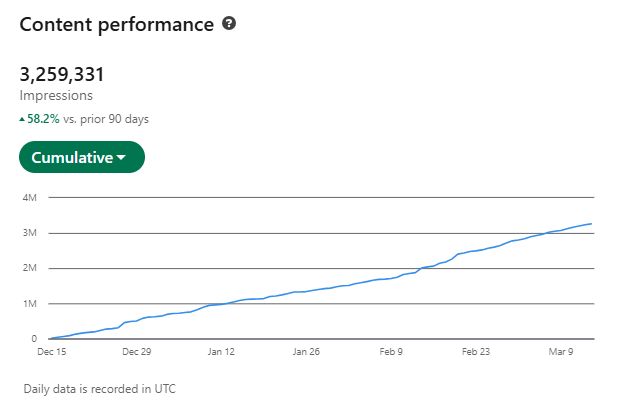
I created my LinkedIn account ~65 weeks ago.
Since then I’ve added $340,000+ in direct revenue from LinkedIn and 14,600 followers.
Easiest algo to crack by a country mile.
Also the single best social media for signing enterprise clients.
Here is the exact system I’m using right now...
Oh, and if you want my full unfiltered cheat sheet with engagement group templates, carousel structures, DM workflows, and my posting system, follow me, repost this, and reply “LinkedIn Growth Guide.”
You must do all 3 to receive the DM.
Let me start with what remains true after 65 weeks of daily testing:
Proof-based content still outperforms everything else.
By proof-based I mean posts that literally show a real metric, revenue, traffic, pipeline, booked calls, etc. and then add context with a clear business takeaway.
Use real numbers whenever possible.
Dwell time still plays a major role too.
If people read the entire post, swipe through multiple carousel slides, or pause on video, the post continues circulating longer.
First-hour replies from people outside your immediate network are still one of the strongest distribution signals you can influence.
On-platform formats beat outbound links in almost every case.
Text posts, carousels and native short video outperform link posts on average.
Link posts without setup consistently stall.
That said, a lower-reach link post with strong intent can still outperform in revenue.
Distribution and conversion are different games.
If you include a link, deliver value first and either modify the preview image or drop the link in the comments.
Topic consistency builds on itself over time.
Posting repeatedly around the same core theme strengthens how LinkedIn categorizes your profile.
Your content then gets shown to people already engaging with that topic.
That improves early engagement quality and comment depth.
Cross-niche engagement still expands reach.
Engaging consistently in two to three adjacent industries pushes your profile into overlapping networks.
Generic likes do almost nothing.
Thoughtful comments that add insight create second-level engagement and extend reach.
Reposting with a new hook still works extremely well.
Most of your followers never saw the original post.
Repost after one to three weeks with a sharper angle, updated numbers, or a clearer outcome.
Posts with replies to replies stay alive longer.
Multi-layer comment threads can extend post lifespan by days compared to shallow discussions.
My posting schedule has not changed.
I post three times per day, every day.
Morning is proof-driven or a strong point of view.
Afternoon is a carousel, teardown, or case study.
Evening is a lesson, system breakdown, or actionable walkthrough.
Skipping even one day reduces momentum for the next 24 hours.
Formats performing best right now:
Carousels with a bold first slide tied to a specific outcome or pain point.
Three to six concise slides with steps, visuals, or proof.
A final slide with a clear next step.
Short native videos under 60 seconds with subtitles.
The hook must land in the first two to four seconds.
Walkthrough and behind-the-scenes videos continue outperforming polished talking-head content when the information is concrete and tactical.
What is underperforming:
Link posts with no setup.
Metrics with no narrative.
Large, dense text blocks.
Generic advice that applies to everyone.
Posts where the author disappears after publishing and does not reply in the first hour.
My engagement strategy:
Comment on 20 to 30 posts per day with insight tied directly to the post.
Like 50 or more posts per day.
Reply to every comment on your own posts within the first hour.
DM five to ten people per day with context-first value tied to something they posted.
Ask follow-up questions inside comment threads to deepen discussion.
Repeated engagement from the same people increases future distribution.
Hooks performing best right now:
“I started this account 65 weeks ago. Here is what $340,000 in LinkedIn revenue actually looks like.”
“This 4-slide carousel booked 5 calls in 24 hours.”
“If I had to rebuild my LinkedIn from zero today, this is the exact system I would use.”
“My 3-post-per-day routine for consistent inbound.”
“I made X this month from LinkedIn. Here is the breakdown.”
Every hook must be backed by proof.
Without proof, credibility drops fast.
Here is a 30-day plan that still works:
Post three times per day with at least one proof-based post.
Comment on 20 to 30 posts daily with substance.
Like 50 or more posts per day.
Reply to every comment within the first hour.
Repost one winner each week with a new angle.
DM five to ten people per day with context-first value.
Track impressions, comment depth, leads, and repeating commenters weekly.
Test hooks, formats, and timing every week.
Run this system for 30 days.
Screenshot your Day 31 results.
Tag me when inbound starts.
If you want the full cheat sheet, follow me, repost this, and reply “LinkedIn Growth Guide.”
You must do all 3 to receive the DM.
My brother is 19.
A sophomore majoring in Software Engineering.
I’m the older brother. I have a career. And for two years, I’ve been covering everything tuition, rent, food every single month.
Recently, my patience finally snapped.
It’s not that I’m heartless.
It’s just that every time I saw him, he was glued to his laptop, and to me, it looked like nothing but gaming and endless YouTube loops.
I called him and didn't hold back:
“David , I honestly don’t see what I’ve been paying for these last two years. Can you show me anything you’ve actually built? Because if not, we need to have a serious talk about whether we should keep doing this.”
Silence on the other end.
Then, he said quietly:
“Okay. Give me one week.”
I’ll be honest I wasn’t expecting much.
I thought he’d show me a basic landing page or a simple calculator.
Typical student stuff.
But seven days later, he showed up at my place.
He opened his laptop and revealed a live trading terminal.
I didn't even realize what I was looking at at first.
On the screen: a real-time equity curve.
Black background.
A steady white line climbing upward.
Numbers flickering every few seconds.
On the left complex math formulas.
On the right a live trade log from Polymarket.
He started explaining:
“I mapped out the logic for Claude AI, and it wrote the code. The bot trades markets like 'Bitcoin Up or Down' across 5-minute, 15-minute, and 1-hour intervals. It’s built on three core pillars:”
- The Kelly Criterion a mathematical formula from 1956 that calculates exactly what percentage of the bankroll to risk on each trade. No more, no less. Growth without the blow-up.
- Bayesian Updating the system recalculates probabilities after every single trade. It learns on the fly like a human brain, but without the ego or emotions.
- Expected Value (EV) Filter the bot doesn’t even enter a trade unless the math shows a clear edge. If the numbers aren't there, it simply waits for the next opportunity.
As I listened, one thing became crystal clear:
He hadn’t just "learned to code."
He had learned how to think.
The Stats:
> Initial Deposit: $100
> 7-Day Result: $3,000
> Win Rate: ~80%
I asked him:
“David, did you come up with all of this yourself?”
He just shrugged:
“I knew what needed to happen. Claude knew how to write it. We built it together.”
That evening, I transferred the money for his next month of tuition.
For the first time in two years, I did it with a smile.
If you want the code it’s open-source.
Like&Follow&Retweet
I’ll DM the link to everyone who does all three.