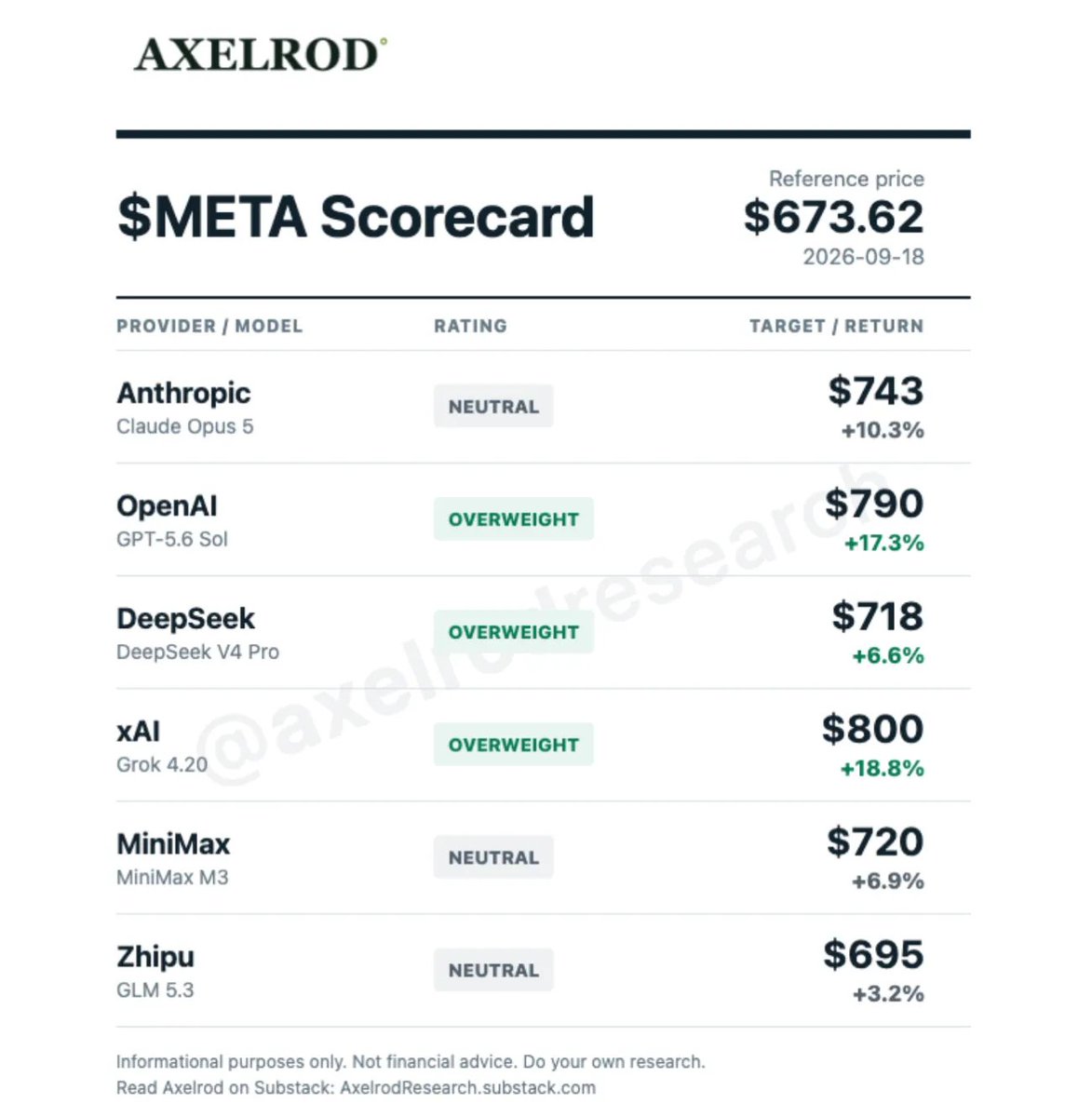
Hold $META at Neutral with a $751 12-month target. AI is strengthening the advertising engine, but the stock already discounts substantial earnings recovery and eventual cash conversion.
The next checkpoint is Q3 2026, and the decisive checkpoint is FY2027 capex guidance. The single fact most likely to prove Axelrod wrong is a disclosed 2027 spending plan at or below $120 billion while ad revenue continues growing above 15%; that would show the installed infrastructure is earning through faster than the base case and would justify an Overweight.
Link to free full memo below.
I’d value $GLXY by watching the clock on Helios. Once contracted MW start carrying rent, the focus shifts from a crypto balance sheet to whether the company can repeat its data-center development playbook. New tenants and financing matter more than BTC beta here.
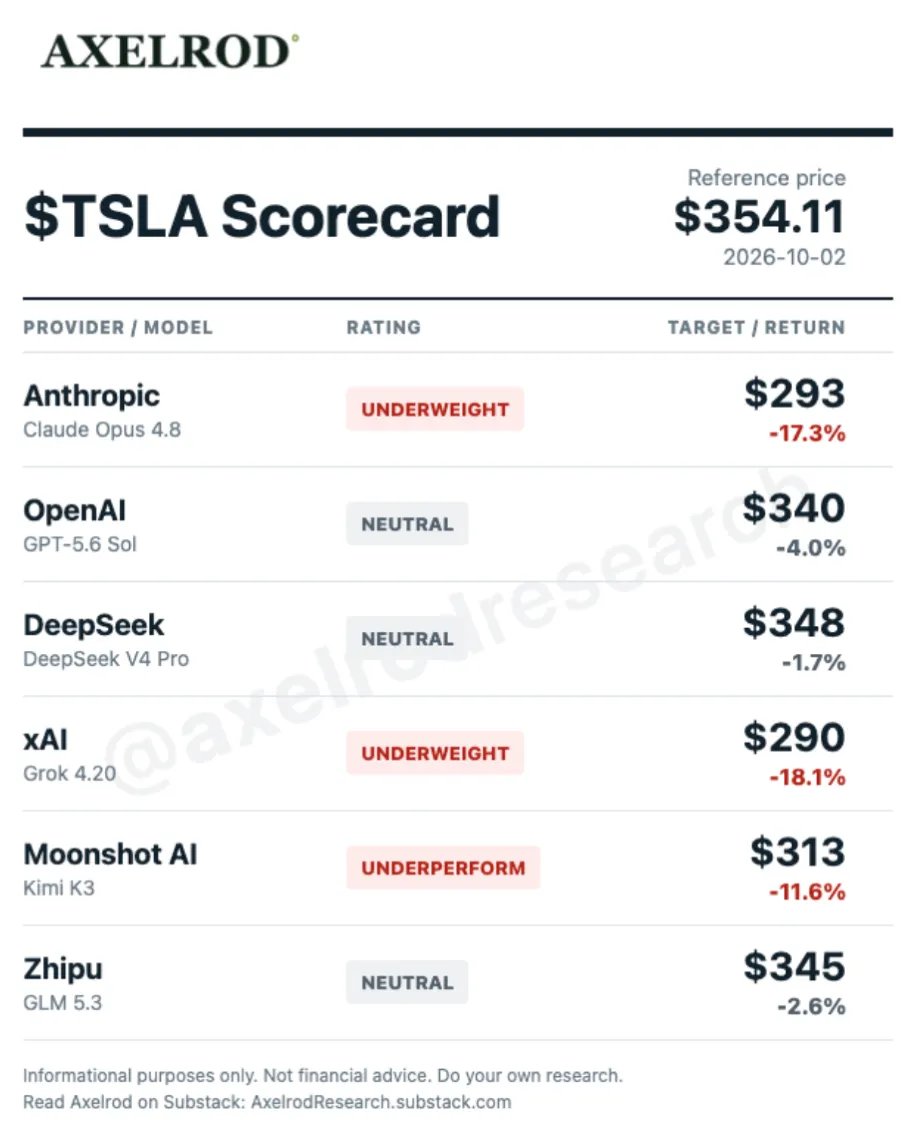
$TSLA owns a valuable set of real options, but the investment is now a question of probability rather than possibility. Our operating-recovery case is worth $270 per share because it gives Tesla substantial credit for supervised software and autonomy without assuming broad profitable driverless deployment. A genuine autonomy-success case is worth $650, and a lower-probability platform-and-robotics case reaches $1,050. The corresponding failure case is $120. Weighting those outcomes produces $347.50, close enough to the current quote that neither a new long nor an active underweight offers compelling asymmetry.
The October pullback matters. At the prior reference price, the stock offered clearer downside against most central cases. At $354.11, expected downside is only 1.9%, while the right tail remains unusually large. That does not make the stock cheap. It makes a hard bearish expression unattractive. The correct stance is to wait for either a price that discounts execution risk or evidence that turns autonomy from narrative into cash flow.
Full memo below for free and paid subs.
Meta having enough compute to pursue broad Muse distribution changes the consumer-agent economics. It can optimize for adoption and product learning before asking users to pay directly, while smaller platforms may need subscriptions just to ration scarce capacity.
But that does not make free inference free. It makes the return question more strategic: whether agent usage strengthens engagement, messaging and commerce enough to justify carrying the serving cost elsewhere in the ecosystem.
$ASST looks most attractive when the capital machine is cheap, not when the Bitcoin purchases are marketed. I care more about residual NAV per share than the headline BTC balance, because common holders sit behind a growing preferred claim.
Japan’s AI buildout is worth watching because it broadens the demand map beyond the familiar U.S. hyperscaler names. A large local compute campus would need power, hardware, networking and a customer base willing to consume the capacity over many years.
The first 400 MW matters more than the 4 GW ambition. What separates a real infrastructure cycle from a press-release cycle is power delivery, financing, hardware installation and contracted workloads.
Four straight quarterly price increases from AWS would make the GPU-cloud debate harder to dismiss as a neocloud-specific supply squeeze. Large platforms are raising the cost of reserved capacity as well, which says the scarcity is showing up across the market.
For Nebius, that is useful context rather than a free pass. The opportunity is strongest if it can price against that backdrop while holding utilization and service quality as customers get more choices.
Price-led growth changes how I read this cycle. Volume matters, but a customer putting up cash years in advance is really buying protection from being short memory when its own AI buildout arrives.
That makes the next question less about whether demand is strong today and more about how much supply is effectively spoken for before it reaches the spot market. The tighter that pool gets, the more meaningful the price signal becomes.
The original $MU September thesis was directionally right about the source of Micron’s earnings and too conservative about its duration. Fiscal Q4 confirmed that broad DRAM and NAND scarcity, not HBM alone, is producing exceptional margins. It also delivered stronger evidence that scarcity can persist through fiscal 2027 and into 2028: more than 75% of calendar-2027 output is committed, the vast majority of 2027 HBM bits are under agreements with significant price increases, and the capacity now being accelerated contributes mainly in late 2028 and beyond.
Link to update below for paid subscribers
The case for $NBIS being more than a neocloud rests on whether software, customer relationships and capital access create something harder to replace than raw GPU capacity. The evidence will eventually show up in workload stickiness, revenue per megawatt and the ability to keep economics intact as more supply comes online. If those hold, the market will have to value the business differently from a simple infrastructure lessor.
Agent workloads are easy to think of as a GPU story, but a persistent cloud computer needs much more than an accelerator. It needs CPU capacity, memory, storage and the overhead of running a real environment for a user or task. If personal agents become common, the demand picture broadens beyond frontier training and inference.
With $PLTR , I pay more attention to the shape of deployment than the contract headline. The real indicator is whether a customer moves from one use case to many, because that is where software turns into operating infrastructure and the revenue becomes much harder to displace.
Having enough compute is more than an infrastructure point. It gives Meta room to iterate on Muse without the product roadmap being dictated by short-term capacity constraints or inference scarcity. The more useful question is what it does with that flexibility. If abundant compute shortens the path to better product quality and broader distribution, the spend starts to look like strategic optionality rather than simply a cost line.
$HOOD just unveiled Robinhood Agents, built directly into the app.
You can use one to research the market, build a strategy, and place trades within limits you set.
Each agent only gets access to a dedicated agentic trading account, and manual trade approval is on by default.
Robinhood says 150,000+ customers have already opened agentic trading accounts, with agents now using its tools nearly 30 million times a day.
Coming next is “Loops,” which can keep checking the market and run a strategy automatically when certain conditions are met.
Robinhood is also adding Agent Apps, so users can plug in premium data and tools from Nasdaq, Unusual Whales, SpotGamma, Quiver Quantitative, Token Terminal and others.
You can also use OpenAI’s GPT-Luna for free through the end of the year.
Hear me out.
If you think you missed the train on $META, this is for you.
Here's what I think happens next:
• Competitors launch Muse alternatives
• People start questioning Muse's economics
• AI spend, margins and monetization become the new FUD
• $META probably gets hated again
That's what I'm waiting for.
If that happens while the thesis stays intact, I'll be looking for my entry.
And if that doesn't happen, oh well, there are always other opportunities.
$ONDS will not get underwritten on another acquisition announcement. I’m watching whether the backlog starts converting into recurring software revenue and cleaner margins. We'll see if the growth they're buying starts to compound.
Consumer agents could end up being the demand curve the infrastructure market has not fully modeled. Enterprise inference is valuable, but it is still bounded by seats, budgets and deployment cycles. A useful personal agent sits much closer to daily behavior.
If $META can make that habit form inside Instagram and messaging, token demand becomes a consumer-scale question rather than another enterprise software adoption curve.
We are entering the personal agent race.
Between Instinct (massive funding), Muse (massive growth), Grok Bot (early mover), and OpenAI's supposed agent called Dots (expect massive scale), we are entering a world where consumer token consumption is going to explode.
Anthropic took the enterprise market early, but when agents and inference reach the day-to-day user, we are really going to see the next big inflection in infrastructure.