"I learned very early the difference between knowing the name of something and knowing something." - Richard Feynman
Axiom Flow puts that to the test. You teach an AI student named Sam, correct his misconceptions, and his exam score tells you how well you actually taught him.
Built for the AI era, where copy-paste answers don't prove real understanding anymore.
https://t.co/nR3DiNuwuF
Students scored 3.07/4 on answers alone.
Add "explain why," and it dropped to 1.57.
Tests check answers. Conceptual gaps live in the reasoning behind them.
https://t.co/7YQPl4YUKS
What assessment for learning actually requires in higher education, and why explaining a concept reveals more than selecting an answer:
https://t.co/J7rzlQDxCz
AI can write a flawless essay whether or not the student understands anything. That breaks grading.
Axiom Flow flips the task: students teach an AI called Sam, who starts out with wrong ideas about the material. Then Sam takes the exam using only what he was taught. The AI never grades anything, it's a straight string match against the correct answer.
If a student understands it, Sam gets it right. If they just copied an explanation, Sam's follow-up questions expose it.
Full white paper: https://t.co/oYnJp4z1wC
Axiom Flow placed 2nd Runner Up in the Technology category at Yarl Geek Challenge Season 15 Senior Finale.
Grateful for the recognition and excited to keep building an assessment platform that actually measures understanding, not just output.
Thank you @YarlITHub and the evaluation panel.
#YarlGeekChallenge #EdTech #AxiomFlow #Jaffna
Axiom Flow placed 2nd Runner Up in the Technology category at Yarl Geek Challenge Season 15 Senior Finale.
Grateful for the recognition and excited to keep building an assessment platform that actually measures understanding, not just output.
Thank you Yarl IT Hub and the evaluation panel.
#YarlGeekChallenge #EdTech #AxiomFlow #Jaffna
A 92% match to a human grader still doesn't tell you if the student understood anything. AI can score an answer. It can't tell you whether the student could explain it, defend it, or apply it somewhere new. That's the real gap in most "AI assessment" tools right now.
We wrote about why grading accuracy and understanding are not the same thing, and what it actually takes to measure one instead of the other.
Read here: https://t.co/kDGeeaWGPJ
There's a new study tracking 26,811 Chinese students over 30 months that's worth a look if you care about how AI is actually affecting learning, not just test scores.
Kids using AI on homework got 18% higher scores and finished 30% faster. Sounds great until you check what happened on actual exams: scores dropped 20% within six months, and on entrance exams the drop was 18-24%, with the worst of it not even showing up until two years in.
Here's the interesting part though. About 80% of the AI users were basically outsourcing, finishing fast and scoring high in a way that doesn't add up unless AI did the thinking for them. But the students who kept a normal pace while using AI, using it more like a check than a crutch, barely lost anything.
So it's not really an "AI is bad" story. It's that homework stopped being a good measure of understanding the second AI could fake it convincingly.
Kind of the whole reason Axiom Flow exists. Sam can't be taught to fake understanding on the exam, he only knows what a student actually explained to him well enough to correct.
Paper here: https://t.co/TAQm7loK1W
Most tools sold as "AI assessment" are actually AI tutors with a grading interface. A good tutor removes obstacles for the student. A good assessor can't do that without ruining its own measurement. I wrote about why AI tutoring and AI assessment are two different jobs, and why conflating them is costing schools an accurate read on what students actually understand.
https://t.co/OyIrlep9XL
A student can pick the right answer and still be wrong about the concept. Research on the Force Concept Inventory found students often reach correct answers through flawed reasoning, and once they "know" the answer, the misconception underneath never gets checked.
Exams grade the output. They don't ask a student to defend the thinking behind it.
We wrote about why this happens, and what it actually takes to catch a misconception before it survives another semester.
Read it here: https://t.co/y9ZUEYj4EC
Multiple choice tests can't tell you what a student actually understands. Teaching can.
I dug into the research while building an assessment tool, and it changed how I think about learning. Wrote up what I found 👇 https://t.co/jOVxjVdgwy
A grade tells you where you landed. It doesn't tell you what to fix.
We dug into the research on formative feedback vs. grades (Butler 1988, Guskey's work at Kappan, a 2021 review in Review of Education) and found something surprising: when a grade is attached, students often skip the feedback underneath it entirely.
New post on why that distinction matters for how universities design assessment: https://t.co/aFTDVN1HtV
A January 2026 AAC&U and Elon University survey found that 78% of college faculty say cheating has increased since generative AI became widely available, and 73% have personally dealt with academic integrity issues in their own classes.
The typical response is better detection tools. But detection is a losing game. Models improve, accuracy drops, and non-native English speakers get flagged for writing differently.
The harder fix is designing assessments where AI shortcuts simply do not help. That is what we built Axiom Flow around.
Students teach a misconception-holding AI named Sam. They cannot paste from ChatGPT; they have to explain concepts in their own words. Sam only retains what they actually teach him, then takes a mock exam based on that. The student's grade is Sam's score.
If a student does not understand something, Sam will not either. The gap shows up in the results, not in a plagiarism report.
Source: AAC&U / Elon University National Survey, January 2026
https://t.co/MNbYygaQEJ
Diagnostic assessment usually happens before teaching starts, to catch what students already misunderstand. But the more useful question is: which of those misconceptions are still there after the lesson?
That's what a gap report answers, not just where a student started, but where the confusion still lives once teaching is done.
Read more: https://t.co/0UC2z8b52S
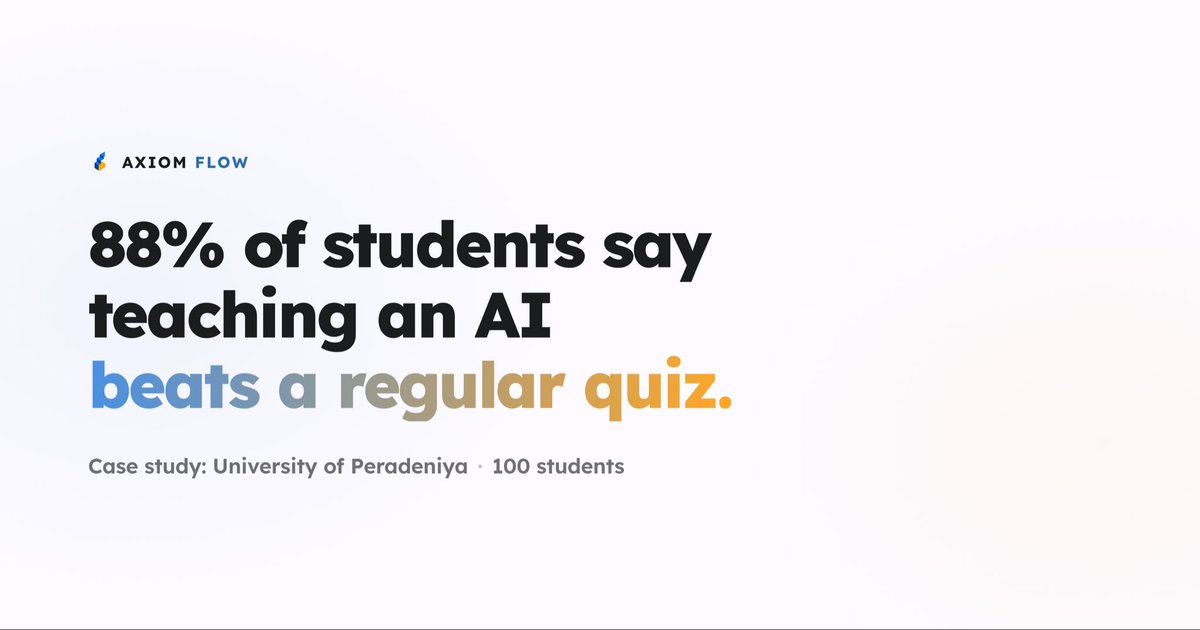
We ran Axiom Flow with 100 students at the University of Peradeniya. 52 responded to our survey.
87% said teaching Sam helped them understand the material better than studying alone.
88% preferred it to a regular quiz.
The honest part: only 62% felt the score was fair. That's the part we're fixing next.
Full case study here → https://t.co/ruxrhqYMf3
Getting a right answer and understanding why it's right aren't the same thing.
Our new demo walkthrough shows exactly how Axiom Flow tells them apart: you teach an AI student named Sam, and his exam score only reflects what you actually taught him.
Watch the full session: https://t.co/cLDLTwA5tl
Do you actually know how banks make money?
Sam (an AI student) has 5 misconceptions about it. See if you can spot them before you correct him:
1️⃣Banks pay interest on deposits mainly to fund their own expenses and keep the lights on.
2️⃣ Fractional reserve banking means banks hold 10% of deposits for the Fed to inspect, then lend the rest to other banks.
3️⃣ When a bank lends out your deposit, total money in the system stays the same, it's just your money being used by someone else.
4️⃣ Banks need deposits first before they can make loans.
5️⃣ The reserve requirement is the main thing stopping banks from over-lending.
Teach Sam yourself, no login needed → https://t.co/OoBXVK5SOI
@0xRokko@caspr_exe AI can take decisions and actions and it can improve itself. So AI is definitely not a tool like print press. This time is different.