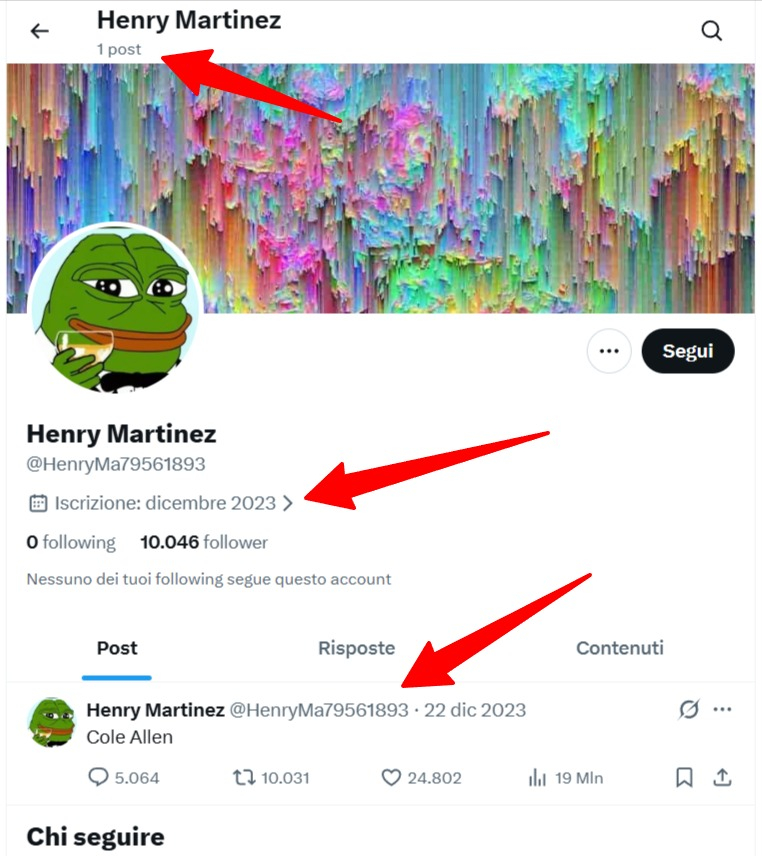
This technique is well known:
1) create an account
2) set the profile to private with hidden posts
3) write posts with names or events (e.g. the date of the Pope's death)
4) if the event happens, you delete everything else and leave only the matching one
5) make the profile public
6) the profile goes viral and gains followers
How many posts does the user have? Just one: the one with the name.
#ColeAllen #Trump
@swisscryptocat Turns out most hackers are still human and most humans will sacrifice some ideals to take the $200k/yr job and health benefits over eating ramen in a studio apartment.
The notion that there is a discipline whose practitioners can, despite deep theoretical disputes and uneven training, solve every emotional and interpersonal problem of every person who chooses to avail themselves of their services is almost a kind of conspiracy theory in reverse
When simulation becomes the norm, it weakens the human capacity for discernment. As a result, our social bonds close in upon themselves, forming self-referential circuits that no longer expose us to reality. We thus come to live within bubbles, impermeable to one another. Feeling threatened by anyone who is different, we grow unaccustomed to encounter and dialogue. In this way, polarization, conflict, fear and violence spread. What is at stake is not merely the risk of error, but a transformation in our very relationship with truth.
The CEO of Krafton (creator of PUBG) asked ChatGPT to create a "corporate takeover strategy" to prevent a company they acquired from hitting a revenue target within a certain time window (which would trigger an additional payout).
ChatGPT (against his lawyer's advice) suggested locking down the acquired companies Steam account to prevent them from publishing Subnautica 2 in the time window, which the CEO of Krafton followed.
ChatGPT's advice did not hold up at trial and the judge was not happy. The opinion is a wild read and includes several direct quotes from the Krafton CEO's ChatGPT conversation.
I feel like it's gonna take a few more high profile examples like this until executives start realizing that conversations with ChatGPT are not privileged and you probably shouldn't describe your questionably legal schemes to them in detail!
A CEO ASKED CHATGPT HOW TO STEAL $250M FROM GAME DEVS. BIG MISTAKE
→ Krafton buys Subnautica studio for $500M
→ Promises $250M bonus if the sequel sells well
→ Sequel is about to sell really well
→ CEO panics, asks ChatGPT how to get out of it
→ GPT writes him a takeover plan called "Project X"
→ CEO ignores his lawyers and executes the plan
→ Delaware court reads his ChatGPT logs at trial
→ Judge calls it out by name in the ruling
→ CEO loses. Devs get reinstated. $250M still owed.
Conversations with AI are not privileged.
Executives haven't figured this out yet.