Deep inner suffering inevitably arises when the human person is reduced to performance, consumption, or a statistical datum. Many young people today live under the yoke of expectations to perform, immersed in an exasperated competitiveness that generates anxiety, fear of not measuring up, and disorientation.
Las inteligencias artificiales no viven una experiencia, no poseen un cuerpo, no pasan por la alegría y el dolor, no maduran en las relaciones ni conocen desde dentro lo que significan el amor, el trabajo, la amistad y la responsabilidad. Tampoco tienen una conciencia moral: no juzgan el bien y el mal, no captan el sentido último de las situaciones ni asumen el peso de las consecuencias. Pueden imitar, pueden simular pero no conocen lo que producen, porque no residen en el horizonte afectivo, relacional y espiritual en el que el ser humano se hace sabio. #MagnificaHumanitas
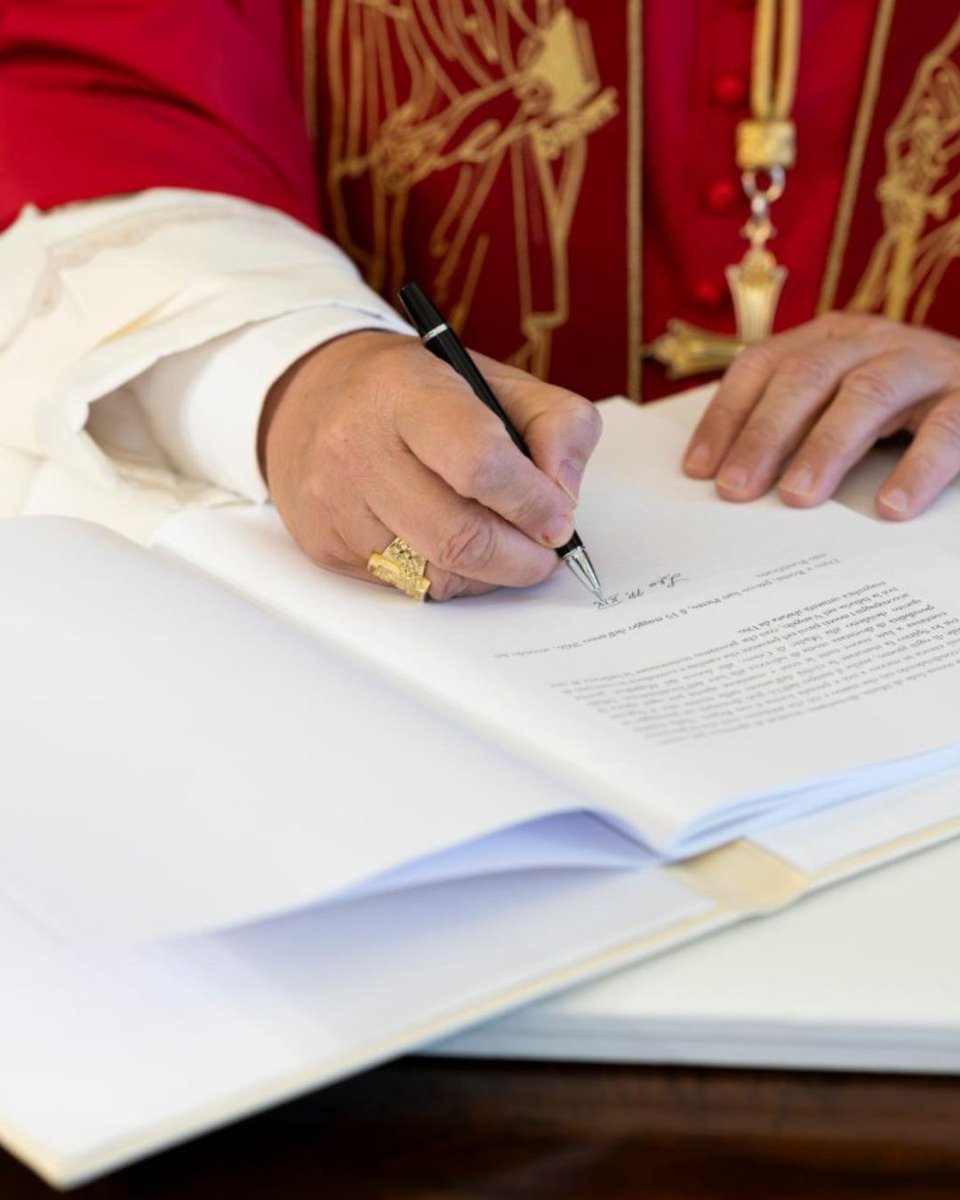
Pope Leo XIV has penned an encyclical letter calling for the disarmament of artificial intelligence. His biggest issue with the technology is the tech oligarchs putting profit before people.
https://t.co/5ULi3RB0ed
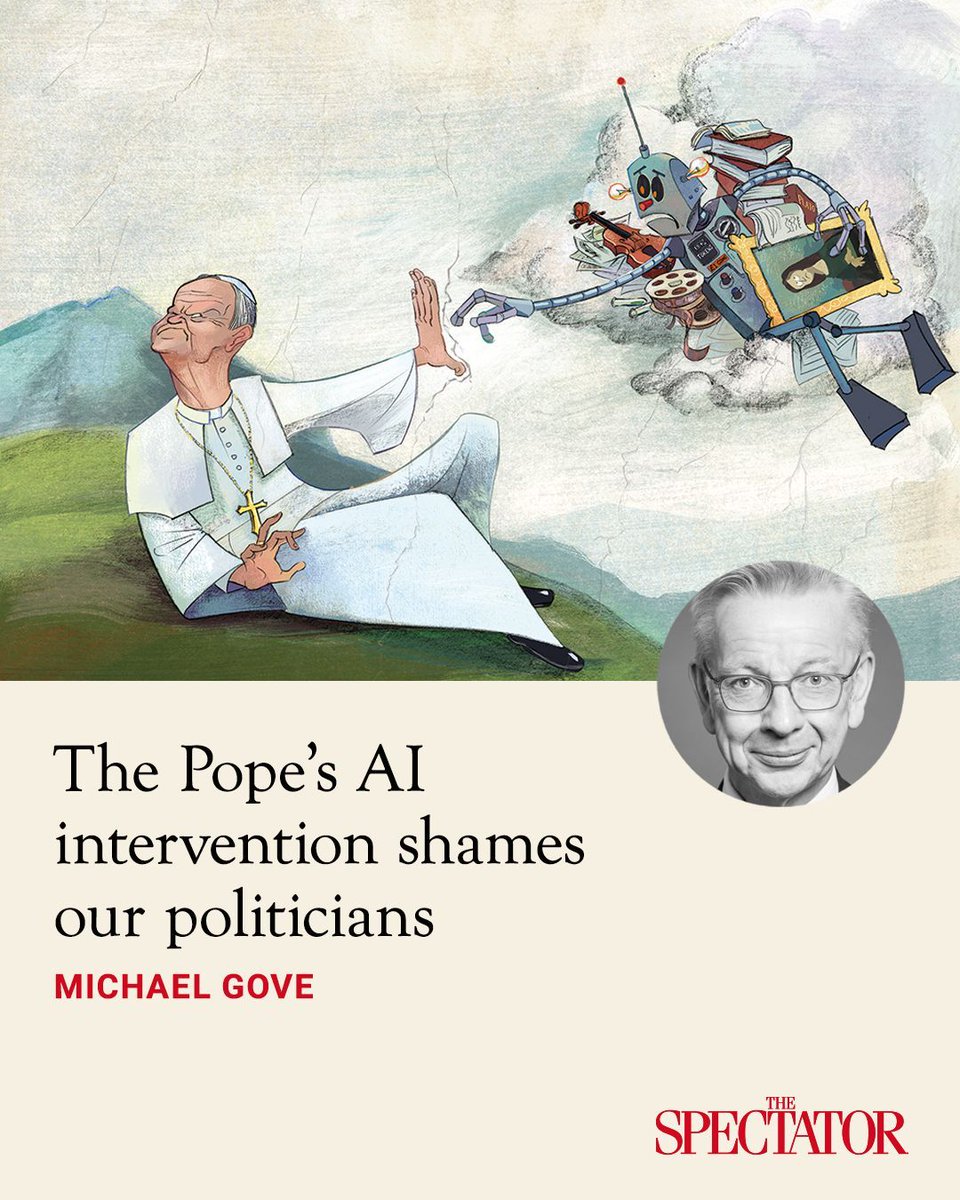
I was born into a sternly Presbyterian culture. Politically, I’m more Orange than Donald Trump’s skin tone. But today I am on my knees giving thanks to the Pope.
He has produced the most powerful political document of the year, taking on the greatest challenge of our times. His first encyclical, Magnifica Humanitas, deals with the changes which will be wrought to all our lives by artificial intelligence in the months and years ahead.
AI will transform our economies and societies massively and irrevocably; it will change what it means to be human; it may even mark the end of humanity itself. If it takes the Pope to alert us to this revolution then perhaps the Reformation wasn’t such a good idea after all.
✍️ Michael Gove
Article | https://t.co/ZZfyMFPFsX
Pope Leo XIV: "Among these ideologies, I consider particularly insidious the one that suggests that every person must earn or justify his or her own worth, to the point of attributing greater value to those who are more efficient or effective. From this perspective, persons end up being reduced to a means of achieving results, a resource to be used and exploited, and are no longer recognized as a proper end in themselves who should never be instrumentalized. The value of persons, however, does not depend on what they achieve or produce. There are rights that apply to everyone simply by virtue of being human, and no human power can legitimately deny or arbitrarily limit them." #MagnificaHumanitas
In the era of #ArtificialIntelligence, when human dignity is threatened by new forms of dehumanization, ours is the pressing duty to remain profoundly human. We must lovingly safeguard the grandeur of humanity bestowed upon us and revealed in its fullness in Christ, the splendor of which no machine can ever replace. #MagnificaHumanitas
https://t.co/6i9MWs6LJl
During the Wednesday General Audience, Pope Leo XIV greeted His Holiness Aram I, Catholicos of the Armenian Apostolic Church—See of Cilicia, who joined him on the stage in St. Peter’s Square. The Pope invited everyone to pray for peace in Lebanon and the Middle East and also highlighted how Catholicos Aram I’s visit is an opportunity to “strengthen the bonds of unity that already exist between us, as we draw closer to full communion between our Churches.”
Mit einem Ehepaar, das vor kurzem seinen 22-jährigen Sohn verloren hatte, betete Papst Leo XIV. heute Abend in Castel Gandolfo gemeinsam und spendete den Trauernden seinen Segen sowie Worte des Trostes. Vor seiner Rückkehr in den Vatikan nahm er sich Zeit für die Pilger.
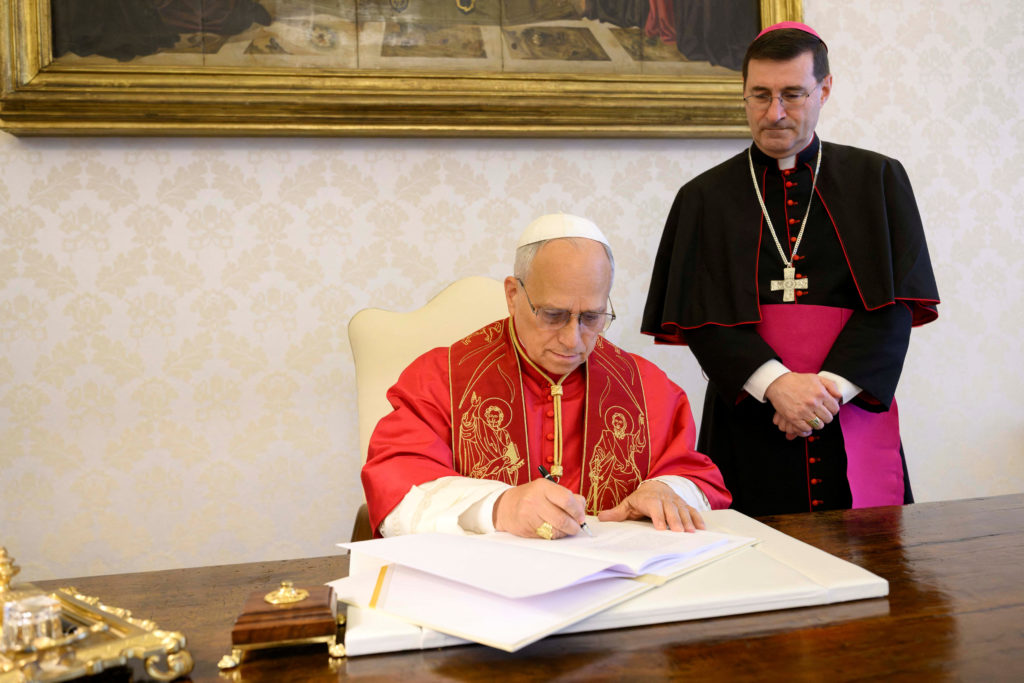
Pope Leo XIV will present a major Church document on artificial intelligence next week and he will be joined by Chris Olah, the billionaire co-founder of Anthropic.
Read more: https://t.co/7av1iWTAfc
Photo: Andreas Solaro/AFP via Getty Images
Zsolt Hegedus, the leading candidate for health minister in Hungary's new government, recreated his viral dance complete with air guitar moves on parliament steps as tens of thousands gathered in Budapest for Peter Magyar's inauguration as prime minister https://t.co/bvmvNMY9aU
Two months into his pontificate, a man named Robert Prevost picked up the phone from the Vatican and called his bank in South Chicago. He wanted to update the phone number on his account.
The teller asked the standard security questions, and he answered every one of them. Then her screen flagged his file: any further changes had to be made in person, at the branch, with a photo ID.
Coming in person would not be possible, he told her, in the polite tone of a man who knew the answer before he asked the question. The teller apologized.
He paused, then asked: “Would it matter to you if I told you I’m Pope Leo?”
She hung up on him. https://t.co/8tmnS3hg62
Winston Churchill fought his depression with bricks. He'd lay them for hours at his country home in Kent. He joined the bricklayers' union. And in 1921 he wrote about why it worked. It took psychology another 75 years to catch up.
He called his depression the "Black Dog." It followed him for decades. His method for fighting it back was as basic as it sounds: laying brick after brick, hour after hour.
Churchill spelled out his theory in a long essay for The Strand Magazine. People who think for a living, he wrote, can't fix a tired brain just by resting it. They have to use a different part of themselves. The part that moves the eyes and the hands. Woodworking, chemistry, bookbinding, bricklaying, painting. Anything that drags the body into a problem the mind can't solve by itself.
Modern psychology now calls this behavioral activation. It's one of the most-studied depression treatments out there. Depression sets a behavior trap. You feel bad, so you stop doing things, and doing less means less to feel good about. Feeling worse makes you do even less. The loop tightens until you can't breathe inside it.
Behavioral activation breaks the loop from the action side. You schedule the activity first, even when every part of you doesn't want to. Doing it produces small rewards: a wall gets straighter, a painting fills in, a messy room gets clean. Those small rewards slowly rewire the brain. Action comes first, and the feeling follows.
Researchers at the University of Washington put this to the test in 2006. They studied 241 adults with major depression and compared three treatments: behavioral activation, regular talk therapy, and antidepressants. For the people who were most severely depressed, behavioral activation matched the drugs. It beat the talk therapy. A 2014 review of more than 1,500 patients across 26 trials backed up the result.
Physical work like bricklaying does something extra on top of this. It crowds out rumination, the looping bad thoughts that grind people down during the worst stretches of depression. Bricklaying needs both hands and gives feedback brick by brick: each one is straight or crooked. After an hour you can see exactly how much wall you built. No room left for the mental chewing.
The line George Mack used in his post, "depression hates a moving target," is good poetry. The science behind it is sharper. Depression hates a brain that has somewhere else to be.