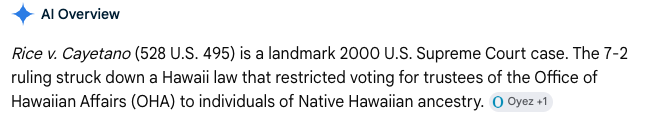
@bdubbs25 Now if you’re saying that the violation of the 15th amendment was not the PRIMARY reason that Rice won this case, then please share screenshots of your sources.
@bdubbs25 This is directly from Google’s search engine that allows u to click on its sources. It directly mentions a constitutional violation of 15th amendment
@bdubbs25 Idk if u seen my previous comment but I explained this exact scenario. We can see, in Rice’s case, he was denied his constitutional voting rights based off race/lineage,
What constitutional right would a non-descendant be prohibited from under a Federal Reparations Bill?
@bdubbs25 So then, why didn’t they say that earmarked funds for native Hawaiians were “illegal”? The ruling only determined that restricting the voter rights based off race was illegal. But we clearly see that the Justice spoke about “earmarked funds”
@Afro_Research Most ppl who dislike FBA, dislike it cuz it was coined by Tariq Nasheed and they have an issue with him. (For whatever reason) But to me, it’s a logical term that eliminates most confusion when u hear the term.
@Afro_Research confusion. Ppl are only confused by the word “Foundational”. Whereas African-American, well, Africa is a giant continent. And so calling someone “African” really doesn’t specify much especially since most Africans self-identify as a member of an ethnic tribal group.
@Afro_Research They can have that term. We should abandon it becuz it was given to us from the govt and it causes confusion. We know what it means but it isn’t specific enough to let’s say, a foreigner, who isn’t educated about our experience. Thats why I prefer FBA cuz it eliminates most…
@Afro_Research For over 300+ years but we’ll just say since 1789, which was the year the U.S. constitution was ratified into law. Thats 237 years, that we’ve been away from Africa. During that time, we developed our own culture here. Yes, we have remnants of African culture but…
@Afro_Research Delineation is important because the term “African-American” is a misnomer and ignores one crucial aspect…ethnogenesis. Just like Jamaicans, Haitians etc., we are a distinct ethnic group. Yes, we have African DNA but we’ve been removed, culturally, from Africa…
@bdubbs25 But maybe I'm missing something so plz explain how Rice vs Cayetano could even be used as precedent against Reparations. Cuz I'm just not seeing the similarities at all. Our reparations doesn't infringe or restricts the legal rights of ANY American citizens
@bdubbs25 Now that we both can clearly see this was a voting restriction dispute. Plz, help me find ANY similarity, correlation or viable comparison that this case would have as it relates to reparations for descendants of Freedman?
Our reparations bill has nothing to do with voting.
@bdubbs25 ok, let's walk this through step by step. Maybe I'm missing the correlation between a Voting Rights case and lineage specific governmental remedies that address past grievances. This is the general conclusion of Rice vs Cayetano, according to most law/web sources.
@bdubbs25 Specifically mentions that these resources are remedy for all the centuries of financial, physical and psychological stress that was inflicted on Freedman and their descendants. That tailors it to us exclusively
@bdubbs25 If a non-descendant of Freedman applied for reparations and were instantly denied, they would have no claim in court. Because how could they prove that they were a member of the aggrieved ethnic lineage? It’s not discrimination so long as the language in the Bill…
@bdubbs25 We can all clearly see that the court NEVER said that the earmarked funds were “illegal”. The illegality was forbidding Rice to vote. Which makes sense since Hawaii is under the legal jurisdiction of the U.S.
@bdubbs25 The government has precedent for restricting public resources to aggrieved groups. The Native Americans, the Japanese, Faith-based organizations (Jews) and most recently, 9/11 survivors as well as the families of victims. All aggrieved groups