Most traders will eventually see their account go parabolic after a life changing trade. It’s one of the best feelings in the market… and also one of the most dangerous.
Almost everyone goes through the same sequence: the big win, the sudden confidence, and the quiet urge to keep pressing size right away. The traders who last are usually the ones who recognize that urge for what it is and understand that it’s often the wrong time to act on it.
A few reasons this happens so consistently:
A life changing win frequently comes from a rare, oversized market move. Those kinds of candles don’t just appear every week. After they print, the market often needs time to digest. What follows is frequently chop, mean reversion, or dead money.
That said, many times there is genuine follow through. It’s not guaranteed, but when the setup is clean and you already have a meaningful profit cushion, the risk/reward can make selective continuation worth considering. The key is that this decision has to come from process, not from the emotional high of the previous win.
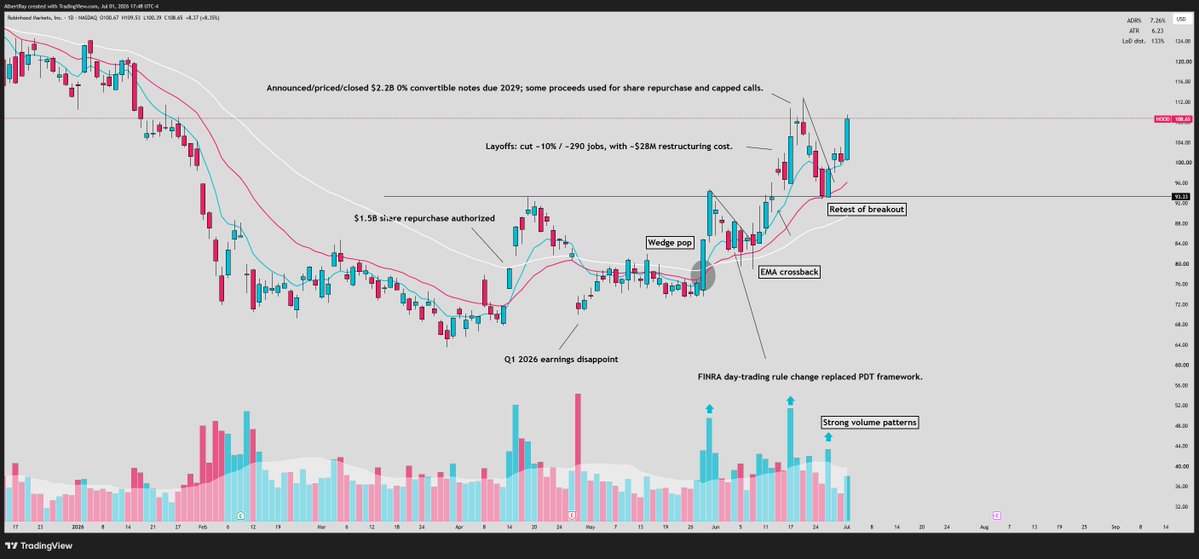
Last week was a good example. Look at the daily candle on $SPX. Moves of that magnitude are uncommon, and fully catching one as we did everytime this year is even rarer. The natural impulse afterward is to press. That’s typically when the next trap starts forming.
I wrote a longer note to the Fam about this exact dynamic after last week’s move, hoping to reduce the number of people who walked into it. It helped most. But ultimately no one can make these decisions for you.
This is one of those lessons that either gets learned the smart way… or the expensive way.
Let’s nerd.🤓🧠
Most retail traders miss this: big institutions trade completely differently, and it’s shaping the market more than you think. Worth the read if you want an edge.
Institutions and big money don’t trade the same way most retail investors do. Pension funds, large managers, and allocators often put serious capital to work through ETFs like $MTUM (momentum) instead of buying tons of individual stocks. It’s more efficient, scalable, and gives them clean exposure to themes or factors. One big inflow can mean buying across an entire basket of stocks at once.
Incredible Luc... I could talk about this concept all day.
Shift from an "opportunity scarcity" mindset to an "opportunity abundance" mindset!
Rather than feeling compelled to participate in every move, recognize that markets continuously generate new leadership, fresh bases + evolving trends.
This perspective will naturally improve patience, selectivity, and long-term consistency.
Renew the mind.
I curate my X feed.
If you're not adding value or spreading negativity, I'll unfollow or block w/o thinking twice.
I don't think I'm better than anyone... I just know whatever I feed my mind eventually shows up in my own life.
Zero tolerance for negativity.
Life's 2 short.
How to spot a stock’s “change of character” moment:
A change of character occurs when a stock starts behaving differently than it has been.
For example:
A stock that has been:
-Making lower highs and lower lows
-Failing at resistance
-Selling off on strength
Suddenly starts:
-Holding pullbacks
-Reclaiming key moving averages
-Making higher lows
-Breaking resistance on volume
That's a change of character.
The biggest clue is how the stock responds to bad news, market weakness, or pullbacks.
When a stock stops reacting negatively to bearish conditions, pay attention....
Many of the best moves begin with a subtle change in character before the crowd recognizes the trend has changed.
Price behavior changes first.
The headlines come later.
Just because everything breaks out at the same time doesn't mean I have to own everything.
I'd spend hours building a Focus List, then the market would open, and 5-6 names would trigger within fifteen minutes of each other. My first thought was always, "How am I supposed to progressively build exposure if they're all going at once?"
Now I actually view that as a good problem to have.
When that happens, I don't try to catch every breakout...but instead, I start ranking them!
Not every setup deserves the same amount of capital.
I immediately start asking myself:
- Which name has the biggest base?
- Which chart is giving me the tightest risk?
- Which one would I be most disappointed watching without a position?
- Which theme has the strongest institutional money flowing into it?
- Which stock has shown the most relative strength over the last few weeks?
Usually, those questions narrow my list down pretty quickly.
Then I simply start somewhere.
I always enter 1 position at a time.
Maybe I open a starter in my highest-conviction name, or maybe I take 2 half-sized positions instead of 1 full-sized position. Maybe I don't take anything if the open is too erratic and I wait for the first pullback.
There's no rule that says I have to own every leader.
Here's something else I've noticed...
When everything breaks out together, they rarely continue behaving identically. 1 stock will hold the 9EMA perfectly + another will immediately get too far extended intraday, another will fail + another will build a second base a week later!
That's where progressive exposure naturally starts kicking in.
The first breakout isn't always the only opportunity. In fact, a lot of my biggest adds happen after the initial b/o.
I'll let the first move happen, then if the stock builds a tight 3-5 day flag, pulls into the 9EMA, and gives me another 15/30 minute pivot off support, that's usually where I become more aggressive.
I don't need to own everything on Day 1. I just need to own the names that continue proving themselves time and time again.
This is also why my watchlist doesn't change much.
Names like $ARM, $MU, $SNDK, $DELL, $INTC ...I've watched them since the start of the year. Just because they break out doesn't mean I stop following them. If they're true leaders, they'll usually give multiple opportunities over the course of the trend.
That's something I completely missed early in my career.
I'd buy the breakout, sell it, cross it off my list, and move on...but now I do the opposite.
Leadership doesn't owe you one opportunity. It usually gives you several if you're patient enough to keep stalking it.
So if your entire Focus List is triggering at once, don't think of it as a problem.
Think of it as confirmation that your stock selection is improving, and your job now isn't to catch every breakout...
...it's to identify which leaders deserve your capital today, then let the market tell you which ones deserve even more of it tomorrow!
My 2 cents.
My biggest tip for this type of environment:
Learn how to find rotation in the market
You will be focusing on the stuff that's actually moving while everyone else is getting chopped up chasing leaders
Capital is constantly rotating between sectors, industries, and individual stocks.
When institutions begin taking profits in one area, they don't simply move to cash..
They often rotate into another group that's beginning to show strength
Your job isn't to guess where they'll go.
Your job is to identify where they've already started buying.
Here's how I do it:
1. Start with the major indexes
Before looking at individual stocks, determine the overall environment.
Are big tech caps getting sold? $QQQ
Is the the $DIA stronger than $QQQ ?
Likely rotation from large caps to defensive names
Is $IWM strong? rotation into small caps.. etc
2. Find the strongest sectors.
The narrative is constantly changing
First it was semis
Then memory
Now biotech..
Ask yourself:
"Which groups are making new highs while everything else is chopping?"
That's usually where institutions are putting money to work.
3. Find the leader within the leader.
Not every stock in a strong sector deserves your attention.
Every theme has stocks that lead...
...and stocks that lag.
I want the names making:
-New highs
-Tight consolidations
-Strong relative strength
-Above-average volume
-Clean trends above key moving averages
Those are usually the stocks institutions are accumulating.
4. Pay attention to red days.
This is where rotation becomes obvious.
When the indexes sell off, look at your watchlist.
Some stocks will completely fall apart.
Others barely move.
Some even close green.
That's valuable information.
Those stocks are telling you demand is overwhelming supply.
When the market stabilizes, these are often the first names to continue higher.
5. Build your watchlist every night.
I don't wait until the market opens to decide what I'm interested in.
Every evening I scan:
-Strong sectors
-Strong trends
-Relative strength
-Volume
-Stocks holding key moving averages
By the time the market opens, I already know where I want to focus.
Money flows from one group to another.
Your job is to identify where it's flowing today
Not where it was flowing last month.
The market leaves clues every single day.
Learn to follow the leaders instead of chasing the laggards.
That's where the biggest momentum moves usually begin.
Bookmark this for the next market pullback.
It might completely change the way you build your watchlist.
#education Intraday Sequencing
After the Trump TS headline, every risk asset got hit with the same algo candle lower. $SPY, $IWM and $BTC all sold off together.
The difference came on the next few 5-min candle
Bitcoin immediately started reclaiming the move while the equity indexes were still sitting at the lows. Within (4) candles, BTC had already closed back above the high of the news candle while the other were still lagging.
That divergence caught personally caught my attention, especially because $BTCUSD has been the leader on this most recent pullback.
#TradeJournal
I have a personal bias on $IWM, so I started buying calls, expecting it to play catch up to BTC's strength for a scalp trade.
And basically that's exactly what happened.
Now, this isn't some magic strategy and correlation breaks all the time. Bitcoin does not lead equities every day. But on high volatility sessions, paying attention to small anomalies between correlated assets can give you an edge for a scalp or a day trade.
For that reason, I always keep 5-min charts of $SPY, $QQQ, $IWM, $XBI, and $BTC on my screen. Sometimes the first clue isn't on the chart you're trading, it's in the others.
#Image
Notice how BTC reclaimed the algo candle high in 4 candles vs. the other names.