Keynesian stimulus has never worked, and never will, and the record proves it. Every. Single. Time.
Start with the New Deal. Roosevelt tripled federal spending between 1933 and 1940, and unemployment still sat at 14.6 percent in 1940. Seven years of pump-priming bought a decade the economists call the Great Depression.
Japan tried the same trick. Through the 1990s Tokyo ran ten separate stimulus packages, poured trillions of yen into bridges and roads to nowhere, and drove public debt above 130 percent of GDP by 2000. The reward was the Lost Decade, then a second one.
Then came 2009. Obama and his advisers promised the $831 billion stimulus would hold unemployment under 8 percent. It hit 10 percent in October 2009. They spent the money anyway on shovel-ready projects that the president himself later admitted were not shovel-ready.
You see the pattern? Politicians take resources out of the productive economy through taxes and borrowing, hand them to whoever has the best lobbyists, and call the shuffle "growth."
They count the spending. They never count what the money would have built if the private sector had kept it.
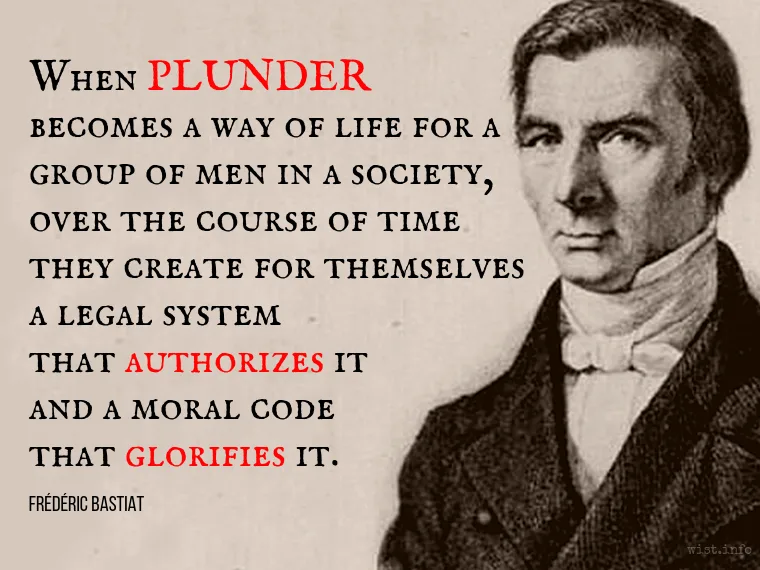
Frédéric Bastiat explained this in 1850 with the broken window. The stimulus crowd still hasn't read him.
The government cannot spend you into prosperity. It can only move wealth around and skim off the top.
They told you in 1989 that you had until 2000. Then the deadline moved to 2010. Then 2030. Noel Brown of the UN Environment Programme warned in 1989 that entire nations would vanish under rising seas by 2000. The Maldives are still there, building new airports and luxury resorts on the very atolls that were supposed to be underwater.
A scientific question does not require this much state coercion to enforce it. When governments want carbon taxes, subsidy regimes, and a 1,400-page Inflation Reduction Act to protect a theory, you should ask why the theory cannot defend itself.
Follow the money, because that is what economics actually teaches you to do. Al Gore co-founded Generation Investment Management in 2004 and grew his net worth past $300 million selling the panic he narrated in his films. BlackRock manages roughly $10 trillion and lectures you about ESG while collecting fees on every green fund it can package. The Bank for International Settlements coined "green swan" in 2020 to justify central banks intervening in capital allocation under the climate banner. These people are positioning. Every prediction of doom arrives bundled with a request for more of your money and less of your freedom, which is a curious feature for a disinterested measurement of atmospheric physics.
Consider the incentive structure inside the academy. A climatologist who finds the threat overstated loses his grant. A climatologist who finds catastrophe coming gets funded, published, and invited to Davos. Men respond to the rewards in front of them, and governments have spent decades rewarding alarm.
None of this proves the climate never changes. The climate has changed for four billion years without a single carbon credit. The honest position is humility about a chaotic system and contempt for the planners who claim they can fine-tune the global thermostat by taxing your gasoline and banning your stove.
They cannot run a post office properly, but you are trusting them with the temperature of the entire planet?.
In 1984, left wing economists declared the death of New Zeeland farming when free market reformers scrapped their system of agricultural subsidies and trade protections. But instead of collapsing, the market adapted – and prospered. Stripped of government aid and freed from stifling regulations, farmers innovated rapidly, reduced waste, shifted away from unprofitable products. Heavy reliance on sheep and wool was replaced by highly profitable and diversified dairy operations, viticulture, and horticulture. The reforms turned New Zealand into one of the most hyper-efficient, competitive, and profitable agricultural exporters in the world. The sheep population more than halved, from 70 to 30 million, while productivity jumped by 170%.
Contrast that with the European Union’s Common Agricultural Policy (CAP), a EUR 60bn policy which amounts to a massive distortion of the free market, replacing competitive dynamics with heavy-handed state interventionism. A vast subsidy system and protective tariff walls stifle innovation, misallocate resources, and harm consumers.
Perversely, subsidies are linked to land ownership and is completely disconnected from production of agricultural produce. Instead of responding to authentic consumer demand, farmers are incentivized to meet bureaucratic criteria such as Crop Rotation Requirements to secure government funding.
The system has delayed necessary structural modernization. In a free market, inefficient farms would consolidate or adapt; under the CAP, public money keeps uncompetitive operations afloat. An average EU farm generates between $19 and $28 of output per hour of labour compared to New Zeeland’s $45 to $60 per hour. While the Kiwi agricultural sector prospers, the EU is stuck with a system that forces taxpayers to subsidize their own artificially inflated grocery bills.
Two small island economies blew up in 2008. Iceland and Ireland. Their names differ by one letter, and their handling of the crisis differed by everything that matters.
Iceland's three big banks, Kaupthing, Landsbanki, and Glitnir, had grown assets to roughly ten times the country's GDP by 2008. Pure credit-fueled madness. When the music stopped, the Icelandic government did the unthinkable: it let them fail. Bondholders ate the losses. The state refused to socialize private bank debt onto 320,000 citizens who never signed up for it. Capital controls went up, the króna collapsed, and the politicians actually prosecuted bankers. Twenty-six of them went to prison. Sigurður Einarsson and Hreiðar Már Sigurðsson, the men who ran Kaupthing, served real sentences.
Ireland took the opposite road. In September 2008, the Irish government issued a blanket guarantee covering the liabilities of its major banks, including Anglo Irish Bank, a property-lending casino that should have been allowed to die in peace. The taxpayer absorbed the bill. By the time the rescue ended, Ireland had poured around 64 billion euros into its banks, roughly 40 percent of GDP. The state took on private gambling debts, then went to the Troika in 2010 hat in hand for an 85 billion euro bailout, and accepted years of austerity to pay for losses it had no business owning.
Both economies recovered. Both eventually grew again. The difference is who paid and who learned. Iceland made creditors and reckless bankers bear the consequences of their own decisions, which is the entire point of capitalism: profit and loss, not profit and bailout. Ireland protected the people who made the bad bets and handed the invoice to schoolteachers and shopkeepers.
You will hear economists call Ireland's GDP rebound a triumph (much of that "growth" is multinational accounting fiction, Leprechaun economics, but that's another lesson). What they skip is the moral architecture. When you guarantee bank liabilities, you abolish the discipline that makes markets work. You tell every banker in the country that downside is optional.
Iceland jailed its bankers. Ireland reimbursed theirs.
In 1968, while teenage Red Guards beat their professors to death with clubs in Beijing courtyards, Jean-Paul Sartre sat in Paris calling Mao's Cultural Revolution a model of revolutionary democracy. The most celebrated intellectual in France looked at a country burning its own libraries and saw liberation. He sold the Maoist newspaper La Cause du Peuple on French street corners himself, holding it aloft like a sacrament.
Consider what he was endorsing. Between 1966 and 1976, the Cultural Revolution killed somewhere between 500,000 and two million people. Schools shut down across the entire country. Students dragged teachers onto stages, hung placards around their necks, forced them to kneel on broken glass, then murdered them. The historian Bian Zhongyun, vice-principal of a girls' school in Beijing, died on August 5, 1966, beaten by her own students with nail-studded clubs. Sartre called this the people governing themselves.
You should understand why a man this intelligent got it this wrong. Sartre believed knowledge served power, that truth was whatever the revolution required, that the individual existed to be dissolved into the collective will. So when Mao abolished the distinction between teacher and student, between expert and mob, Sartre cheered. He had spent decades arguing that bourgeois reason was a class weapon. Here was a regime taking him at his word and clubbing the reasoners to death.
This is what economic illiteracy buys you. A university, a price, a contract, and a peasant's grain stockpile all carry knowledge that no central planner can seize or replicate. Mises explained the calculation problem in 1920. Hayek explained dispersed knowledge in 1945. Sartre had access to both and chose the dunce cap of the collective instead, then handed out its propaganda on the Rue de Rennes.
He died in 1980, mourned by 50,000 followers, never having retracted a word about Mao. The professors of Beijing got no such funeral. They got a ditch, and a philosopher in Paris explaining that their murder was freedom.
McDonald's announced they're replacing cashiers with kiosks in California just after the $20 minimum wage kicked in. Shocking to absolutely no one who understands basic economics. When you artificially price labor above its market value, employers find substitutes. Machines, automation, or they simply eliminate positions entirely.
The teenagers who desperately need that first job experience? Gone. The single mother trying to re-enter the workforce after years away? Priced out by someone with more skills. You've just created a legal barrier that prevents the least skilled workers from competing on the one thing they had going for them: willingness to work for less while they build experience.
Politicians pat themselves on the back for "helping workers" while unemployment among young minorities hits double digits. The workers who keep their jobs benefit (temporarily), but the invisible victims, those who never get hired in the first place, don't make headlines. Economics doesn't care about your good intentions.
Ethiopia was never colonized.
For much of its history, it was one of the poorest countries on the continent.
Meanwhile, Vietnam was colonized by the French, devastated by decades of war, and is now on its way to serious economic prosperity.
If colonialism were the answer to why Africa is poor, Ethiopia should be rich and Vietnam should be broke. Neither is true.
Can we please retire this excuse?
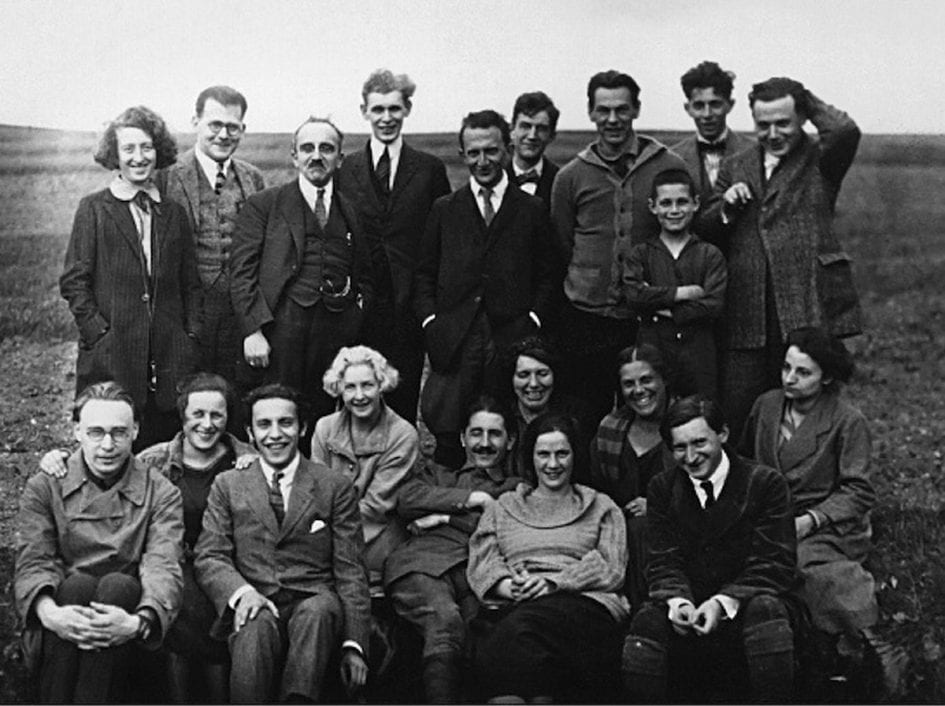
By the 1930s many Western intellectuals reluctantly realised that classical Marxism had failed and the proletariat wasn’t revolting. But then a group of exiled German Marxists led by Max Horkheimer, Theodor Adorno, Erich Fromm and Herbert Marcuse decided to change the battlefield.
Instead of economics, they targeted the “cultural superstructure”: family, religion, tradition, sexual norms and the very idea of objective truth. Their weapon was Critical Theory - a relentless campaign of negative criticism designed to portray every Western institution as inherently oppressive and capitalism as not just economically flawed, but psychologically and morally corrupt.
Marcuse gave the strategy its most powerful tactical manual in his 1965 essay “Repressive Tolerance”: true liberation, he argued, required “liberating tolerance” - tolerance only for progressive ideas and outright intolerance for conservative or “regressive” ones. Free speech, in other words, was only legitimate when it served the revolution.
The intellectual poison of the Frankfurt School was extraordinarily influential and as its graduates and intellectual heirs colonised universities, media, NGOs and corporate HR departments, Critical Theory evolved into today’s identity politics, DEI mandates and cancel culture - a cultural Marxism that attacks the individual in the name of group grievance. What began with a small circle of German émigrés in the 1930s now shapes the moral vocabulary of much of the Western elite. The result has been a softer, more pervasive authoritarianism: the dictatorship of the politically correct.
A top concern for the overwhelming majority of Brits is legal and illegal migration.
So following the local election results, Keir Starmer has brought back the man who called a Gillian Duffy a “bigoted woman”.
She only said what many others have said.
BRO WTF 🤬
The dog clocks the gunman right away and follows the shooter into another room twice.
The dumb ass guard just walks away.
1/2 a second later the shooter runs out of the same room with a rifle in his hand.
We should ban foreigners from claiming benefits, and remove migrants who are incapable of financially supporting themselves - use those many saved billions to slash tax for the British men and women keeping the economy running.
We must put our own people first.
Finally.
Capital gains tax represents one of the most egregious examples of double taxation in the federal code, yet politicians treat it as if they're taxing "unearned" income for the first time.
You earn $100,000, pay income tax on it, and save $70,000 after Uncle Sam takes his cut. You invest that already-taxed money in stocks, real estate, or bonds. Ten years later, you sell for $140,000. The government swoops in again, demanding capital gains tax on your $70,000 profit. They're taxing the same economic activity twice: your initial productive work that generated the savings, then the delayed consumption that made investment possible.
Capital gains represent nothing more than the time value of money plus compensation for risk. When you save instead of consume immediately, you defer gratification to provide capital for productive investment. That $70,000 you invested didn't sit idle; it funded business expansion, job creation, and economic growth. The return you earned reflects both the productive use of that capital and inflation's erosion of purchasing power over time.
The double taxation becomes even more perverse when you consider inflation. If your $70,000 investment becomes $140,000 over ten years, but inflation averaged 3% annually, your real purchasing power increased by roughly $18,000, not $70,000. Yet the IRS taxes the entire nominal gain, including the portion that merely kept pace with their own monetary debasement.
Every dollar collected through capital gains tax is a dollar stolen twice; once from your labor, again from your thrift.
Trans-identified female lawyer berates judge, pulls trans card, gets found in contempt, resists arrest, screams “I can’t breathe,” and yells for people to call 911 as she’s fighting police.
Absolutely glorious performance.
Women should not take testosterone.
We will not lie to the British people. Restoring Britain will require decisions that are controversial and unpleasant.
We are going to strip millions of healthy Brits who refuse to work of benefits. If that causes outrage from those who think the taxpayer owes them a living, so be it.
We are going to deport all illegal and burdensome migrants. If that means millions go, so be it.
We are going to outlaw incompatible cultural and religious practices. If that means those who refuse to integrate no longer feel welcome, so be it.
We are going to execute pedophiles, rapists, and murderers if that is what the British people want. If that means we are condemned by subversive "human rights" groups, so be it.
We take no pleasure in these measures. It is a damning indictment of our political class that they are necessary in the first place.
But necessary they are.
Capitalism lets you pursue any field you want.
What it doesn’t promise is that other people will be forced to pay for it.
If you want to make a living doing something, others have to voluntarily value it enough to buy it.
That isn’t suppression of dreams. It’s the absence of coercion.
Capitalism says: pursue whatever you want, but earn support voluntarily.
Socialism says: pursue what's dictated, and we’ll force others to fund it.
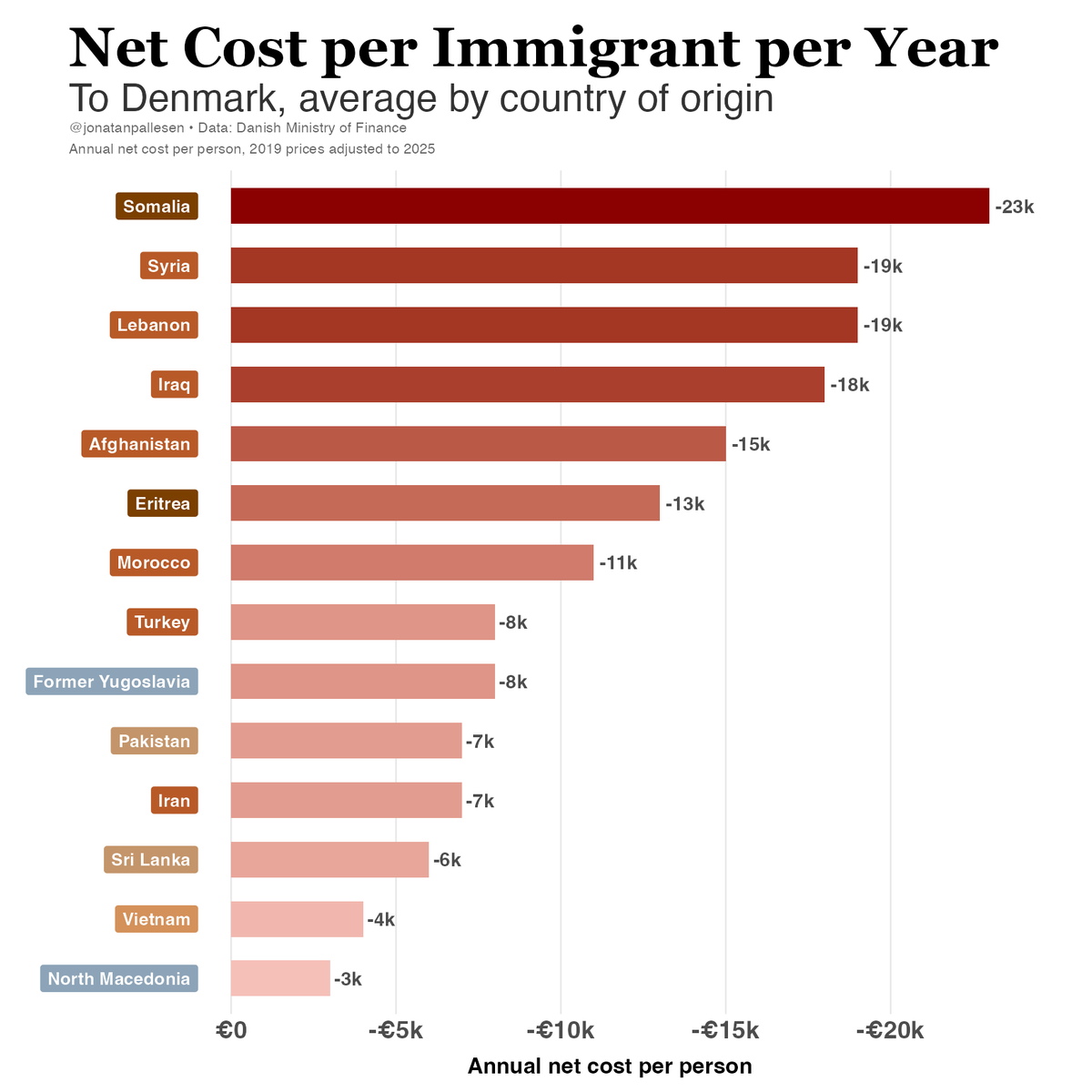
There are 68,000 Turks in Denmark.
Over the next 50 years Danes will spend €27 billion sustaining these migrants.
Denmark could deport the 33,000 without citizenship and save €13 billion
And pay the other 35,000 with citizenship €100,00 to leave and save €11 billion more.
Remigration is the fiscally responsible policy.
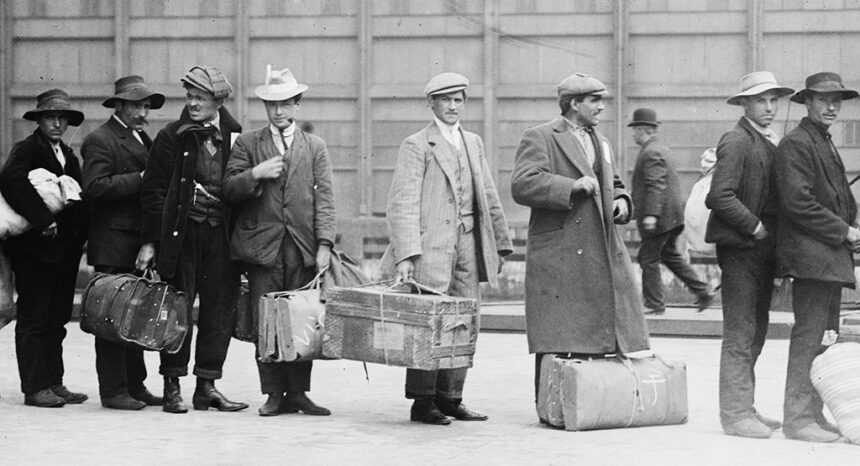
19th century America had virtually no welfare state, minimal regulations, and a federal government so small you could fit it in a few buildings. And what happened? The greatest economic boom in human history, with immigrants literally flooding in from around the world to participate.
People weren't fleeing TO America for government handouts—they were fleeing FROM the suffocating bureaucracies of Europe to a place where you could actually build something without asking permission from seventeen different agencies.
But today's intellectuals have convinced themselves that this was all some historical accident. That prosperity happens DESPITE economic freedom, not because of it. The same people who can't figure out why housing costs so much in cities with 47 different zoning boards somehow think they've improved on the formula that built the modern world.