People who believe China has run out of profitable infrastructure projects haven’t heard of the 红旗河工程, ie routing water from Tibet to Xinjiang (whose recent desertification was due to overdrawing of ground water).
The Motuo project (not a dam) is a small down payment.
@pmarca And that would be a wonderful way to ship knowledge jobs abroad where they can use cheap models to do the work and send the results back to US.
Apparently sending manufacturing jobs overseas is not enough.
The US government, citing national security authorities, has issued an export control directive to suspend all access to Fable 5 and Mythos 5 by any foreign national, whether inside or outside the United States, including foreign national Anthropic employees.
The net effect of this order is that we must abruptly disable Fable 5 and Mythos 5 for all our customers to ensure compliance.
Access to all other Claude models is not affected.
We apologize for this disruption to our customers. We believe this is a misunderstanding and are working to restore access as soon as possible.
Read our full statement: https://t.co/bwn0sximKZ
@SantiagoAuFund@LukeGromen SPR draw down is 1.14-1.4 Mbpd (Google), which looking at that chart, accounts for all the export increase. Which also means there is no organic increase in production. Not surprising given the level and volatility of the price signal.
🇺🇸Latest from CNBC claims “China poaches AI talent from the U.S.”
Look at the actual names and backgrounds they cite, though. Every high-profile case involves a Chinese national who did an undergraduate degree at Tsinghua or somewhere equivalent, earned a PhD in the United States, worked at OpenAI, Google DeepMind or Meta AI and has now returned or moved to a major Chinese company.
That’s not poaching. That’s diaspora talent coming home as the incentives change.
CNBC’s piece leads with Yao Shunyu, the former OpenAI researcher now Chief AI Scientist at Tencent. He’s talking openly about building long-term AGI capability inside China, foundational models, agents, what he calls the next “super-app” opportunity worth trillions and he’s just 27. Tsinghua Yao Class undergraduate, Princeton PhD, a stint at Google, then OpenAI in San Francisco.
China’s domestic system drives much of this. The gaokao produces millions of high scorers from a vast population trained hard in STEM. The strongest candidates from places like Tsinghua often go abroad for additional frontier exposure or prestige because the competition at home is so fierce. U.S. universities have logical reasons to take them.
These students typically pay full tuition without government loans or heavy aid packages, making Chinese cohorts among the highest net revenue contributors on campus. They also arrive academically prepared, strong in quantitative fields and research fundamentals. They help to sustain PhD pipelines in computer science, engineering and AI at a time when fewer domestic Americans pursue long research tracks when industry salaries are high right after undergrad.
The same pattern runs through every other name they mention.
Yang Zhilin, born in Shantou, Tsinghua undergraduate, CMU PhD, time at Google Brain and Meta AI, now running Moonshot AI and the Kimi model in Beijing. Wu Yonghui, long-time Google researcher who rose to Google Fellow and VP of Research at DeepMind in California, now heading foundational research at ByteDance’s Seed team. Hao Zhou, Chinese national with top domestic scholarships, Wisconsin-Madison PhD, key contributor to Gemini at Google DeepMind in the Bay Area and recently joined Alibaba’s Qwen team on post-training.
The article itself notes that uncertainty over U.S. immigration policy is pushing Chinese nationals to return, even when the pay is lower. It also mentions China ramping up basic research spending. Both points are correct, but the framing wrapped around them is not.
For years the U.S. AI ecosystem drew heavily on exactly this cohort: top Chinese students and researchers trained at its best universities and labs. That flow was celebrated as proof of American openness and attractiveness. Now that some of it is reversing as China’s own ecosystem scales, the same movement gets labelled “poaching.”
The approach has always been straightforward: send talent abroad to absorb what’s at the frontier, build domestic capacity at the same time, then create conditions for knowledge and people to come back when the domestic game becomes more interesting.
China’s top universities, Tsinghua and Peking especially, have climbed global rankings rapidly in recent years, particularly in STEM and engineering. They now compete at the highest levels. That improvement lines up with declining Chinese enrolments in the U.S., alongside visa friction and costs. Chip export controls, visa scrutiny and the sheer scale of China’s application opportunities across manufacturing, consumer internet, infrastructure and data are all accelerating the return right now.
What these researchers bring back matters. Yao is importing the aggressive AGI timeline thinking that dominates parts of the U.S. conversation. At the same time he’s operating inside a system that prizes reliable performance at scale, lower inference costs and rapid deployment across real-world use cases. That combination of frontier ambition and China’s engineering and deployment advantages is exactly what the article is quietly documenting, even while it reaches for the “poaching” headline.
Talent moves to where the interesting problems, resources and long-term runway are. Right now China has all three in AI, plus the political will to treat it as a national priority for the next five-year cycle and beyond. The U.S. still has enormous strengths, but it is also generating new friction for the very people who helped build its lead.
The real story isn’t theft of American genius. It’s the predictable outcome of two large systems competing for the same mobile, highly trained human capital, while one of them, the one doing the alleged “poaching,” is also the one that educated and sent out a large share of that talent in the first place.
When will the coverage stop using loaded language and simply report that Chinese researchers, trained in America, are returning home to innovate, bringing their pioneering spirit with them?
Read the CNBC article here: https://t.co/vIix4QmWeJ
@DavidLe76335983 The key will be enforcement esp secondary sanctions. NXP is in the auto semi biz, so force its customers to chose between NXP and the Chinese market and any JV with Chinese automakers, and potentially the Chinese auto supply chain.
Alex Lo in SCMP on the rising “China-maxxing” phenomenon among young Westerners, and on why it isn’t really about TikTok aesthetics. It’s about a generation that has watched the West tear off its mask in Gaza, in Iran, in the Caribbean, in ICE detention facilities, and concluded that the social-moral-ideological hierarchy it grew up being told to take for granted does not actually exist.
The comparison the younger generation is making isn’t between China and some imaginary frictionless Western liberal democracy. It’s between China and the West we can actually see. A West that has armed, financed and politically protected a genocide that has killed more than 75,000 people. A West whose largest power runs over 240 immigration detention camps – scholars are now calling them concentration camps.
The China-bashing era required two things: that the West retain its status at the top of an ethical hierarchy, and that audiences keep buying that narrative. Neither survives Gaza. Neither survives the war on Iran. The generational shift “China-maxxing” describes is, fundamentally, the moment a generation has realised it was sold an account of the world that wasn’t true.
A lot of people seem to think that Huawei has side-stepped EUV and developed a method to scale to 1.4nm without it
But as u can see from their graph, a huge density & clock speed jump happens between 2030 & 2031
After the 2019 sanctions, Huawei started project Mount Everest in 2020
The goal was to develop and mass-produce EUV machines within 10 years
The tentative date of China's EUV is 2030 rn
Yet another striking illustration of just how ideologically rigid the West has become compared to what we used to be.
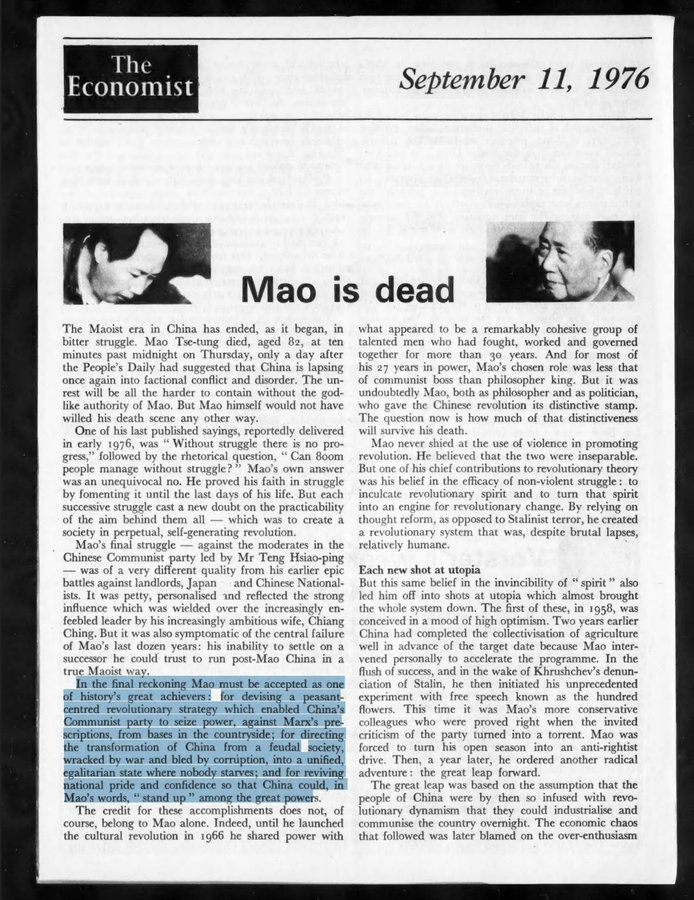
This was the obituary The Economist published for Mao in 1976 - at the height of the Cold War.
Read this part:
"In the final reckoning Mao must be accepted as one of history's great achievers: for devising a peasant-centred revolutionary strategy which enabled China's Communist party to seize power, against Marx's prescriptions, from bases in the countryside; for directing the transformation of China from a feudal society wracked by war and bled by corruption, into a unified egalitarian state where nobody starves; and for reviving national pride and confidence so that China could, in Mao's words, 'stand up' among the great power."
Show this text to any Economist "journalists" today - without telling them it's from their own paper - and they'd reply: surely it's "CCP propaganda" 😏
Yes, incredible as it may sound, there used to be a time when Western journalists could assess a geopolitical rival honestly and respectfully without being accused of being a traitor. And this honesty was in no small part a key factor why the West won the Cold War.
Today we call honest assessment "propaganda," and we harass, smear, and blacklist people for it. And we're puzzled why the West is in steep decline.
Truth matters.