Important : Demandez votre visa canadien en ligne de façon sécuritaire au moyen du site d’IRCC, la seule source officielle d’information sur les programmes et services d’immigration du Canada.
Ne prenez pas le risque d’utiliser des services tiers non autorisés qui pourraient vous arnaquer et vous fournir la mauvaise information.
Apprenez comment vous protéger de la fraude et des arnaques en matière d’immigration : https://t.co/c1EZOzm45o
Glad to be part of the publication that provides clues for the role of epigenetics in the asymmetric expression of bZIP in temperature-stressed bread wheat led by the first author @BaidwanRaminder 👏👏from Dr. Vikas Rishi's lab.
@NABI_India@DBTIndia
https://t.co/oMufwkgrwa
Identifying the genetic and epigenetic basis for asymmetric bZIP expression in temperature-stressed bread wheat https://t.co/SFqcZdn655 #biorxiv_plants
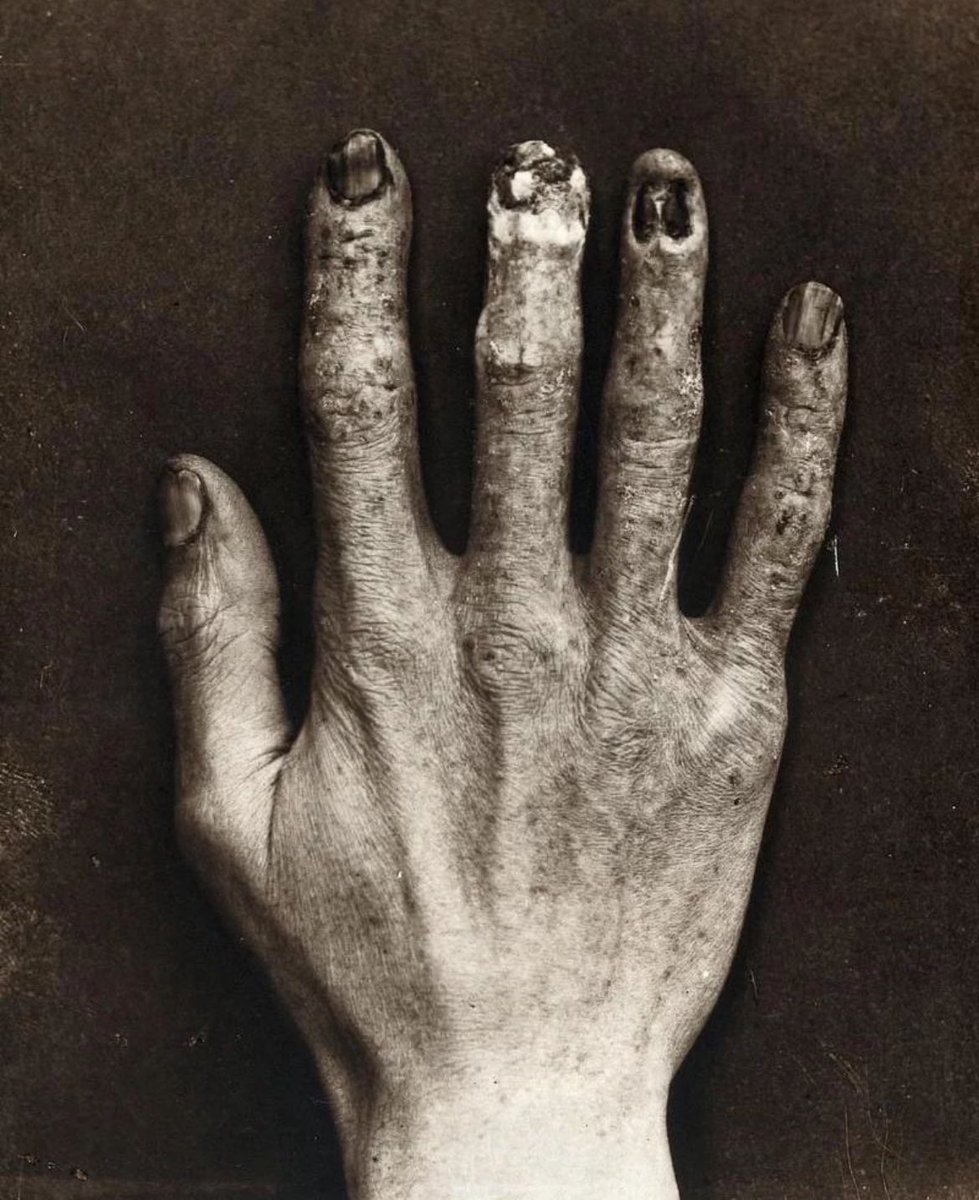
Hand belonging to an X-ray technician at the Royal London Hospital, which shows the damage from radiation exposure, 1900.
Every morning, they would calibrate the machines by taking an X-ray of their hands. So you might be wondering, why not just use something else to test the X-ray? Like a piece of meat or a chicken leg? Well back in 1900, people didn't know the dangers of radiation exposure so they thought it would be harmless to use their hands. During this time, people could even purchase and build their own X-ray at home for entertainment purposes. Those who did, however, often went on to develop cancer or suffer from amputations.
The X-ray had been discovered just a few years before in 1895 by a man name Wilhelm Conrad Röntgen, a German mechanical engineer and physicist. He named it X-ray because he actually didn't have a name for his invention and decided to use the mathematical designation "x" for something unknown. In some European countries, X-rays are actually called Röntgen rays.
Röntgen did not seek patents for his discoveries because he wanted society to benefit from the practical applications of X-rays. In 1901, Röntgen was awarded the first Nobel Prize in Physics.