I’m past pretending to care about niceties. I wish on anyone what they wish on Palestine. For me, Palestine marks the moral line between being human and being monstrous. Whether you have children, or parents who "lost" you, whether you're white, black, brown, wherther you're human or ape, go ahead and stand with a genocidaire and you forfeit any claim to my sympathy.
Actually...Good riddance.
Momentum maulid mengingatkan kita akan amanat besar: membela kaum tertindas dan menghidupkan risalah Nabi dalam kehidupan nyata. https://t.co/UycWAqKIt4
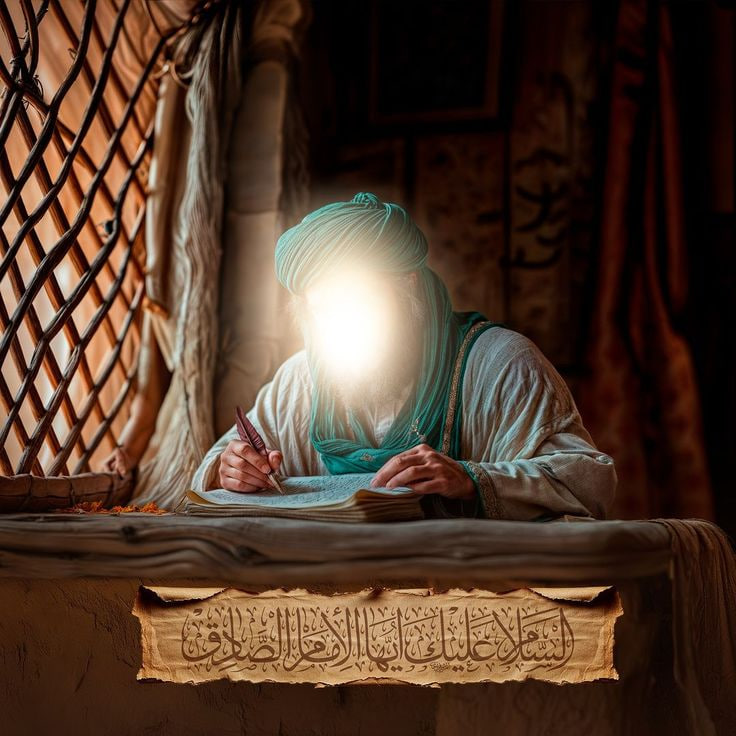
Imam al-Sadiq’s political role during the Umayyad and Abbasid periods
He was more than scientist
The Ummayad and Abbasid regimes being corrupt, brutal and tyrant regimes, they would not only use force to maintain their position and preserve ruling whenever an opposition rises, but also use other tactics to ensure that no opposition rises, where people remain misguided, intellectually weak, obedient… And what means they could use to achieve such agenda? Through intellectual oppression, spread of rumors, fabricating narrations and hadiths in for their own benefit or even creating their own narrations and hadiths to serve their interests (propaganda), they used brutal and harsh methods to punish people and widespread fear to ensure no one ever dares to challenge them.
Especially in times of Ummayad, their image shattered after the tragedy in Karbala when Imam Hussein (AS), his companions, some of his family were killed by Yazid (curses be upon him), after that tragedy, their image became very weak and they had to resort to lies, fabrications and propaganda to help and boost their image and status. Similar to how today’s powers, after committing massacres, genocide, brutal and heinous crimes, they begin losing public support and public opinion begins shifting, leading to boycotts, protests and so on, they resort with propaganda, media campaign to regain or maintain what’s left from the support.
Imam Ja’far al-Sadiq (AS) lived both periods, Ummayad and Abbasid, and he faced challenges from both regimes. In his time, the Ummayad were declining and the Abbasid state was slowly forming, it allowed the Imam to stay away from any open political conflict. During these times and especially in times of Abbasid, the Imam carried out his political role carefully, rather than aiming for an open uprising against the regimes, he rather focused on building and strengthening the intellectual and religious foundation for the Shia movement. The Imam resisted injustice, resistance not by the sword and direct confrontation, but by emphasizing scientific and cultural development, covering all branches of knowledge, including Quranic sciences, Hadith, jurisprudence, theology, philosophy, chemistry, and medicine. Because of this, the era of Imam al-Sadiq is seen as a time of intellectual and cultural openness for the school of Ahl al-Bayt (peace be upon them), especially compared to earlier periods in Islamic history.
At the same time, the Imam worked through his educational and cultural institution to achieve an important goal, and that is shifting the society from political and military confrontation to peaceful engagement, from violence to method of intellect, dialogue, reasoning, fostering unity based on love, cooperation, mutual support, self-improvement, and awakening both individual and collective conscience regarding the ongoing matters in that time, regarding the true Mohammadi Islam, when it was being exploited by the rulers to preserve their power, along with confronting some belief deviancy that was spread among some Muslim groups in that time.
In that time, many misguided groups and sects emerged which promoted ideas that contradicted Islam and undermined its religious, political foundations and principles. Imam al-Sadiq (AS) countered such phenomenon with advancing the philosophical thought, exposing and refuting such falsehood of those misguided sects.
Confronting such deviation, misguidance and falsehood carries the same importance as confronting enemies with swords, as such deviancy posed a serious threat to Islam where falsehood gets mixed with truth.
This shows that the Imam’s scholarly movement carried clear political weight, going beyond religious study to awaken society, strengthen its intellectual awareness, and give it the tools to recognize a just ruler from an unqualified one. In doing so, he filled the dangerous intellectual vacuum of his time.
Imam al-Sadiq (AS):
"Avoid disputes in religion, for they distract the heart from remembering Allah Almighty, lead to hypocrisy, foster grudges, and permit lying" - Mizan al-Hikma, vol. 1, page 748
The Imam also said:
“Do not quarrel with people, for if they could love us, they would. God has taken the covenant of our Shia as He took the covenant of the prophets, and no one can increase or decrease them” - Bihar al-Anwar, vol. 2, page 134
Just because he had no military role, does not mean he avoided politics and had no say over the injustice taking place by the Abbasid. Imam al-Sadiq (AS) worked to clarify that implicit recognition of the ruling political reality does not mean legitimate approval of it or acknowledgment of its authority. It is not a call for submission or compromise with the ruling power but rather allows one, as a citizen, to fulfill duties and maintain responsibility. For this reason, Imam al-Sadiq (AS) recognized the legitimacy of resistance within a peaceful framework. Imam al-Sadiq (AS) worked to correct misconceptions about the legitimacy of cooperating with authority, primarily to the extent necessary for the responsibilities assigned to him, according to limited guidelines, to achieve public benefit by establishing justice, preventing harm and oppression, and showing kindness to the people.
Imam al-Sadiq (AS):
“Do not humiliate yourselves by abandoning obedience to your ruler. If he is just, ask God for his protection; if he is unjust, ask God for his reform. Your welfare lies in the welfare of your ruler. A just ruler is like a compassionate parent, so love for him what you love for yourselves, and dislike for him what you dislike for yourselves” - Al-Amali by al-Sadooq, page 418
Although Imam al-Sadiq (AS) did fight any war, it does not mean that he had no political role, nor that he distanced himself from politics and focused solely on worship, jurisprudence, Islamic law, and science. He exposed the injustice and corruption of the Abbasids, protected Islam’s core teachings from alteration and distortion, and strengthened the development of an aware Shia community that could stand firm against oppression while avoiding impulsive or misguided uprisings.
Unfortunately, some people today, still have this view that the Imams were not political and completely refrained from anything political… Why? Because there was no direct military confrontation between them and the Ummayad or Abbasids. They use this misunderstanding as a justification for complete submissiveness to today’s Abbasids, today’s oppressive rulers, normalization with tyrants and legitimizing them. In reality this distorted view erases the true mission and approach of the Imams (AS) and ignores that their resistance which still continued even after Karbala, but it took different forms, varying from clarification, guiding the people, preserving the integrity of Islam, and exposing the corruption of unjust authorities.
👤 Rydro (Abbas)
✍️ Birth anniversary of Imam al-Sadiq (AS)
🗓 17th of Rabi’ al-Awwal, 1447 - 10th of September, 2025
bila cinta kepada Nabi Muhammad ShallaLlâhu alaihi wa âlihi was salam sungguh² menghiasi hatimu, maka kau kan menapaki hidup yg penuh keindahan hingga detik terakhir nafasmu
اللَّهُمَّ صَلِّ عَلَىٰ مُحَمَّدٍ خاتَمِ النَّبِيِّينَ، وَتَمامِ عِدَّةِ المُرْسَلِين
#AlwaysSayShalawat
Allahumma
Ya Allah,
cukupkanlah aku dengan yang halal dari-Mu sehingga aku tidak membutuhkan yang haram,
dan perkayalah aku dengan karunia-Mu sehingga aku tidak membutuhkan selain-Mu.
Mudah-mudahan dikabulkan doa² kita dengan keberkahan Sayyidul Wujud ShallaLlâhu alaihi wa âli
...bacalah ayat tersebut sebanyak 7 kali, kemudian lanjutkan dengan doa ini juga 7x
اللَّهُمَّ اكْفِنِي بِحَلَالِكَ عَنْ حَرَامِكَ، وَأَغْنِنِي بِفَضْلِكَ عَمَّنْ سِوَاكَ
Allahumma akfinî bihalâlika ‘an harâmika wa aghninî bifadhlika ‘amman siwâk.
... artinya: 👇
Saya mengakui Zionisme sebagai terorisme Yahudi dan saya menolaknya, dan mengirimkannya membusuk di neraka, tempatnya seharusnya.
...
✍️ @alon_mizrahi
[silakan klik link di atas untuk baca selengkapnya, semoga bermanfaat]
... ... ...
{kutipan}
Saya terlahir sebagai seorang Yahudi dari garis keturunan panjang Yahudi Arab dan Sephardi dari Maroko dan Palestina. Saya membenci hak istimewa, termasuk dan terutama yang dipaksakan kepada saya oleh Barat yang sakit dan ideologi Zionisme yang lebih sakit.
Saya tidak menginginkannya. Membayangkan menakut-nakuti seorang anak sedetik saja membuat saya marah. Saya tidak mengerti bagaimana seseorang bisa menerima apa yang dilakukan Israel dan tidak terguncang sampai ke akar-akarnya.