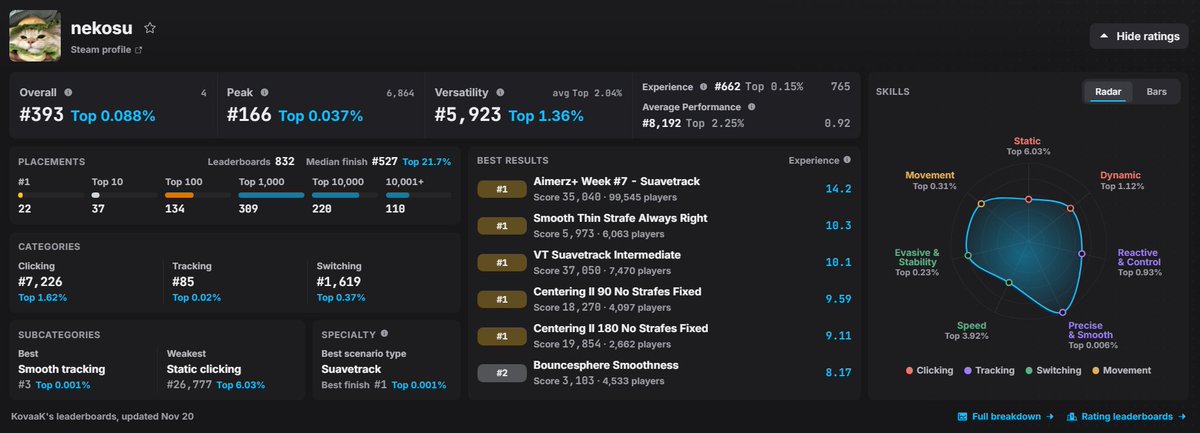
VT ArcTrack Dodge Intermediate - 4,541 (Elusive)
VT Antispiral Intermediate - 4,006 (Elusive)
the movement benches are pretty fun, prob will grind these more
That said, someone has brought this up, and it’s something I was already planning to look into. So I’ll be looking for professional ADC evaluation kits for ENOB testing. I’ll do my best to tell players roughly how many effective bits they can expect from their selected sampling setting, and how close that comes to fully utilizing the resolution that mainstream stick modules can deliver.
However, all of these figures will still be approximate, because actual operating conditions vary too much to give an exact value for everyone.
This is also why we switched to a different MCU for the production version of HS2. Our goal is to achieve a higher effective number of bits, and we’ve placed particular emphasis on reworking and optimizing the circuit design. We also offer an oversampling option, allowing players to trade speed for greater precision.
In practice, all of these improvements are only just enough to fully capture the 13–14 bits of effective resolution offered by today’s mainstream thumbsticks. I believe every one of these changes is necessary.
Native 16-bit sampling does not guarantee that the complete controller achieves 16 bits of effective resolution, nor does it automatically translate into a “16-bit experience.” Native bit depth describes the ADC’s quantization scale, while actual effective performance must be evaluated in the context of noise, distortion, signal range, and test conditions.
In addition, if the thumbstick’s mechanical travel limits mean that its actual output voltage covers only part of the ADC’s input range, fewer raw ADC codes are available across that usable travel. This is a separate issue from the reduction in effective performance caused by noise, and the two should not be confused.
This leads to two conclusions:
A design can accurately be described as using “native 12-bit ADC sampling” or “native 16-bit ADC sampling,” provided that the hardware and actual sampling configuration support that description. However, this does not mean the complete system achieves the same number of bits of effective resolution.
When the thumbstick’s actual output uses only part of the ADC’s input range, the ADC needs sufficient resolution and noise margin to prevent the conversion stage from becoming a bottleneck. What matters is the quantization step size and noise performance over the range actually used.
If a particular thumbstick is measured to provide around 13–14 bits of effective resolution over a defined mechanical travel range, within a specified measurement bandwidth, and under clearly stated evaluation criteria, choosing an ADC with sufficiently fine quantization and sufficiently low noise can help preserve that detail. This is where a high-performance 16-bit ADC can provide real value.