Nifty trades at 19.7 times earnings. That is about 15% below its 10 year average.
Every valuation site calls it undervalued.
The 10 year government bond pays 7%.
Before you call India cheap, read the next tweet.
🔰 UPI Remains Free for Consumers
UPI continues to be free for customers. Sending money to friends, paying at shops, or scanning a QR code — all remain without charges.
Key Facts:
✅ No charges on P2P: Person-to-Person transfers are always free, regardless of amount.
✅ Small merchants protected: Vendors earning up to ₹1 lakh per month via UPI QR codes continue to enjoy zero charges.
✅ Everyday payments safe: Over 95% of merchant payments are below ₹2,000 — these remain free.
✅ Nominal MDR above ₹2,000: Only larger merchant transactions above ₹2,000 attract a small fee (0.4%) to be borne by merchants, far lower than credit card charges or other network charges.
✅ Essential services capped: Railways, fuel, telecom, bill payments, insurance, etc have a flat fee of ₹5 per transaction above ₹2,000.
✅ Special low rates: Mutual fund and securities payments attract just 0.02%, capped at ₹300.
Safeguards for Consumers
✅Banks instructed: Merchants cannot pass MDR costs to customers.
✅No hidden fees: UPI apps cannot levy platform charges.
Debunking the “External Pressure” Myth:
✅ Some claims suggest the change is due to foreign influence. This is false. India’s UPI policy decisions are made independently, with the clear goal of building a self-sustaining, inclusive, and affordable digital payments ecosystem.
Why This Matters:
Since its launch in 2016, UPI has grown into the world’s largest real-time interoperable payment system — entirely on India’s own terms. UPI processed 24.5 billion transactions in August 2026 alone. To keep this system self-sustainable, secure and innovative, a small fee on high-value merchant transactions helps fund:
☑️Better infrastructure and cybersecurity
☑️Support for small merchants in Tier III–VI towns and rural areas
☑️Awareness and incentives to expand UPI adoption
The new framework ensures resources from higher-value merchant transactions are reinvested to support small businesses and strengthen digital payments across the country.
🔗Read FAQs at: https://t.co/SFh8c2eT4F
India mein koi 5 minutes number Google kar le to doodh ka doodh paani ka paani ho jaye.
RBI surplus to Govt : ₹2.87 Lakh Crores (US$30 Bn)
Total listed bank profits : ₹4.11 Lakh Crores (US$42 Bn)
NPCI - which runs UPI pre tax ‘surplus’ : ₹ 1,888 crores (US$200 Mn)
To nuksaan kis ka ho raha hai UPI se aur kaunsi subsidy de rahi hai Govt UPI pe jo chubh rahi hai?
Cost of running ATMs and cash logistics in India is ₹30,500 crores (US$ 3.0 Bn). If you want to optimise shut ATMs and promote UPI instead.
Any levy on UPI is just tax collection. UPI is the one scientific achievement of India everyone acknowledges par ab tax ki bali chadhegi.
Bajaj Finance is really one of the most unethical businesses in India.
They have started a new type of scam called sms otp bombing or otp flood attack.
They have given some sms bombing software to their employees to generate otps of common apps/websites like @Swiggy@zomatocare
Hey Wasim - i have never ever registered with Bajaj Finance. Other than the fact that I hold Bajaj stocks. Hence why would you want me to register on Do not call / SMS platform. Unless you are spamming shareholders into buying your loans / FDs? Which I think is really unethical and worse.
@Swiggy@zomatocare This cyber attack has recently become very common and I am not sure what Bajaj is trying to achieve from this. An enforcement agency can easily check logs of these websites and find the culprits. Why is SEBI allowing this?
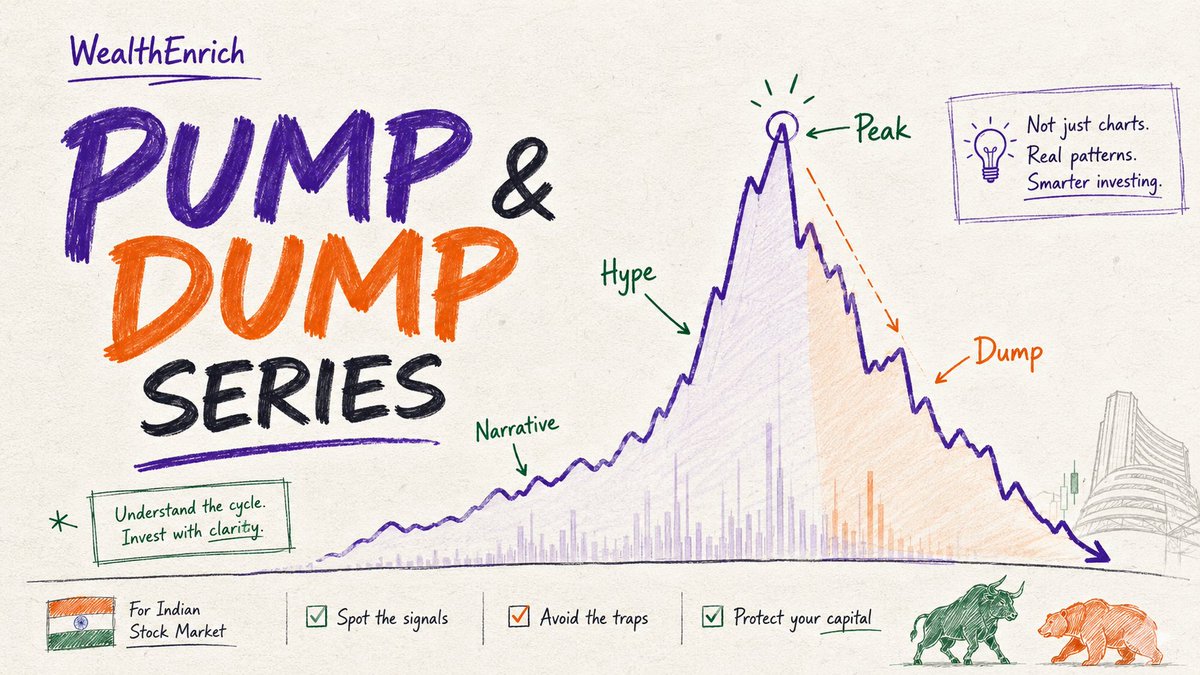
PUMP… DUMP… DUMP… DUMP.
👉 That is #Zaggle for you!
IPO Price: ₹164
Listing Price: ₹164
Record High: ₹597
Current Price: ₹166
Zaggle went from ₹164 to ₹597 in around 15 months and then spent the next 20 months giving almost the entire move back. Someone who bought at the IPO is almost exactly where he started, while someone who bought near the peak is down more than 72%.
Zaggle listed in Sep'23 with a strong story around fintech, SaaS, corporate spend management, cards and banking partnerships. The numbers backed that story too. Sales went from ₹553 crore in FY23 to ₹776 crore in FY24 and ₹1,303 crore in FY25, while profit moved from ₹23 crore to ₹44 crore and then ₹87 crore.
The combination of narrative plus strong growth pushed the stock from ₹164 to nearly ₹597 by December 2024, a rise of about 264% in fifteen months. The company was growing well, but the stock price was growing much faster than the business.
From December 2024, the direction changed. ₹597 became ₹500, then ₹450, ₹350 and eventually below ₹200, with several sharp recoveries in between. Almost twenty months later, the stock is back near its original IPO price.
The shareholding pattern during this fall is worth looking at:
FII holding fell from 9.17% in December 2024 to 2.31% by June 2026.
DII holding fell from 14.56% to 5.44% during the same period.
Public holding increased from 36.17% to 47.96%.
The number of shareholders increased from around 91,000 to 1.18 lakh.
So while the stock kept falling, institutional ownership reduced and public ownership increased. Promoters were not selling in the same way; promoter holding actually moved from around 40% in December 2024 to above 44% by June 2026.
What makes Zaggle more interesting is that the business itself continued growing. FY25 revenue was around ₹1,303 crore and FY26 revenue increased to about ₹1,853 crore. Profit also rose from roughly ₹87 crore to ₹133 crore.
Yet the stock fell from nearly ₹600 to below ₹170. This is a good reminder that strong earnings growth does not guarantee strong stock returns when the starting valuation already assumes years of growth.
Q1 FY27 then showed some pressure in the numbers:
Sales still grew about 18% year on year.
Profit fell around 33% year on year.
Operating margin slipped towards 7% from around 9%.
Quarterly PAT came down to around ₹17.5 crore from ₹26 crore.
There were a few other numbers I would watch as well. ROCE has fallen from around 33% in FY23 to about 13%, FY26 operating cash flow was around negative ₹6 crore, and free cash flow was approximately negative ₹113 crore.
That is why I would not call Zaggle a failed business or anything like that. Sales grew, profits grew and the company became much larger after listing. The problem was that the stock price had run far ahead of what the business had actually delivered.
The full journey is almost the entire lesson in one line: ₹164 → ₹597 → ₹166. The company grew, but expectations and valuation grew much faster, and when those expectations came down, most of the stock market return disappeared.
Folks, when a stock doubles or triples on a strong narrative, the question is not only how fast the company can grow. The more useful question is how much of that future growth is already included in today’s price?
(Disclaimer: The phrase “Pump & Dump” here refers to the movement in market expectations, valuation and stock price. It is not an allegation of manipulation or wrongdoing by Zaggle, its promoters, management, institutions or any shareholder)
If someone tells you to move money from a 20%+ returning mutual fund to a simple 6% fixed deposit, you would probably think they are crazy. But there is a very smart reason a lot of wise investors actually do this, lets discuss the reasons why!
Suppose you had ₹10 lakh. ₹7 lakh in equity & ₹3 lakh in debt.
After a very good year, equity may become roughly ₹10 lakh while debt is somewhere around ₹3.2 lakh.
Now suddenly almost 75% of your money is in equity. You see, you did not decide to increase equity portion from 70% to 75%, but the market did it for you.
Now if the market falls 20% from here, obviously it would feel more painful because your exposure itself has gone up.
So maybe you take ₹70 to 80,000 out of equity & put it back into debt or FD.
Yes this may feels strange, but this is how balancing of your asset allocation happens.
You are basically selling something which is green & putting the money into something boring but low risk giving 6-7%.
By this rebalancing you are simply bringing your risk back to where you originally wanted it be. The 70-30 Equity-Debt plan .
Yes practially our portfolios are never this clean nor so simple.
EPF cannot be moved around & PPF is also locked. Also, selling mutual funds means you have to pay tax. Your house or investment property should not be part of this 70:30 calculation either.
So rebalance only the part which is actually investible & movable and this could be done once or twice a year where you can take your ratio to where your originally wanted it to be.
Markets running up is a good problem to have but sometimes the very return we are celebrating can make the portfolio riskier than we realise !