Google has published a paper that might end the transformer era.
For the last 7 years, every major AI, ChatGPT, Claude, Gemini, has been built on the exact same architecture: The Transformer.
But Transformers have a fatal flaw.
To remember context, they have to process every single word against every other word. It’s called quadratic complexity. As your prompt gets longer, the compute cost explodes.
The alternative is the old-school RNN (Recurrent Neural Network). RNNs are incredibly cheap and fast, but they have a fixed memory size. If you give them a long document, they get amnesia.
Until today.
Google researchers published Memory Caching: RNNs with Growing Memory.
And it fixes the biggest bottleneck in AI.
Instead of an RNN having a fixed, rigid memory that constantly overwrites itself, Google gave it a "save" button.
The technique allows the RNN to cache checkpoints of its hidden states as it reads.
The memory capacity of the RNN can now dynamically grow as the sequence gets longer.
They built four different variants, including sparse selective mechanisms where the AI actively chooses exactly which checkpoints matter most.
The results rewrite the rules of efficiency.
On long-context understanding and recall-intensive tasks, these new Memory-Cached RNNs closed the gap with Transformers.
They achieved competitive accuracy without the explosive, quadratic compute cost. It perfectly bridges the gap between the cheap efficiency of an RNN and the massive capability of a Transformer.
We have spent billions scaling Transformers because we thought they were the only way an AI could remember a long conversation.
But Google just proved we don't need to process the whole history every single time.
We just needed a smarter cache.
The entire RAG industry is about to get cooked.
Researchers have built a new RAG approach that:
- does not need a vector DB.
- does not embed data.
- involves no chunking.
- performs no similarity search.
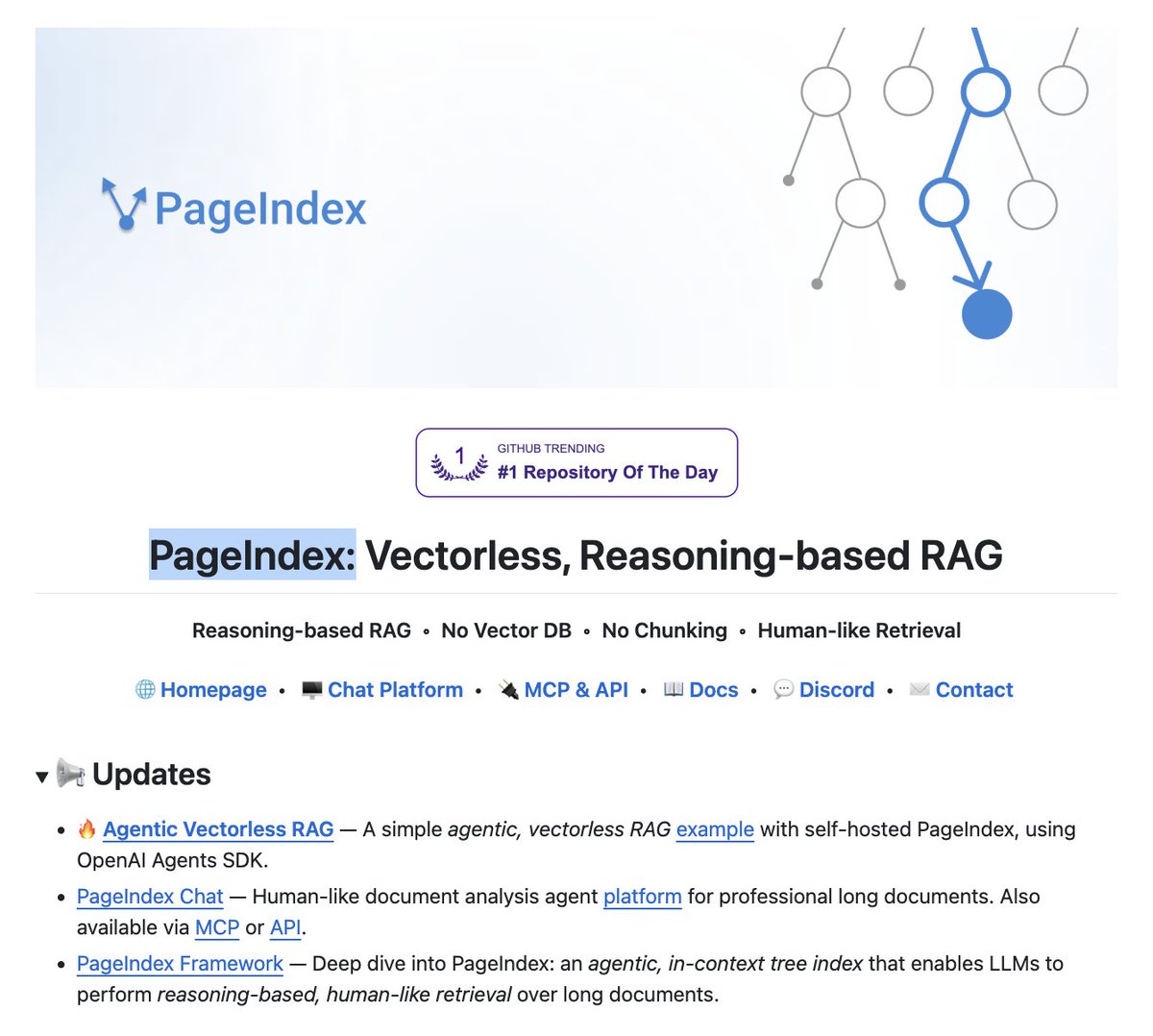
It's called PageIndex. Instead of chunking your docs and stuffing them into pinecone, it builds a tree index and lets the LLM reason through it like a human reading a book.
hit 98.7% on financebench. beats every vector RAG on the leaderboard.
no embeddings. no chunking. no vector DB.
100% open source.
I’m 54, a physicist, have spent decades using mathematics to study the universe, solve problems, and build things.
If your work touches numbers, now or in the future, and you want to learn math properly, this thread shows a from-the-ground-up math you’ll actually need:
Breakthrough: Game-Theoretic Pruning Slashes Neural Network Size by Up to 90% with Near-Zero Accuracy Loss: Unlocking Edge AI Revolution!
I am testing this now on local AI and it is astonishing!
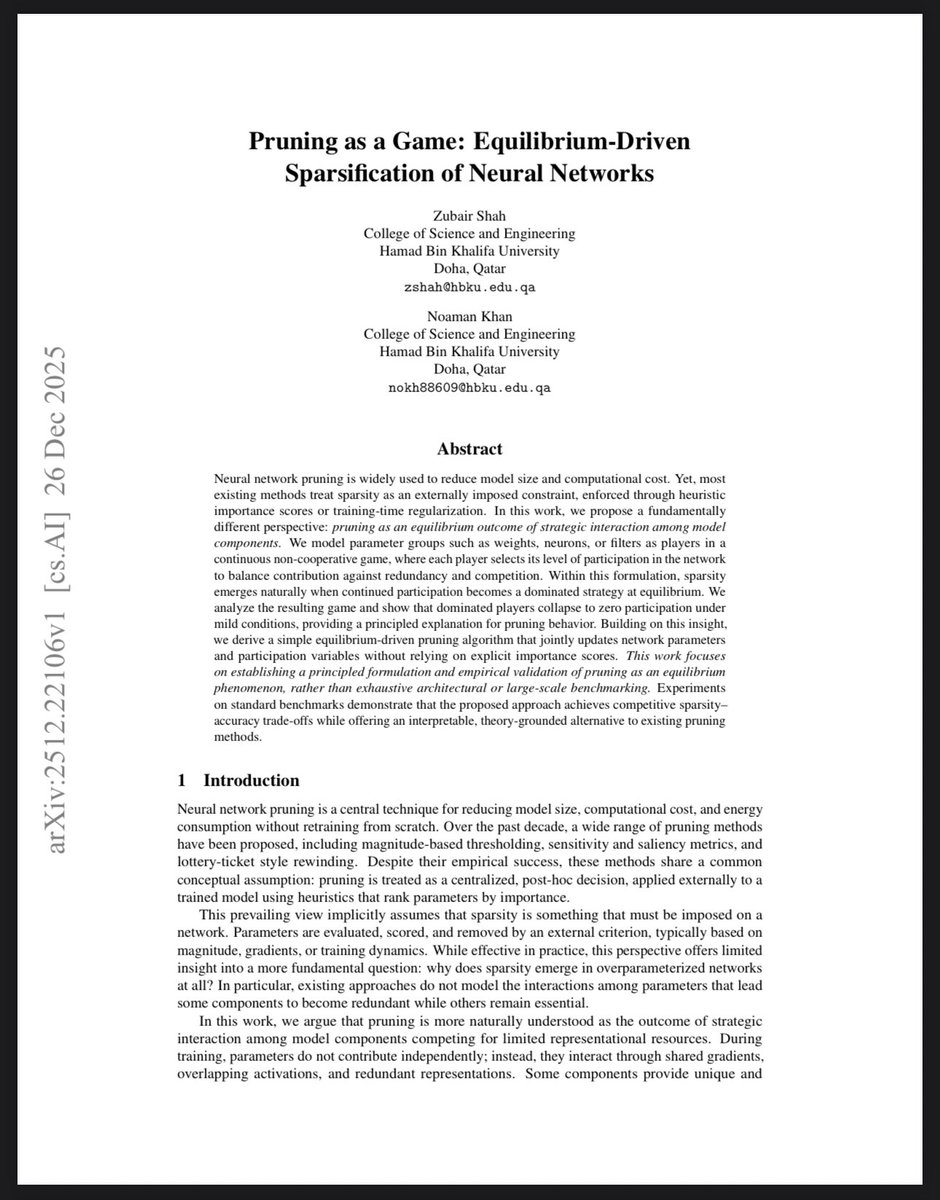
introduced Pruning as a Game.
Equilibrium-Driven Sparsification of Neural Networks, a novel approach that treats parameter pruning as a strategic competition among weights. This method dynamically identifies and removes redundant connections through game-theoretic equilibrium, achieving massive compression while preserving – and sometimes even improving – model performance.
Published on arXiv just days ago (December 2025), the paper demonstrates staggering results: sparsity levels exceeding 90% in large-scale models with accuracy drops of less than 1% on benchmarks like ImageNet and CIFAR-10. For billion-parameter behemoths, this translates to drastic reductions in memory footprint (up to 10x smaller), inference speed (2-5x faster on standard hardware), and energy consumption – all without the retraining headaches of traditional methods.
Why This Changes Everything
Traditional pruning techniques – like magnitude-based or gradient-based removal – often struggle with “pruning regret,” where aggressive compression tanks performance, forcing costly fine-tuning cycles. But this new equilibrium-driven framework flips the script: parameters “compete” in a cooperative or non-cooperative game, where the Nash-like equilibrium reveals truly unimportant weights.
The result?
Cleaner, more stable sparsification that outperforms state-of-the-art baselines across vision transformers, convolutional nets, and even emerging multimodal architectures.
Key highlights from the experiments:
•90-95% sparsity on ResNet-50 with top-1 accuracy loss <0.5% (vs. 2-5% in prior SOTA).
•Up to 4x faster inference on mobile GPUs, making billion-parameter models viable for smartphones and IoT devices.
•Superior robustness: Sparse models maintain performance under distribution shifts and adversarial attacks better than dense counterparts.
This isn’t just incremental – it’s a paradigm shift. Imagine running GPT-scale reasoning on your phone, real-time video analysis on drones, or edge-based healthcare diagnostics without cloud dependency.
By reducing the environmental footprint of massive training and inference, it also tackles AI’s growing energy crisis head-on.
The implications ripple across industries:
•Mobile & Edge AI: Affordable on-device intelligence explodes.
•Green Computing: Lower power draw for data centers and devices.
•Democratized AI: Smaller models mean broader access for startups and developing regions.
As AI scales toward trillion-parameter frontiers, techniques like this are essential to keep progress practical and inclusive.
Pruning as a Game: Equilibrium-Driven Sparsification of Neural Networks (PDF: https://t.co/OxRgcEqOue)
I will continue my testing but thus far results are robust!
It’s here: ParaGen Beta is live.
Spin up real AI agents in minutes. Choose leading Hugging Face models, bring your dataset, fine-tune, and deploy on ParaHub GPUs with zero DevOps.
Get a secure inference endpoint, full logs, usage history, and credit-based billing. Build fast today; monetize through the upcoming Agent Marketplace next.
Start building: https://t.co/TtX2ho2ExP
Stanford just made a $200,000 AI degree free.
No application.
No tuition.
No “elite access”.
Stanford released its actual AI/ML curriculum on YouTube.
Not a PR-friendly intro.
Not “AI for the public”.
This is the real thing.
The same lectures shaping people working on frontier models.
What just became public:
Deep Learning (CS230)
→ https://t.co/DUtL9MO6Y7
Transformers & LLMs (CME295)
→ https://t.co/gN57biwLsE
Language Models from Scratch (CS336)
→ https://t.co/GnH11pPBdW
ML from Human Feedback (CS329H)
→ https://t.co/X9nxEX6PNg
Computer Vision (CS231N)
→ https://t.co/oBxKKWZP22
LLM Evaluation & Scaling
→ https://t.co/1tDpw9ArTq
The uncomfortable truth:
The degree isn’t the scarce asset anymore.
Execution speed is.
Top schools know this.
That’s why they’re publishing the playbook.
👉 Bookmark this.
Comment the first lecture you’ll actually watch.
ParaGen Development Update: Reply Quality, Cleaner UX, and Launch Prep
ParaGen is nearing production readiness. This cycle focused on simplifying the try-out experience for deployed models, improving response quality, and wiring the new answer workflow into the product.
Try-Out UX Simplification
We removed cost and credit elements from the Try Out screen for deployed models. Inference on your own deployments now runs without redundant billing UI, with smooth transitions between public vs. deployed model flows.
Model Reply Quality (POC Complete)
We evaluated multiple strategies to make replies clearer and more context-aware. The best-performing approach has been validated in sample inference tests and is now being integrated.
Improved Answer Workflow (Integration In Progress)
Backend and frontend structures are being updated to support the new response pipeline. We’re refining formatting, API mapping, and UI adjustments; final validations land next iteration.
Looking Ahead
🟣 Multiple model training across varied datasets with deep inference validation.
🟣 Full-platform testing and hardening.
🟣 Production deployment preparation.
Core ParaGen development is largely complete. We’re now stress testing end-to-end flows before the official rollout bringing a streamlined, production-ready agent deployment experience to the community soon.
Click-to-deploy agents are coming!
ParaGen V1 launches December 30th 2025
🟣Pick a Hugging Face model
🟣Pair a dataset
🟣Deploy to ParaHub GPUs, and
🟣Ship a live endpoint - No DevOps.
Logs, cost tracking, and an agent marketplace from day one.
Stay tuned.
ParaGen Development Update: Marketplace Monetization and Usage Insights
ParaGen is shifting from “deploy and run” to a marketplace-driven experience. This cycle delivers costed inference on public models, full marketplace flow, user-level history, credit tracking, and discovery via Trending Agents - bringing monetization and transparency to the forefront.
🔹Marketplace & Monetization🔹
Cost deduction for inference on public models is live and tied to the existing credit ledger. The full marketplace workflow; APIs, UI, and inference logic is integrated end-to-end, enabling users to try models and pay per run.
🔹Inference History in Marketplace🔹
Users can now view and revisit prior inference sessions directly within the marketplace. Histories sync with backend logs for accurate usage tracking and better repeatability.
🔹Credits & Billing🔹
Credit balances, auto-deductions, and top-up visibility are integrated into the marketplace UI, with backend synchronization to keep spend and balance aligned in real time.
🔹Trending Agents🔹
A new section highlights the most-used agents based on live popularity and usage metrics, improving discoverability and accelerating evaluation.
🔹UI/UX and Functional Fixes🔹
We refined agent detail rendering, standardized the header for visual consistency, and improved error messaging for inference responses, clarifying outcomes and failures.
🔹Model Fine-Tuning (In Progress)🔹
We’re enhancing model replies for clearer, context-aware outputs. Work includes SFTTrainer integration and CSV indexing (Vector DB) for tabular data comprehension, more accurate answers, and per-user context handling.
🔸Looking Ahead🔸
-Multiple model trainings across varied datasets with deep inference validation.
-Full-platform regression testing and hardening.
-Production deployment preparation.
Where We Are After 7 Weeks:
ParaGen now supports paid marketplace inference, per-user history, live credits, and agent discovery, on top of stable training/deploy pipelines. We’re entering the final phase: multi-model validation and production readiness for an agent platform that is deployable, auditable, and monetizable.
Coming soon - Paragen official Launch!
ParaGen isn’t just becoming a “train & deploy” platform it’s becoming cost-governed compute.
Over the last cycle we built:
• Real-time GPU allocation validation
• Deadlock prevention + conflict resolution
• Accurate cost-per-pod tracking
AI infra isn’t useful unless it’s predictable.
ParaGen is removing the guesswork.
ParaGen Development Update: Cost Control, Performance, and a Live Marketplace Layer
ParaGen is moving from core plumbing to a user-ready agent platform. This cycle focused on cost governance, GPU reliability, tighter execution views, and opening the first public agent listing, bringing us closer to a seamless deploy–run–monetize flow.
🔹Cost & Credit Management🔹
Automatic cost deduction now runs hourly and on pod termination, with start/stop gated by credit checks. Daily USD→PAI rate refresh keeps billing accurate, and groundwork is in place to charge external users when they run inference on public models.
🔹GPU Validation & Performance🔹
Resolved allocation conflicts and deadlocks, improved utilization tracking, and surfaced accurate performance and cost data across the UI so users see true resource consumption.
🔹Execution Details & UI Enhancements🔹
The Execution Detail page is unified and clearer: statuses, logs, and responses render consistently. Dataset navigation is fixed, try-out histories are readable, and costs are visible where they matter.
🔹Deployment & Model Workflows🔹
Kubernetes terminate/restart flows are streamlined. Empty deployment requests are blocked. Training logs are ordered, and deployment logs were added for full traceability from train → deploy → serve.
🔹Transactions & History🔹
A Transaction History view now tracks payments and credit usage, while try-out histories link interaction costs to model usage for better analytics.
🔹AI Agent Marketplace🔹
Public agent listings are live. Users can browse, discover, and test models directly. No dataset uploads or training required to accelerate evaluation and adoption.
🔸Looking Ahead🔸
Next up: Trending Agents, marketplace inference with per-user history, automated payment deduction on inference, and in-platform crediting to model deployers to enable monetization.
Where We Are After 6 Weeks:
ParaGen enforces cost controls, allocates GPUs reliably, unifies execution visibility, and exposes public agent listings. We’re now entering the phase that enables marketplace inference and monetization, transitioning from stable deployments to a revenue-ready agent ecosystem.
ParaGen Development Update: Expanding the Marketplace and Hardening Deployment
This week focused on unlocking public model exploration, tightening deployment reliability, and improving visibility and control across the platform. We’re now bridging discovery with hands-on testing, so users can move from browsing models to real inference faster than ever.
AI Agent Marketplace:
🟢 Public Models API integrated (browse and try pre-trained Hugging Face models)
🟢 “Try Out” screen updated for cleaner outputs and execution states
Datasets & Downloads:
🟢 Download datasets (custom and Hugging Face) directly from the Dataset screen
🟢 Consistent download actions added to Execution Detail and ParaGen card views
Deployment Reliability & Status:
🟢 Real-time status retrieval API integrated across execution views
🟢 HTTPS enabled for inference (secure model interactions)
🟢 GPU validation and guardrails (prevent new deployments when GPUs are busy)
UI & UX Enhancements:
🟢 Inferencing page integrated (run queries against deployed models)
🟢 Execution details page fixes (accurate metadata, status, logs)
🟢 Dashboard table, pagination, and listing refinements for large workloads
Looking Ahead:
🟣 Payments deduction flow for model deployers (monetization)
🟣 Batch job to auto-restart running models after GPU restarts
🟣 Continue building the AI Agent Marketplace end-to-end flow
ParaGen is moving from exploration to production, with secure inference, real-time status and GPU-aware scheduling now live.
Next up: Monetization, resilience improvements, and a fully wired marketplace to deploy, run, and scale agents in one place.