Who stole from whom?
HYBE has spent roughly two years accusing Min Hee-jin of attempting to “steal” NewJeans. It’s a powerful phrase… emotionally charged, morally loaded, and easy to repeat. But when you look closely at what HYBE has actually presented to support this claim, the accusation begins to collapse under its own weight.
The evidence amounts to KakaoTalk messages that were questionably obtained in the first place: casual conversations that say very little of substance. Much of it reads like rambling speculation from ADOR’s former deputy CEO, a man who just happened to be a former HYBE employee and who, after this entire saga unfolded, was quietly reabsorbed back into HYBE’s corporate fold.
That fact alone should give anyone pause.
But let’s put the messages, the leaks, and the media noise aside for a moment and ask a simpler question, one that cuts through the spin. Did Min Hee-jin really try to steal NewJeans? Or did someone else use this whole mess to dress up their intent to steal NewJeans for themselves?
To answer that, we have to return to the beginning.
NewJeans was Min Hee-jin’s brainchild. ADOR itself was created for a purpose: to realize her vision for a new kind of K-pop group and to honor a promise made to five trainees and their parents. Those trainees came from HYBE’s sidelined “N-team,” pushed aside after HYBE promised them to their first girl group and were indefinitely benched after the company chose instead to debut a different girl group from Bang Si-hyuk’s own vision and built around already-established stars with pre-existing fandoms… a safer, more conventional strategy designed to compete directly with another powerhouse group built on the same model.
At the time, no one at HYBE truly believed in what NewJeans would become. Not Bang Si-hyuk. Not the HYBE system.
Only Min Hee-jin and her team believed.
And they were right.
NewJeans delivered one of the most remarkable debuts in modern K-pop history. ADOR and NewJeans didn’t just succeed… they thrived. Record-breaking sales, chart-topping releases, cultural impact both domestic and global. In a remarkably short time, they carved their names into the industry’s history books.
Then, in April 2024, everything changed.
HYBE suddenly audited ADOR and accused Min Hee-jin of corporate usurpation. That happened after a whistleblowing email from Min Hee-jin regarding unacceptable practices within HYBE and the concern about plagiarism within the HYBE multi-label system that devalues NewJeans.
What followed was not a clean internal legal resolution but a barrage of lawsuits, many bearing the unmistakable characteristics of SLAPPs… actions that overwhelm, intimidate, and exhaust rather than seek truth. Amid the chaos, Min Hee-jin was ousted, and HYBE effectively seized control of ADOR and NewJeans.
That hostile takeover set off a chain reaction. NewJeans’ members, citing a complete breakdown of trust with the new management, chose to terminate their exclusive contracts. More lawsuits followed.
After roughly a year of investigation, law enforcement concluded that Min Hee-jin was not guilty of the allegations that triggered the April 2024 audit in the first place.
That fact should have changed everything, right?
It didn’t.
The courts, it seemed, had little interest in reckoning with the consequences of accusations built on falsehoods… the damage done by HYBE’s actions, the professional destruction, the character assassination, the media manipulation, the ostracism, the psychological toll, the erosion of trust and dignity described by the members themselves. Instead, the rulings favored the cold rigidity of contract language: black-and-white text over lived reality.
The members intended to appeal. But HYBE and ADOR had already prepared their next move… divide and conquer.
Through procedural maneuvering, the girls were forced back—not as NewJeans, not as five, not as a united group—divided. HYBE asserted total control: over their careers, their futures, and the boundaries of their individual freedom.
And this is where HYBE’s accusation fully inverts itself.
HYBE claims Min Hee-jin tried to steal NewJeans. But what we are actually witnessing is HYBE successfully taking NewJeans and ADOR away from Min Hee-jin, from Bunnies, and from the girls themselves.
The NewJeans we knew no longer exists. Danielle’s contract has been terminated. Minji remains in limbo. The remaining members are effectively trapped in a system they no longer trust, under a management that cares very little about them, and with people they did not choose.
So we are left with the question HYBE doesn’t want asked.
Who really stole from whom?
Before April 22, 2024, NewJeans and ADOR were actively preparing for a major comeback. The group was set to release two double-single albums: How Sweet in Korea and Supernatural as their Japanese debut. Promotions, scheduling, and long-term planning were already underway.
At the same time, then-ADOR CEO Min Hee-jin was executing a structured seven-year blueprint for NewJeans. This plan included the Bunnies Camp fan meeting in June 2024, a subsequent Bunnies Camp fan meeting in Korea, a full-length album targeted for the end of 2024, and a global world tour planned for 2025. Nothing in the public record at that point indicated instability or turmoil with the HYBE multi-label system.
That trajectory abruptly collapsed on April 22, 2024, when HYBE initiated a sudden audit and public attack on ADOR and Min Hee-jin. What followed was not a routine internal review but a cascade of aggressive legal actions, media campaigns and character assassination, and internal power struggles. These actions triggered multiple lawsuits, paralyzed ADOR’s operations, and ultimately forced Min Hee-jin out of the company... effectively severing her from the success metrics upon which her put option depended.
After HYBE consolidated full control over ADOR, the consequences for NewJeans escalated further. Creative leadership was removed and the group’s long-term plans were effectively dismantled. The situation culminated in Danielle being pushed out of NewJeans entirely, despite the court affirming the validity of the members’ exclusive contracts, followed by a massive damages lawsuit against her and even her family.
What began as a thriving comeback cycle and a clearly defined future for NewJeans, the most promising act of this generation, was derailed not by the artists, but by a corporate power struggle initiated from above. The fallout has left the group fractured, their plans destroyed, and individual members facing extraordinary legal and personal pressure.
If HYBE genuinely cared about the well-being of the girls and their long-term future, there were countless professional, discreet, and diplomatic ways to manage internal conflict. Corporate disagreements, especially within a parent–subsidiary structure, are typically handled through negotiation, mediation, internal governance mechanisms, and quiet restructuring. None of these require public spectacle, scorched-earth litigation, or the destabilization of artists’ careers.
Instead, what has gradually come into focus is that HYBE’s actions were never primarily about protecting one of its most valuable artistic assets. The pattern of behavior... the audit, the SLAPP and the aggressive lawsuits, the narrative control through the media... points elsewhere. This was not risk management. It was discipline.
At its core, this appears to be retaliation: retaliation against a small subsidiary that asserted creative autonomy, against a woman who refused to be a compliant executive, and against five young artists who did not “fall in line” within a rigid corporate hierarchy. Rather than safeguarding the artists, HYBE treated them as leverage in a power struggle, collateral damage in a broader effort to reassert dominance and send a warning.
If the priority were truly the artists’ futures, the outcome would look very different. Plans would have been preserved, careers protected, and conflicts resolved behind closed doors. What we are witnessing instead is the use of institutional power to punish defiance... regardless of the human cost.
HYBE Didn’t “Protect the System.” It Executed NewJeans!!!
There are corporate miscalculations and honest mishaps, and then there are acts of sabotage so spectacular they deserve to be studied in business schools as cautionary tales. HYBE and ADOR’s decision to surgically remove Danielle from NewJeans under the euphemism of “selective contract enforcement” belongs firmly in the latter category.
This is not management. This is demolition.
NewJeans was never a collection of interchangeable parts. It was a unit, a cultural artifact built on cohesion, intimacy, and the rare illusion... painstakingly earned... of sincerity in an industry addicted to artifice. The brand was not five soloists sharing a logo. It was five girls whose chemistry was the product. To tear one out and pretend the structure still stands is to insult not only the audience, but basic intelligence.
HYBE knows this. ADOR knows this. Which is precisely why this decision feels less like incompetence and more like vengeance dressed up as governance.
Let’s be clear: kicking Danielle out does not “save” NewJeans. It ends NewJeans.
What remains is not a group, but a corporate replica, hollowed out, fear-driven, and permanently marked by the knowledge that unity is conditional and loyalty is punishable. A brand once defined by warmth and mutual trust is now defined by surveillance, litigation, and the silent terror of becoming the next expendable member.
This is divide-and-conquer strategy at its most cynical: reward compliance, annihilate dissent, and force the remaining artists to perform under the shadow of legal ruin. HYBE may call this “system maintenance.” History calls it something else: coercion.
And the timing is not subtle. Danielle’s removal functions neatly as both a warning and a legal chess piece, pressure applied not just to the remaining members, but to Min Hee-jin by proxy. The message is unmistakable: we will burn the house down if you don’t hand us the keys.
In doing so, HYBE and ADOR reveal a truth the industry prefers to keep buried: K-pop companies do not see artists as human beings, or even as brands worth preserving. They see them as leverage. As bargaining chips. As disposable assets to be sacrificed if power must be reasserted.
The media, predictably, plays along... parroting press releases, laundering corporate cruelty into neutral language, and treating the public destruction of a young artist as a “business dispute.” When young artists cry out, the press does not listen. It punches down, shielding conglomerates while amplifying hate toward the very people whose labor built the empire.
What HYBE has done here is more than cruel. It is irrational.
They have taken the most organically beloved girl group of its generation and shattered its defining identity to win a legal war that should never have been fought on artists’ bodies. No future comeback, no rebrand, no PR campaign will erase the stain of this moment. Fans do not forget when trust is broken this violently.
NewJeans was lightning in a bottle. HYBE didn’t just drop it.
They smashed it on purpose and are now standing in the glass, insisting the system works.
It does not.
And neither, anymore, does the lie that this industry exists to nurture talent.
K-pop is doomed.
[Exclusive] HYBE Moves to Expel Only NewJeans’ Danielle
https://t.co/elsqcICIJL
By Choi Hoon-min
Despite the fact that all members effectively signaled their intention to return—accepting the first-instance ruling in the lawsuit confirming the validity of their exclusive contracts and foregoing an appeal—HYBE has issued return statements only for Haerin and Hyein. It has now emerged that HYBE is attempting a “retaliatory termination of contract” targeting only NewJeans member Danielle.
Among the three members whose return status has not yet been publicly announced, HYBE appears to be singling out Danielle for expulsion. Following an apparent 2–3 split, the company’s actions now resemble retaliation directed solely at Danielle among the remaining three members.
According to reporting by the Maeil Shinmun on the 28th, HYBE recently decided on a policy to terminate only Danielle’s exclusive contract, citing alleged violations of contract terms. An anonymous industry source stated, “While HYBE is preparing an official announcement regarding Hanni and Minji’s return, Danielle is expected to face measures such as contract termination.”
Citing violations of exclusive contract terms as grounds for termination would logically mean that all NewJeans members should be subject to termination. However, as HYBE appears to be targeting only Danielle, speculation is spreading throughout the industry that this constitutes a retaliatory contract termination.
Legal experts warn that such retaliatory action by HYBE could instead become a legal weakness. This is because, after HYBE won the lawsuit confirming the validity of the exclusive contracts against all five NewJeans members on October 30, the company promised the resumption of NewJeans’ activities. At the time, HYBE stated, “All preparations for activities such as the release of a full-length NewJeans album have been completed,” adding, “We will do our utmost, through discussions with the artists, to help them return to their fans.”
In simple terms, the concern is that HYBE’s authority to maintain or terminate contracts is being perceived not as a means of “protecting” its artists, but as a tool of retaliation—thereby undermining the trust between HYBE and NewJeans that had been gradually stabilizing. One lawyer noted, “In 2024, the Supreme Court recognized ‘breakdown of trust’ due to opaque profit settlements as a legitimate ground for contract termination in the LOONA Chuu case.” The lawyer added, “HYBE’s approach—suggesting that trust has collapsed only with a specific individual—directly contradicts the Supreme Court’s established legal doctrine on trust relationships and borders on a legal contradiction.”
Another legal professional echoed this view, stating, “HYBE’s selective disciplinary action is highly likely to be used as evidence unfavorable to HYBE when the court determines responsibility for the breakdown of trust.”
Regarding the matter, HYBE Vice President Park Tae-hee said, “We cannot confirm the facts until an official statement is released.”
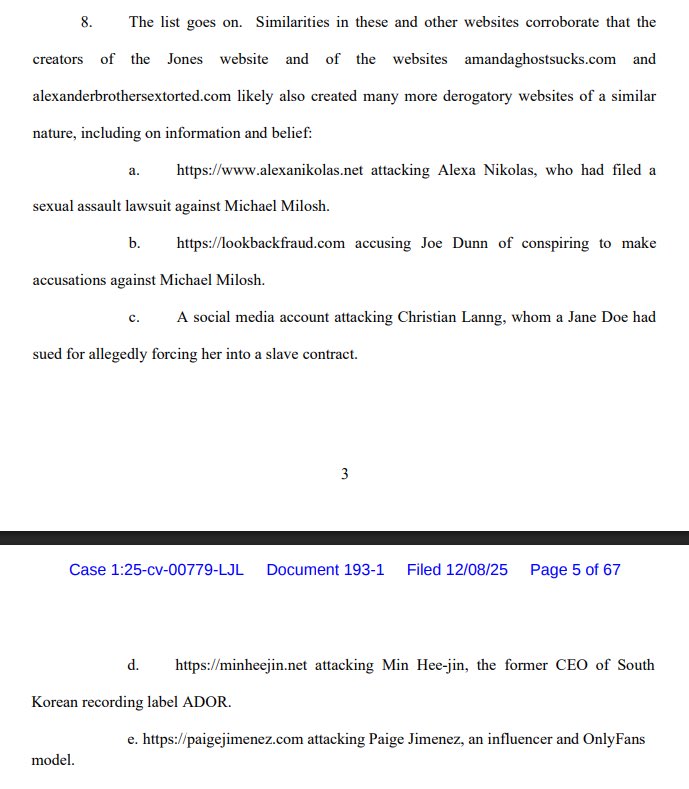
New court document reveals that TAG PR, associated with Justin Baldoni and accused of launching a smear campaign against Blake Lively, also targeted former ADOR CEO Min Hee-jin and 6 others.
HYBE had purchased a 51% stake in TAG PR earlier in 2024.
Dreamcatcher x King’s Raid Chronicles 2 “The Destiny” unreleased song MP3 download
This is the full cut of the song from the final art video.
https://t.co/ZePVhyrCMy
Now think about HYBE.
HYBE controls internal communications, deletes evidence whenever they want, blackmails staff, intimidates witnesses, and floods the internet with coordinated hate and bot activity… for gaslighting and astroturfing.
They have far more power, money, and influence than a Hollywood PR team, and they operate in a system where Bang Si-Hyuk, despite his alleged crimes, is treated like an untouchable deity. If the Korean legal system struggles to check someone that powerful, how on earth are five young idols supposed to expose a corporate smear campaign in real time?
People keep demanding “proof”, but in situations like this, proof doesn’t magically appear unless a whistleblower is brave (or careless) enough to leak something. That’s why HYBE is so confident… they know the girls don’t have access to internal communications, Slack logs, private group chats, PR directives, or the backchannel instructions that fuel these online attacks.
The Blake Lively case shows exactly how these things work: Smear campaigns look invisible until the moment one insider slips up.
And with HYBE’s level of control? NewJeans and MHJ might have felt like their truth stand very little chance. The power imbalance is the entire point… and HYBE has been exploiting it from day one.
The NewJeans case and the problems of the Korean entertainment industry
The group is back in business, but is there really cause for celebration?
https://t.co/SJZZlk19Lx
Written by Manuela Irena D'Orso for NSS Magazine
“Beneath the surface, however, the fans’ frustration goes beyond artistic disappointment. Many see this case as evidence that the K-pop system continues to exercise total control over its artists, denying them contractual and creative autonomy. The story of Hanni, Danielle, Minji, Haerin, and Hyein confirms that the Western perception of K-pop as a hyper-controlled industry is not far from reality. Even when five young women try to defend their rights, they end up returning to the environment they once tried to escape, risking everything, even their careers. In the group’s last public appearance, Danielle, while accepting an award, shouted to the crowd: “NewJeans never die”. A phrase that now resonates louder than ever, but one that leaves an open question: at what cost?”
The World’s Eyes Are on K-Entertainment — But Its Reality Lies in a Regulatory Blind Spot
https://t.co/1B7MXNLfD4
[Child and Youth Media Human Rights Network – Series ②] Minimum Institutional Conditions for a Sustainable K-POP Industry
This is the second of four articles addressing the neglected labor and human rights of children and youth in the ever-expanding K-POP industry. This installment is written by Attorney Noh Jong-eon (Law Firm Jonjae).
K-entertainment has now established itself as South Korea’s leading cultural export industry. Yet, as a lawyer handling disputes in this field, I can say with certainty that the reality I witness bears little resemblance to its glamorous surface. The endless stream of unfair contracts and payment disputes exposes the industry’s structural problems. These are not isolated incidents, but rather systemic failures resulting from regulatory blind spots — gaps in oversight that have failed to keep pace with the industry’s rapid growth. It is time we confront the shadows hidden behind its success and search for real solutions.
[Structural Problem ①] The Toothless “Standard Contract”
Most disputes begin with unfair contracts. The Standard Exclusive Contract introduced in 2009 was only a recommendation without legal enforceability, rendering it largely ineffective. Entertainment agencies may appear to follow the standard contract on paper, but in reality, they often attach “supplementary agreements” that reintroduce harmful clauses — such as excessive penalty fees or invasive control over personal lives.
A particularly chronic issue is the non-transparent “deduct first, settle later” accounting system. Under this structure, agencies first recover their massive investment costs before sharing profits, effectively shifting the business risks onto the artists. Artists, meanwhile, have no way to verify how billions of won in expenses were actually spent. They are forced into an unreasonable position where they shoulder all the risk with no transparency — an exploitative structure rooted in information asymmetry, not a partnership built on trust.
[Structural Problem ②] Unprotected Members of the System
A fundamental problem in the K-POP system lies in the perception of people as mere “products.” Despite existing laws to protect minors, young artists are still exposed to long working hours and extreme stress. The right to education remains little more than a slogan, and there are virtually no systems in place to safeguard their mental health.
In cases I have personally handled involving young artists, many reported severe psychological distress — including panic disorders — caused by excessive control and emotional pressure. Yet, their agencies ignored these symptoms and, in many cases, even forced them to continue their activities. In the relentless machinery of capitalist competition, their right to learn and their mental health were treated as secondary concerns. These are tragic examples of how the Juvenile Protection Act is effectively rendered powerless in practice.
[Structural Problem ③] An Ineffective Oversight System
Government oversight functions are scattered across multiple ministries, with policies heavily skewed toward industrial promotion rather than regulation. As a result, penalties for unfair practices are little more than a slap on the wrist, leaving the system without any real deterrent effect. Self-regulation within the industry has also proven inadequate. Business associations like the Korea Entertainment Producers Association (KEPA) have consistently prioritized the interests of their member companies over the establishment of fair industry standards.
Recently, the government revoked KEPA’s designation as a “royalty-collecting organization” due to transparency issues in payment distribution — a move that further eroded public trust in the industry’s ability to self-regulate.
Proposals for a Sustainable K-Entertainment Industry
For K-entertainment to evolve into a sustainable industry, its distorted structure must be corrected. The two most crucial conditions for reform are an independent oversight body and collective bargaining power for the parties involved.
First, we need a unified, independent supervisory institution that consolidates scattered oversight functions currently spread across multiple ministries. This body must operate free from the logic of “industrial promotion” and instead serve as a true watchdog with strong investigative authority to monitor unfair practices on a continuous basis.
Second, we must build collective bargaining power among artists and staff. Like the Screen Actors Guild–American Federation of Television and Radio Artists (SAG-AFTRA) in the United States, there should be a legal and institutional environment that enables creators and workers to form unions and speak for themselves.
The true strength of K-entertainment does not lie in producing another global superstar, but in creating a healthy ecosystem where both creators and workers are respected. Only by recognizing the current crisis and reforming the system can K-entertainment endure as a genuine cultural legacy of global significance.
I actually used to believe the whole “Min Hee-jin is brainwashing them” thing, but when I took the time to read an article about what really happened during her first press conference, I saw nothing more than a manager simply trying to speak up and protect the rights of her group, her artists, and their songs and theme. I saw firsthand how the media manipulated the truth.
I saw the girls in their YouTube videos, full of joy and love for each other and for Bunnies, despite all the hate. Since then, I decided to stand by them, and I’ve never left.
Every other group I saw treated being an idol as “just a job,” like “it’s our job to look perfect, be perfect,” etc. But not NewJeans. To them, this wasn’t a job, it was a passion, a lifestyle. As someone who also thinks that way about my own life and career, I could understand that.
There’s a big difference between someone who shows up because it’s just a paycheck and someone who shows up because they want to be there, because it brings them happiness. That says a lot about a person.
After all the legal struggles, I see that they are truly chosen and blessed to be one of a kind (no pun intended). That’s why I stay. Because I see them as real people fighting for what they love. Their resilience and stubbornness for justice motivate me to do the same in my own life, to always fight for the truth and for what’s right, no matter how long it takes.
If you read all that, you’re a real one. Let’s stay together fighting for them until the end 💪🏽🐇💙
#WeSupportNJZ #WeStandWithNJZ


![LeoPresents's tweet photo. 💥 JUST ANNOUNCED! 💥
➔ @CRTK_official
➔ The 1st World Tour [CRTK: The Beginning]
➔ United States, Canada, Mexico
⚡️ 𝐆𝐞𝐧𝐞𝐫𝐚𝐥 𝐒𝐚𝐥𝐞: Feb 24 at 10AM CST
Tickets and info: https://t.co/aPHMaNhhso
#ChRocktikal #CRTK #크록티칼
#CRTK_THE_BEGINNING_TOUR https://t.co/xNLJUQwnx5](https://pbs.twimg.com/media/HBm5ZAJXYAAQ_fb.jpg)





![LeoPresents's tweet photo. 💥 JUST ANNOUNCED! 💥
➔ @CRTK_official
➔ The 1st World Tour [CRTK: The Beginning]
➔ United States, Canada, Mexico
⚡️ 𝐆𝐞𝐧𝐞𝐫𝐚𝐥 𝐒𝐚𝐥𝐞: Feb 24 at 10AM CST
Tickets and info: https://t.co/aPHMaNhhso
#ChRocktikal #CRTK #크록티칼
#CRTK_THE_BEGINNING_TOUR https://t.co/xNLJUQwnx5](https://pbs.twimg.com/media/HBm5ZAmXcAAtxro.jpg)



![hf_dreamcatcher's tweet photo. [🎂] 𝑫𝒓𝒆𝒂𝒎𝒄𝒂𝒕𝒄𝒉𝒆𝒓 𝑫𝒆𝒃𝒖𝒕 𝟿𝒕𝒉 𝑨𝒏𝒏𝒊𝒗𝒆𝒓𝒔𝒂𝒓𝒚🎉
오늘은 #드림캐쳐 의 데뷔 9주년입니다🎂
9년 동안 드림캐쳐와 함께해 주신
인썸니아 여러분께 감사드립니다❤
❤Happy Dreamcatcher Day❤
#Dreamcatcher
#꿈둥이들_9주년_축하해
#Happy_Dreamcatcher_Day https://t.co/oQOywTemcq](https://pbs.twimg.com/media/G-T44X5bkAA0-Tt.jpg)

![juantokki's tweet photo. [Exclusive] HYBE Moves to Expel Only NewJeans’ Danielle
https://t.co/elsqcICIJL
By Choi Hoon-min
Despite the fact that all members effectively signaled their intention to return—accepting the first-instance ruling in the lawsuit confirming the validity of their exclusive contracts and foregoing an appeal—HYBE has issued return statements only for Haerin and Hyein. It has now emerged that HYBE is attempting a “retaliatory termination of contract” targeting only NewJeans member Danielle.
Among the three members whose return status has not yet been publicly announced, HYBE appears to be singling out Danielle for expulsion. Following an apparent 2–3 split, the company’s actions now resemble retaliation directed solely at Danielle among the remaining three members.
According to reporting by the Maeil Shinmun on the 28th, HYBE recently decided on a policy to terminate only Danielle’s exclusive contract, citing alleged violations of contract terms. An anonymous industry source stated, “While HYBE is preparing an official announcement regarding Hanni and Minji’s return, Danielle is expected to face measures such as contract termination.”
Citing violations of exclusive contract terms as grounds for termination would logically mean that all NewJeans members should be subject to termination. However, as HYBE appears to be targeting only Danielle, speculation is spreading throughout the industry that this constitutes a retaliatory contract termination.
Legal experts warn that such retaliatory action by HYBE could instead become a legal weakness. This is because, after HYBE won the lawsuit confirming the validity of the exclusive contracts against all five NewJeans members on October 30, the company promised the resumption of NewJeans’ activities. At the time, HYBE stated, “All preparations for activities such as the release of a full-length NewJeans album have been completed,” adding, “We will do our utmost, through discussions with the artists, to help them return to their fans.”
In simple terms, the concern is that HYBE’s authority to maintain or terminate contracts is being perceived not as a means of “protecting” its artists, but as a tool of retaliation—thereby undermining the trust between HYBE and NewJeans that had been gradually stabilizing. One lawyer noted, “In 2024, the Supreme Court recognized ‘breakdown of trust’ due to opaque profit settlements as a legitimate ground for contract termination in the LOONA Chuu case.” The lawyer added, “HYBE’s approach—suggesting that trust has collapsed only with a specific individual—directly contradicts the Supreme Court’s established legal doctrine on trust relationships and borders on a legal contradiction.”
Another legal professional echoed this view, stating, “HYBE’s selective disciplinary action is highly likely to be used as evidence unfavorable to HYBE when the court determines responsibility for the breakdown of trust.”
Regarding the matter, HYBE Vice President Park Tae-hee said, “We cannot confirm the facts until an official statement is released.”](https://pbs.twimg.com/media/G9TSo0kbUAAd0gI.jpg)


![juantokki's tweet photo. The World’s Eyes Are on K-Entertainment — But Its Reality Lies in a Regulatory Blind Spot
https://t.co/1B7MXNLfD4
[Child and Youth Media Human Rights Network – Series ②] Minimum Institutional Conditions for a Sustainable K-POP Industry
This is the second of four articles addressing the neglected labor and human rights of children and youth in the ever-expanding K-POP industry. This installment is written by Attorney Noh Jong-eon (Law Firm Jonjae).
K-entertainment has now established itself as South Korea’s leading cultural export industry. Yet, as a lawyer handling disputes in this field, I can say with certainty that the reality I witness bears little resemblance to its glamorous surface. The endless stream of unfair contracts and payment disputes exposes the industry’s structural problems. These are not isolated incidents, but rather systemic failures resulting from regulatory blind spots — gaps in oversight that have failed to keep pace with the industry’s rapid growth. It is time we confront the shadows hidden behind its success and search for real solutions.
[Structural Problem ①] The Toothless “Standard Contract”
Most disputes begin with unfair contracts. The Standard Exclusive Contract introduced in 2009 was only a recommendation without legal enforceability, rendering it largely ineffective. Entertainment agencies may appear to follow the standard contract on paper, but in reality, they often attach “supplementary agreements” that reintroduce harmful clauses — such as excessive penalty fees or invasive control over personal lives.
A particularly chronic issue is the non-transparent “deduct first, settle later” accounting system. Under this structure, agencies first recover their massive investment costs before sharing profits, effectively shifting the business risks onto the artists. Artists, meanwhile, have no way to verify how billions of won in expenses were actually spent. They are forced into an unreasonable position where they shoulder all the risk with no transparency — an exploitative structure rooted in information asymmetry, not a partnership built on trust.
[Structural Problem ②] Unprotected Members of the System
A fundamental problem in the K-POP system lies in the perception of people as mere “products.” Despite existing laws to protect minors, young artists are still exposed to long working hours and extreme stress. The right to education remains little more than a slogan, and there are virtually no systems in place to safeguard their mental health.
In cases I have personally handled involving young artists, many reported severe psychological distress — including panic disorders — caused by excessive control and emotional pressure. Yet, their agencies ignored these symptoms and, in many cases, even forced them to continue their activities. In the relentless machinery of capitalist competition, their right to learn and their mental health were treated as secondary concerns. These are tragic examples of how the Juvenile Protection Act is effectively rendered powerless in practice.
[Structural Problem ③] An Ineffective Oversight System
Government oversight functions are scattered across multiple ministries, with policies heavily skewed toward industrial promotion rather than regulation. As a result, penalties for unfair practices are little more than a slap on the wrist, leaving the system without any real deterrent effect. Self-regulation within the industry has also proven inadequate. Business associations like the Korea Entertainment Producers Association (KEPA) have consistently prioritized the interests of their member companies over the establishment of fair industry standards.
Recently, the government revoked KEPA’s designation as a “royalty-collecting organization” due to transparency issues in payment distribution — a move that further eroded public trust in the industry’s ability to self-regulate.
Proposals for a Sustainable K-Entertainment Industry
For K-entertainment to evolve into a sustainable industry, its distorted structure must be corrected. The two most crucial conditions for reform are an independent oversight body and collective bargaining power for the parties involved.
First, we need a unified, independent supervisory institution that consolidates scattered oversight functions currently spread across multiple ministries. This body must operate free from the logic of “industrial promotion” and instead serve as a true watchdog with strong investigative authority to monitor unfair practices on a continuous basis.
Second, we must build collective bargaining power among artists and staff. Like the Screen Actors Guild–American Federation of Television and Radio Artists (SAG-AFTRA) in the United States, there should be a legal and institutional environment that enables creators and workers to form unions and speak for themselves.
The true strength of K-entertainment does not lie in producing another global superstar, but in creating a healthy ecosystem where both creators and workers are respected. Only by recognizing the current crisis and reforming the system can K-entertainment endure as a genuine cultural legacy of global significance.](https://pbs.twimg.com/media/G41PE-5aAAAiD79.jpg)





