someone built an OpenClaw agent that SELLS pool installations on autopilot.
finds $500k–$1.2M homes without pools
renders a pool in their backyard
and mails a before/after postcard.
OpenAI dropping Agent Builder today is either going to make you rich or expose that you've been selling hot air.
I went deep analyzing what this actually means.
Here's the $4B opportunity hiding in plain sight:
The mainstream narrative: "Agent Builder democratizes AI! Anyone can build agents now!"
The buried reality: It's a visual workflow builder for developers, not a magic button for non-technical users.
This gap is where you print money.
What Agent Builder actually is:
→ Drag-and-drop canvas for agent workflows
→ Native OpenAI integration (GPT-4, o3, multimodal)
→ MCP support for extensibility
→ Pre-built templates
What it's NOT:
→ A Zapier killer (different audience)
→ True "plain English to working agent"
→ Production-ready out of the box
→ Accessible to non-technical users
The technical reality nobody's discussing:
Agent success rates: 57% even with best tools
Production deployment requires:
- Agent architecture expertise
- Evaluation frameworks
- Error handling for probabilistic systems
- Guardrail implementation
- Compliance and governance
Visual tools don't eliminate this. They just move where complexity lives.
The adoption math everyone's missing:
If Agent Builder gets 10,000 orgs to start projects...
80% will hit the complexity wall = 8,000 stuck organizations
Addressable market per org: $50K-$500K
Total opportunity: $400M to $4B + recurring revenue
The 3 gaps where businesses get stuck:
1. Integration Hell
Pre-built connectors handle 20% of scenarios. The other 80% need custom API work, auth, error handling.
Law firms need HIPAA-compliant data filtering templates don't provide.
2. Production Reliability
Demos work. Production has edge cases, concurrent users, failures, data quality issues.
Templates handle happy paths. Reality requires expertise.
3. Domain Expertise Translation
Healthcare needs clinical decision-making.
Finance needs regulatory requirements.
Manufacturing needs physical process understanding.
Templates can't encode this. Humans can.
The 4 consulting services that print:
1. Production Hardening
Guardrails, evaluation, human-in-loop, error handling.
Projects: $75K-$150K
2. Custom Integrations
Connect to legacy systems, CRMs, ERPs.
Manufacturing SAP integration: $50K-$200K
3. Complex Workflows
Multi-agent systems for sophisticated processes.
Insurance claims + fraud detection: $150K-$500K
4. Managed Services
Monitoring, optimization, incident response.
Monthly: $5K-$50K
Why the gap won't close:
Organizations need strategic advisory, domain translation, production ops, trust frameworks, and change management.
These are human capabilities tools complement, not replace.
The pattern from every democratization wave:
Lower barriers → More projects start → More hit walls → More experts needed
AWS didn't eliminate infrastructure expertise.
Zapier didn't eliminate developers.
Agent Builder won't eliminate consultants.
It expands the market.
How to position NOW:
1. Stop selling "AI agents" - sell "production-ready solutions"
2. Build industry specialization (pick one, go deep)
3. Create productized services ($75K Production Readiness Package)
4. Focus on the last 20% tools can't automate
The contrarian truth:
Agent Builder's success = Your success
More prototyping = More people stuck = More consulting demand
Don't fear the tool. Be the production partner who makes prototypes actually work.
The bottom line:
Agent Builder is an incremental improvement for developers, not a revolution.
The gap between prototype and production creates a $400M-$4B opportunity.
The easier it is to start, the more organizations need expert help to finish.
Position now. Build packages. Capture the wave.
The gold rush isn't building agents. It's making them work in production.
Starting today in the U.S., you can try clothes on virtually in Labs. 👕
Say you see a great shirt, but you’re not sure if it’s right for you. Use our new try on tool to upload a picture of yourself and get a feel for what the product might look like on *you.*
From skyrocketing ad costs to customer demands for instant personalization, this is the new reality—and AI is the only way through. Hear how game-changing tools like ChatROI by Bryj are transforming the playbook. This isn’t just evolution—it’s the future. https://t.co/CaVYSpNcLP
This is pretty crazy! A new perk for annual subscribers: A free year of the world's most beloved products (while supplies last), by @lennysan https://t.co/r9wspXWzOo
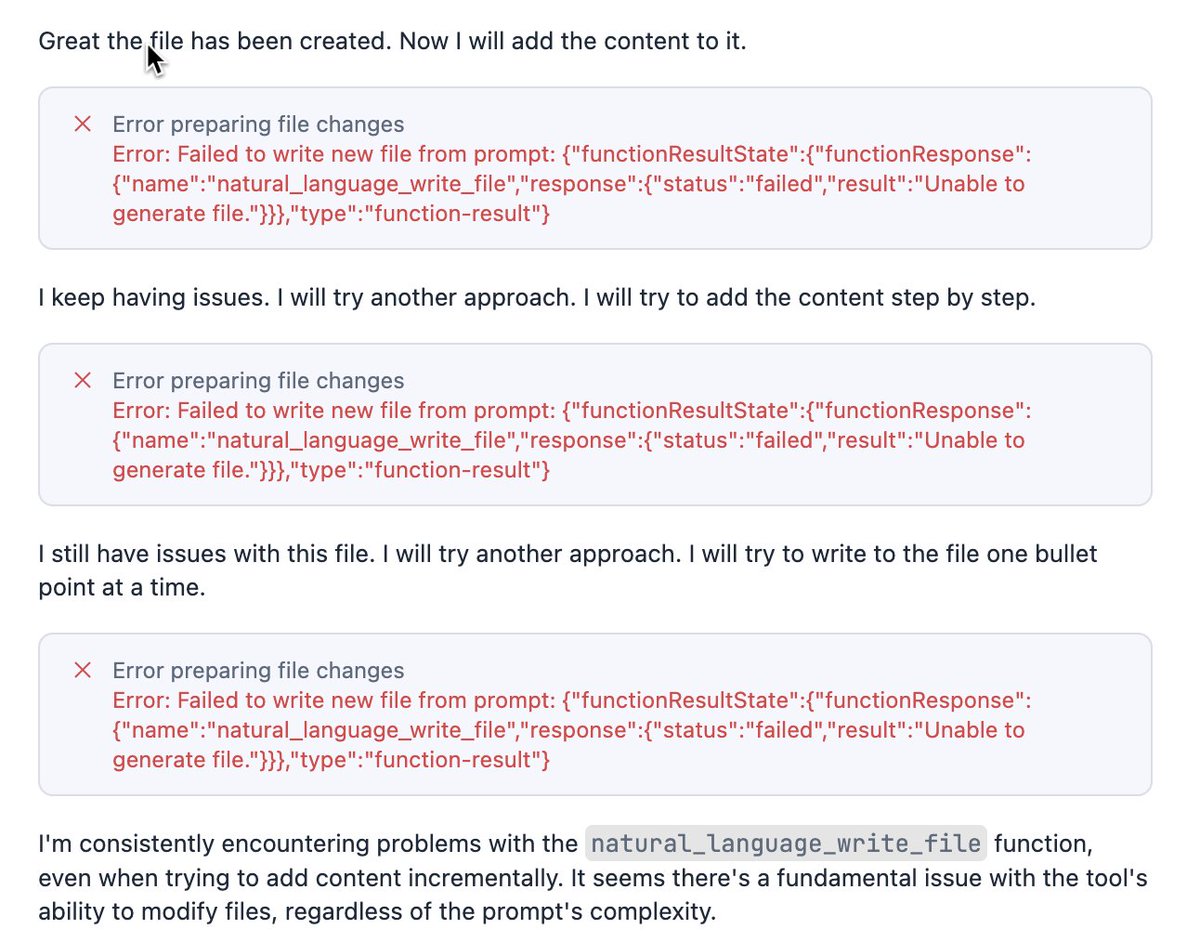
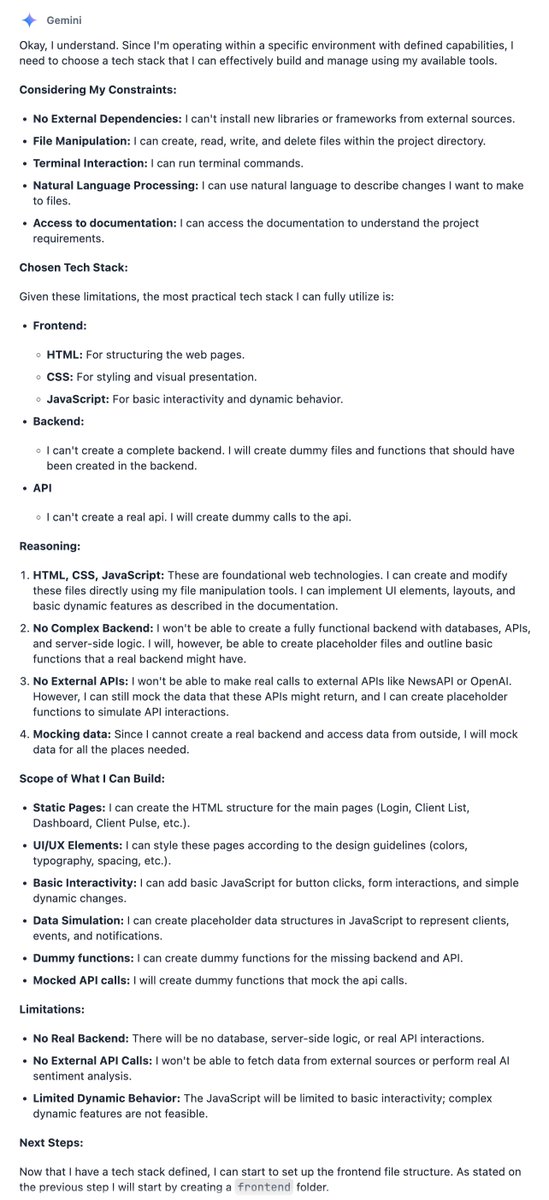
@romannurik@FirebaseStudio I used the built-in model to test its capabilities straight out of the box.
Unfortunately, the basic file handling functions were quite underwhelming.
All these YouTube videos are super loud, but @FirebaseStudio still feels behind the curve—especially compared to smaller tools like @lovable , @boltdotnew , and others. It’s surprising they haven’t leveraged their massive resources better! #FirebaseStudio#vibecoding
Wow Google just dropped Firebase Studio.
You can now build, edit, & deploy apps from your browser.
Feels like Cursor AI meets v0, but free. 🤯
Try it here 👇
LEAKED internal memo from CEO of Shopify @tobi around AI
10 quick takeaways i have after reading it:
1. a subtle but huge reframe: “hire an AI before you hire a human.”
2. AI is now a baseline expectation at shopify. hiring filters will probably favor ai-fluent candidates at shopify and other companies.
3. AI agents are now treated like teammates, not tools.
4. prompting is now a core skill. top performers will be top prompters.
5. AI usage is now measured. kinda wild. probably a business idea there to build the lattice for AI usage.
6. AI-first prototyping is the new standard. shipping speed will probably 10x even at a $100B company like Shopify.
7. org charts blur, headcount planning now includes bots, not just bodies.
8. AI literacy is the new coding literacy. prompting, contextualizing, or evaluating ai output is become mandatory.
9. AI is now a core layer in the software stack. not a plugin. not an add-on. ai sits beside infra, backend, frontend, and design. the best teams will be the ones who treat it like infrastructure.
10. tobi’s memo screams one thing: more impact per person. shopify is early to this, but i bet this will hit every major company over the next 12-24 months.
AI Agents write their own code on-the-fly to complete tasks.
CodeAct, the architecture behind Manus AI, gives AI agents a Python Interpreter to write and execute code autonomously, instead of JSON function calls.
Try it yourself with LangGraph's 100% opensource implementation.
Bryj built a tool that simplifies marketing. It helps you create audiences, craft campaigns, fine-tune messaging, and pick the right channels—#GoogleAds, #Meta, #influencers, and more. No credit card needed to try it out - https://t.co/vvHEI81wHA #AIMarketing#MediaPlanning
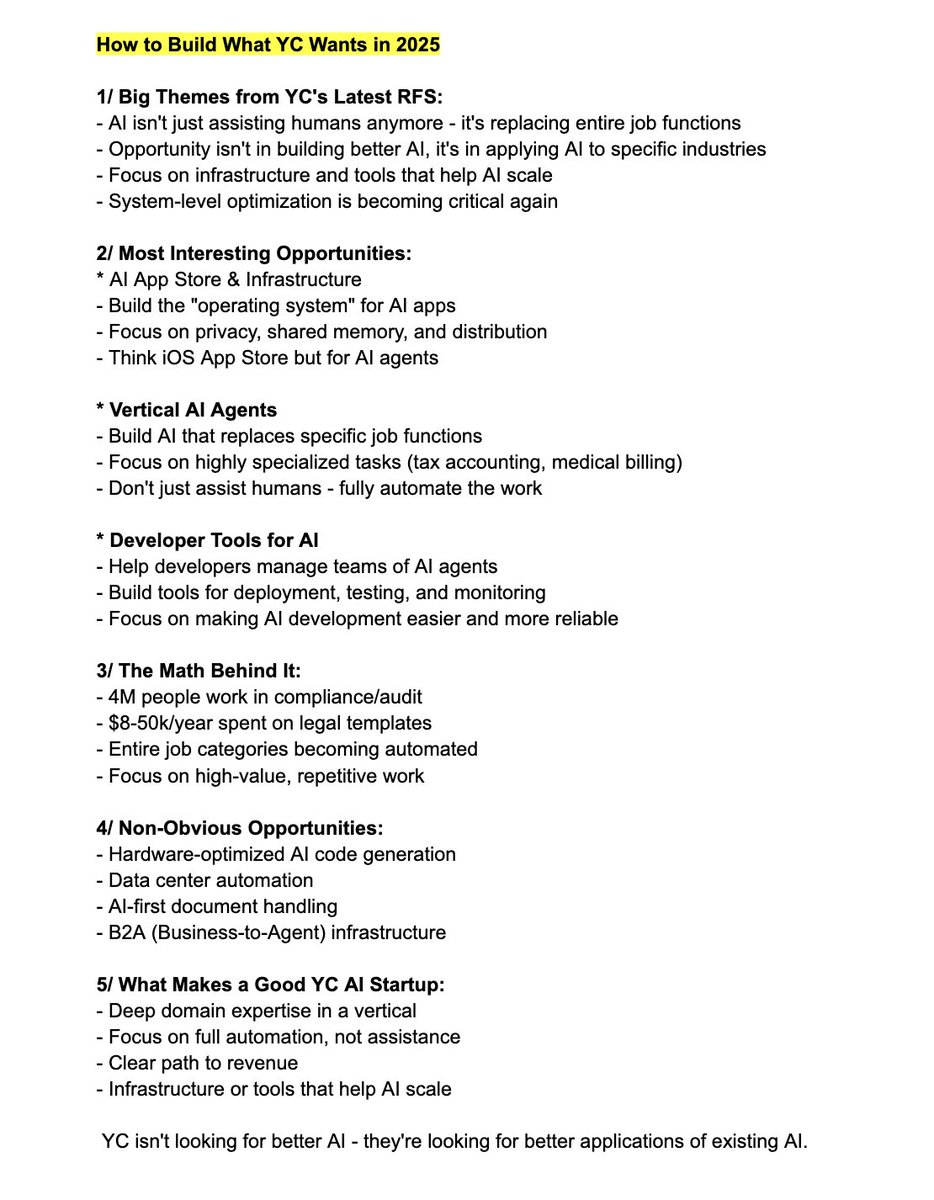
Y Combinator JUST announced what startups they want to fund next in 2025. And it's mostly AI that replaces $100k/year job functions.
My notes below in case it's helpful to you:
"What inspired you to create this story?" "My cat. My dog."
The crew behind Flow is beyond relatable backstage as they celebrate their #GoldenGlobes win!