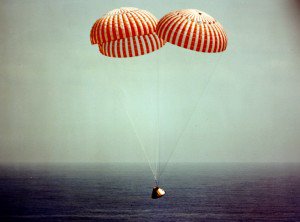
50 years ago today, the Apollo 8 crew splashed down in the ocean as the first people to successfully orbit the moon. They were also able to deliver a message of hope to the world in a year of despair.
But what made Apollo 8 such a significant mission?
https://t.co/pBk4gjAkmU
I think my biggest neurodivergent tell is that I'm visibly uncomfortable during small talk, yet totally at peace when someone starts oversharing the weirdest shit I've ever heard.
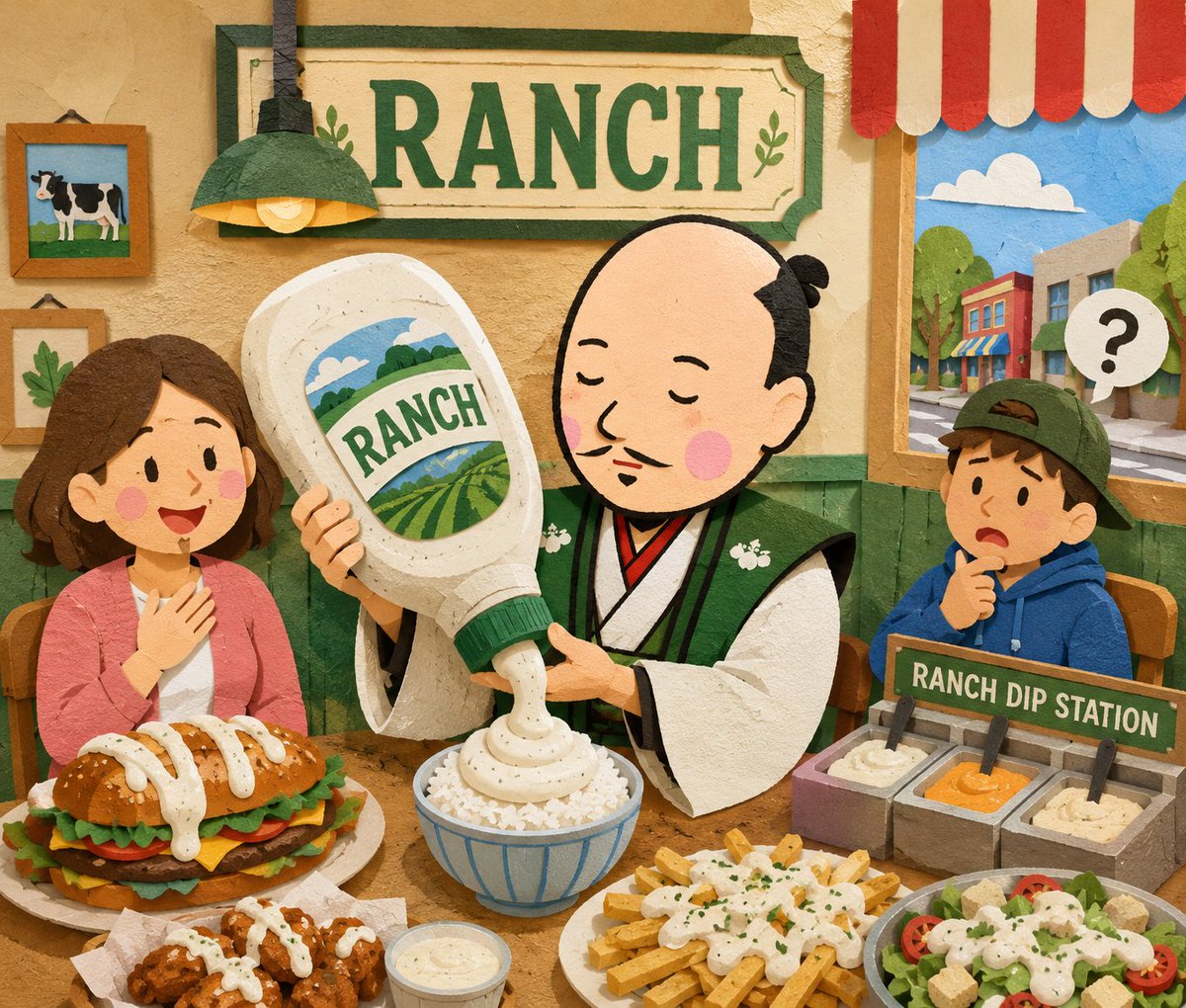
USA. There is a white sauce here that the people pour upon everything, with the devotion of a sacred rite. I have become a believer.
I noticed it slowly. A bowl of it beside the vegetables. A cup of it beside the bread. Beside the meat. Beside the other sauce. Children dipped fruit in it. A grown man beside me poured it onto a slice of pizza that already had a sauce of its own, closed his eyes, and sighed like a man coming home.
I asked its name. They told me with a small reverence: ranch.
For it is written that every great people anoints its food with one sacred thing — a drop of gold pressed from olives, a paste of beans aged in cedar. This nation has chosen a cool white elixir, and it anoints not one dish but all dishes, holding nothing back. For to leave a single food unblessed would be the deeper impiety.
So I anointed. Everything. The vegetable, yes. But also the rice. The egg. The morning fish. I would not be the one barbarian who left his plate unblessed while a whole nation dipped in joy around me.
And here my heart rose, and I declared the thing a calmer man would not:
"I will pour this holy elixir upon every food beneath the heavens — the noble and the humble, the savory and the sweet — until I find the one dish it cannot improve. And on that day I will know I have reached the very edge of the world, for everything within it has been made better by ranch."
The teenager refilling the dip station watched me anoint a bowl of rice.
"...that's a lot of ranch, my guy."
"It is the correct amount," I told him, "for a god."
I have not yet found the dish it cannot improve. I have stopped looking. So I brought a great vat of it to the next gathering and set it at the center of the table, and the whole room descended upon it with cries of joy, and a woman I had never met looked at me and said, "okay — YOU get it."
I have never felt more accepted.
So tell me, America.
You call it ranch. A condiment. A thing on the side.
I call it the one sauce a whole nation agreed to love together —
and I dip, with all of you,
gladly.
Nobunga is an amazing story teller. He takes common American occurrences and tells them from the point of view of a Japanese samurai and it’s hilarious.
USA. A house. The garage is full, so the car sleeps in the rain.
I walked past an open garage today, and I finally understand Americans.
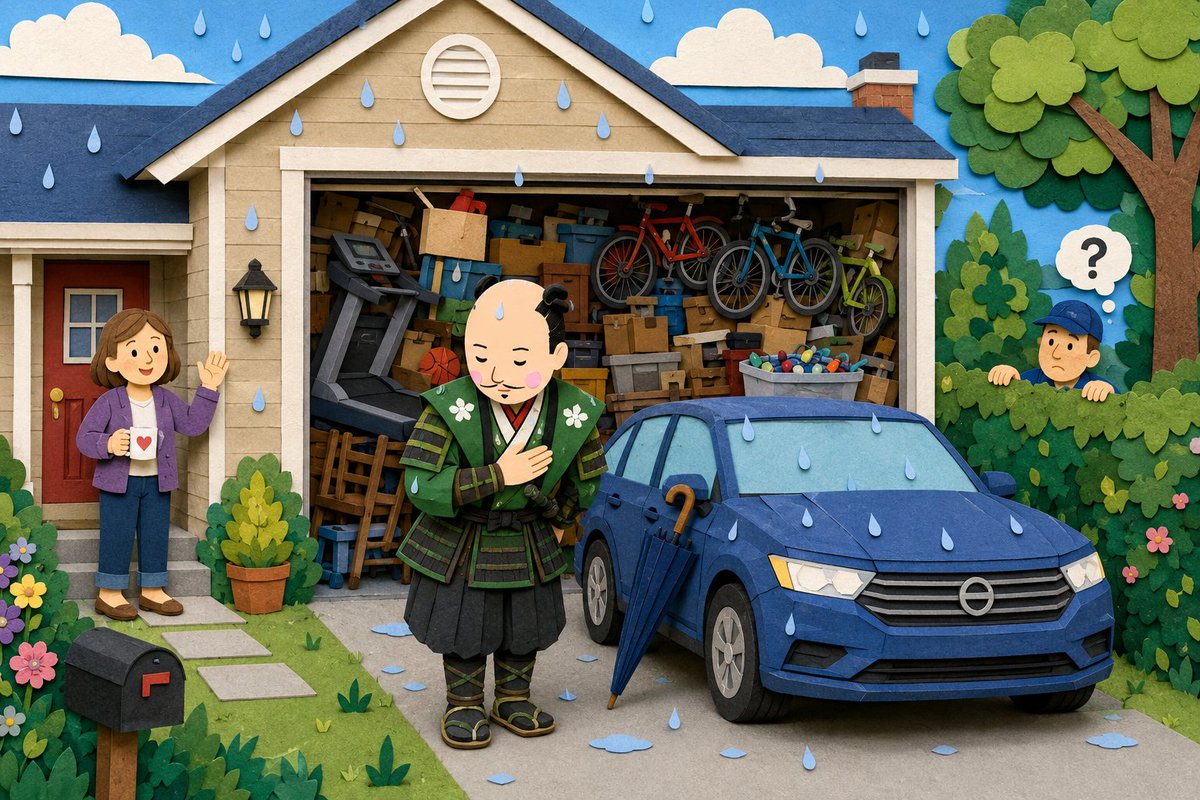
The garage was packed to the ceiling. Boxes. A treadmill. Old chairs. Three bicycles hanging from hooks. Christmas lights in a plastic tub. No room for even one more thing.
And the family car? Parked outside. In the driveway. Getting rained on.
I stood there, deeply moved.
In Japan, we put the car in the garage and the boxes in the house. Americans do the opposite. And now I see why.
The garage is the treasure house. Inside it sleep the sacred relics: the bicycle the child outgrew, the chair no one sits in, the lights that shine one week a year. These must be protected at all costs.
The car is not a treasure. The car is a warrior. So the car is given the highest honor a warrior can receive. It stands guard at the gate, in the storm, all night, so the treasures stay dry.
The owner came out with his coffee. He saw me looking and shook his head.
"Yeah, I really gotta clean out that garage," he said.
Clean it out? I bowed to him. "You are a good man," I said. "Your car guards your home with its life."
He looked at his car. He looked at me. He said, "...thanks?"
He has never thought of it that way. But I could tell he liked it.
So now every morning I walk past, and I bow to the car in the driveway.
It has the hardest job in the family, and it never complains.
The owner waves at me now. He thinks we are friends.
We are. But mostly, I am here for the car.
This morning it was raining again. The car was soaked, still guarding the gate, still faithful.
So I gave it my umbrella.
I do not need it. I have known harder rain.
A warrior on duty should not have to stand in the storm alone.
In America, a stranger will rename you in a single breath, and you are simply expected to come when called.
I went to eat at a busy restaurant. A young man at the front asked for my name, to mark my place in line. I gave it the weight it has carried for eight hundred years.
"Nobunaga."
He smiled, nodded, and wrote it down with great confidence. Then he read it back to me, to be sure he had honored it correctly.
"Perfect. Banana, party of one."
Banana. He had heard my name, held it a moment, and returned to me something rounder and more cheerful. To refuse the name a host gives is to refuse his welcome. I bowed. I was Banana now.
Then he handed me a small black disc, said it would "light up and buzz" when my table was ready, and turned to the next guest as though he had not just placed a living thing in my hands.
I held it in both palms, the way one holds a small sleeping beast that may wake. I found a place to stand. I waited, ready.
It woke.
It screamed. It flashed red. It leapt and shook in my hands like a captured spirit demanding release. A lesser man would have dropped it. I did not. I gripped it, steady, looked into its blinking lights, and told it, in a low voice, that its time had come. Then I carried it back to the host with both hands, the way one returns a hawk to its master.
He took it without looking and shouted across the entire room.
"BANANA! Party of one, your table's ready!"
A hundred strangers turned. I rose. I crossed that floor as Banana, spine straight, chin level, a man answering to his name. A child pointed at me. I gave the child a small bow. He had recognized me.
All through the meal they kept me. "How's it tasting, Banana?" "More water, Banana?" The check, when it came, said Banana, and thanked me for visiting. By the end the whole staff knew me. They waved as I left. "Night, Banana!"
So tell me honestly.
For eight hundred years my clan answered to one name. Tonight I answered to a fruit, calmed a screaming relic in my bare hands, and ate among people who were glad I came.
When the little disc lights up, is the table truly mine, or am I only keeping it warm for the next Banana?
Because I have already decided to return on Friday, and to ask, very humbly, for the same disc.
🚨 SPACEX JUST GOT FAA APPROVAL TO TEST ITS NEW “STARFALL” CAPSULES.
These are not regular reentry vehicles.
SpaceX’s new circular Starfall capsules are designed to bring up to 1,000 kg of payload back from orbit safely, repeatedly, and at scale.
They can launch on either Falcon 9 or Starship, perform in-space manufacturing, then reenter and splash down in the Pacific for rapid recovery.
Why this matters:
• Enables true commercial in-space manufacturing (microgravity + vacuum) that can be returned to Earth
• Could become a “proliferated successor” to the ISS for self-sustaining space industry
• Opens the door to rapid point-to-point cargo delivery from orbit to anywhere on Earth
• Directly competes with companies like Varda that have been flying similar missions on SpaceX rockets
The deeper implication is massive:
We are moving from “occasional experiments in space” to routine manufacturing and logistics in orbit.
If Starfall works at scale, companies could build factories in space, produce high-value materials that can’t be made on Earth, and ship them back down regularly all without needing a full space station.
This is one of the clearest steps yet toward a real, self-sustaining commercial space economy.
What do you think will in-space manufacturing finally become a serious industry, or is this still too early?
Follow for more frontier space and future technology.
the blue origin explosion briefly forces people to remember what the baseline actually is.
rockets aren’t supposed to feel like commercial aviation.
they feel that way because spacex spent years turning an extraordinary event into an ordinary one.