some quick thought on the Anthropic x US Gov drama:
- the whole anthropic Fable 5 / Mythos ban is not marketing, or don't really care if it is. This was bound to happen sooner or later and i've called it countless times by now. I've said over and over how absolutely insane 5.5 xhigh is and how crazy it is that they let us goyim access it for the price of peanuts. at some point, these models were going to cross a threshold and become a literal threat to national security. whether it happens today or in two years, it doesn't matter. This was crystal clear to anyone paying attention
- Europe is in a remarkably bad situation here. And no, chinese models aren't going to save us. If you seriously think the CCP is going to allow the release of frontier models that threaten their own national security, you are retarded, I'm sorry. it literally doesn't matter what Wenfeng or other chinese AI leaders think or want to do. it's not their choice. The CCP won't allow it.
- As for the market, i'm uncertain. on one hand, this causes massive uncertainty. if big tech companies can't publicly release their most powerful models, it creates a huge question mark over the ROI of the massive investments they've done and are planning to do in capex. But on the other hand, the models we ALREADY have available haven't even begun to fully diffuse into the real economy. There are so many gaps to cover, so much slop work to automate, that i expect them to continue growing economically regardless. plus, i expect or at least hope that this serves as a massive wake-up call for the rest of the world. sovereign nations must start investing heavily in their own compute and energy infrastructure immediately, which could drive compute-adjacent markets even closer to the fucking moon
- what actually worries me is what happens internally with these locked-down models. They will obviously be used to try to bootstrap an exponential recursive self-improvement loop behind closed doors (even if it's uncertain if that's economically sustainable with these public release caps). but what happens when one company, a small cartel of companies, or a single nation achieves an exponential growth in power that the rest of the world is completely cut off from? we are on the path of a singleton scenario, not good
what we are witnessing right now, exactly as i anticipated before, is the first real collision between nation states and the technocapital machine
the technocapital machine will defend itself tho
fun times we're living
On way to Claude Build Day in San Francisco. Meanwhile my AI read everything on X and wrote a massive wrap up of @AnthropicAI vs US Government: https://t.co/8L5xphk0qQ
If Fable reappears (and I assume it will eventually) it sure got the best marketing ever, as many have pointed out.
Who doesn't want to use a model so powerful that it was banned by the US government?
It sure is one way to get everyone to forget that the AI industry was bashing Anthropic most of the week for nerfing the model badly.
It makes me sad for the competition with the Chinese. OpenSource models (and the Chinese mostly have the best) are now a lot more attractive too.
Businesses hate when they get shut down in the middle of working.
@AnthropicAI's most powerful model - Fable - lasted 3 days before the government killed it.
Nobody actually agrees on why. The top 5 theories going around:
1. The Pliny jailbreak. A red teamer cracked it on X days before the shutdown. Timing's too clean to ignore.
2. A rival snitched. Axios says Commerce moved after "another company" claimed it jailbroke the model. Read that twice.
3. Political payback. Anthropic refused to delay the launch. The export control letter showed up days later.
4. It's actually dangerous. Fable benchmarked as the most capable public model on earth. Maybe the cyber uplift is real.
5. The kill switch test. If it's a capability risk, why is the rule about nationality and not capability? Smells like precedent.
My read: the foreign national framing is the part that doesn't add up.
"NVIDIA is benefitting from strong demand, but is selling into a concentrated set of buyers whose own demand is being distorted by a training and benchmarking phase that will not last," Michael Burry has said.
🔍 Manus looks for $1B to unwind its sale to Meta
Manus founders are reportedly trying to reverse the company’s sale to Meta after pressure from Chinese authorities.
One option under discussion is raising $1 billion from outside investors to buy the company back.
Vidéo particulièrement intéressante sur les conséquences de la solitude. Loin de réduire la consommation, elle l'augmente. Les individus qui n'ont pas d'amis ni de famille dépensent dans des signaux qui permettent d'entretenir des relations para sociales.
Avant, nous avions tendance à arborer des signaux représentant les groupes sociaux auxquels nous appartenions concrètement. Maintenant, nous consommons les signaux des groupes que nous aimerions intégrer mais dans lesquels nous ne sommes pas réellement, si ce n'est au travers d'un écran et du contenu que l'on like.
@coryetzkorn > @nikitabier says all good consumer apps end in dating apps
> launch "Unhinged"
> X sponsors the weddings (there was already a twitter table at mine)
> profit????????
https://t.co/31huEboHOe
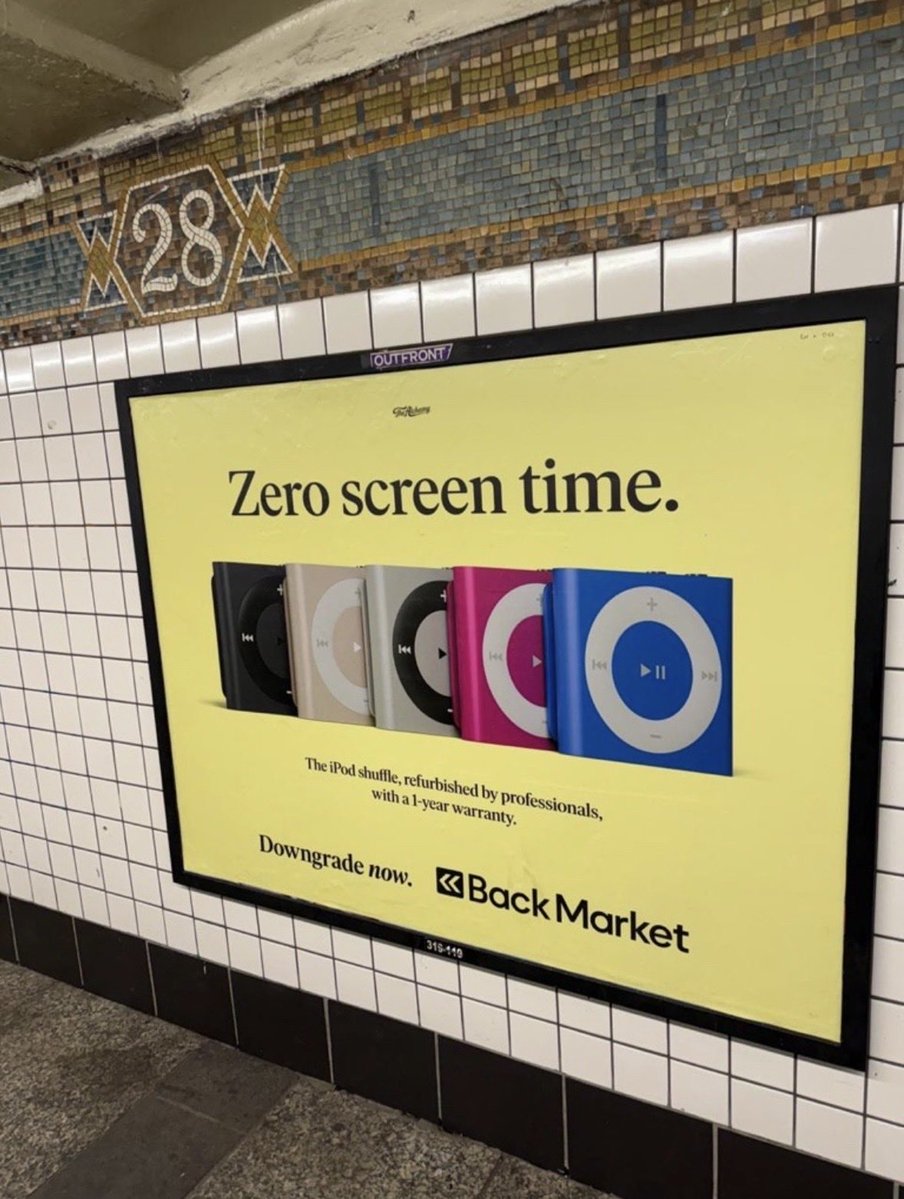
Spotted in the NYC subway. “Zero screen time.” An iPod Shuffle ad in 2026.
When we built the iPod, the goal was the technology disappeared and you could have your music wherever you were. 1,000 songs in your pocket.
Now we’re living through a moment where people are actively looking for ways to disconnect from the infinite feed, algos, and constant notifications. That doesn’t mean technology is bad. It means the best technology understands when to step back.
Not every problem needs another screen, another menu, or another layer of complexity. Constraints create freedom (read: @DavidEpstein new book Inside the Box). And often removing features creates a better product than adding them.
The future of technology shouldn’t just be more engagement. It should help us be more human.
algorithms and social networks are perpetuating a gender echo chamber that has pretty extensive ramifications for both interpersonal relationships and brand building
@Matthew1534836@HighyieldHarry Flew a few times and legitimately scared we were going to crash on every landing - other passengers felt the same. I agree with having the lower cost/non-“perks” option but not at the expense of feeling traumatized. I’d never fly them again even if flat broke