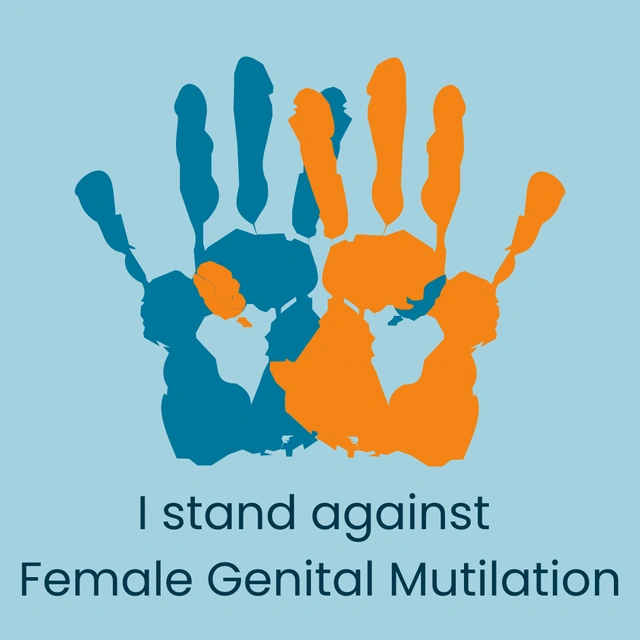
Today, on the International Day of Zero Tolerance for Female Genital Mutilation, we stand unequivocally against FGM. This practice is not culture, tradition, or religion. It is violence against girls. FGM causes lifelong physical and psychological harm and continues only because it is too often excused, ignored, or misunderstood.
At the AHA Foundation, we believe zero tolerance means action. It means centering survivors, equipping professionals to recognize and prevent risk, and demanding laws and policies that protect girls without exception. We stand for the right of every girl to grow up safe, whole, and free from coercion. Zero tolerance is not symbolic. It is a commitment to ending FGM everywhere.
Mr. @ZohranKMamdani, really? Right now?
To be honest, I feel tortured in my own beautiful city of New York, watching you celebrate “World Hijab Day” while women in my wounded country, Iran, are being jailed, shot, and killed for refusing the hijab and the Islamic ideology behind it.
Not a single word of sympathy from you.
No expression of solidarity.
Not even an empty condemnation for the massacre which unfolding right now in Iran.
Your silence, paired with celebration, is shameful.
You are not standing with women.
You are standing with our jailers.
The Tale of Two Contagions
In 2019, German psychiatrists observed a sudden surge of adolescent girls presenting to clinics with abrupt-onset Tourette-like tics. This immediately raised alarm bells. Tourette’s typically affects boys and begins in early childhood.
This was an entirely new patient population.
Researchers quickly identified the index case: Jan Zimmermann, a young Tourette sufferer, whose YouTube channel had recently exploded in popularity. The girls displayed the exact same symptoms as Jan: the same outbursts and catchphrases.
The phenomenon soon migrated to TikTok, where it spread like wildfire.
Researchers coined a new term for what they were observing: mass social media–induced illness — a modern iteration of the long-recognized phenomenon of mass sociogenic illness.
Yet, in 2014, when paediatric gender clinics across the Western world began to fill with adolescent girls — another entirely new patient population — “gender-affirming” clinicians didn’t even bother to look for the trigger.
And it wouldn’t have taken much effort to find. All it required was a glance at the cultural messaging of the time.
Because 2014 was the year Time magazine put Laverne Cox on its cover with the headline: The Transgender Tipping Point: America’s Next Civil Rights Frontier.
And with that, the modern trans rights movement launched.
Trans-identified celebrities were everywhere, trans characters appeared in children’s books and television shows, trans influencers proliferated with astonishing speed online, and schools began teaching gender identity ideology as if it were scientific fact.
And in a perfect-storm scenario, smartphones and social media exploded in popularity, creating the ideal super-spreading environment for this seductive idea to go viral.
The message adolescents received was simple: If you hate your body, that could mean you’re trans.
And right on cue, legions of confused adolescents who hated their developing bodies began showing up at gender clinics believing themselves to be trans.
Just like the TikTok tics. A mass social media–induced illness.
Except on this occasion, instead of scrambling to contain the epidemic, doctors picked up their syringes and scalpels and set about permanently medicalising the innocent youth caught up in this powerful cultural storm.
And activists marched in the streets demanding that these young people be allowed to sacrifice their health, fertility, and body parts — while swiftly demonising anyone who dared point out the obvious parallels to social contagions of the past.
@nic_carter@koeppelmann You are totally right. I've known Martin since before Gnosis. A nice guy. But hey, how many nice guys and gals don't grasp my meaning anymore, since Trump brought good sense to word affairs.
@BrammerAyse You could also ask students to compute cubic roots by hand but fortunately we have adapted to calculators. Adapting to AI requires first of all an effort of study and imagination on the part of teachers.
Europe doesn't have "a problem". It has THREE problems: 3 European nations are suffering from a severe "post-imperial hangover".
First, there is the United Kingdom, a nation that voted for Brexit to "take back control" only to realize it has completely forgotten how to drive.
The British identity crisis is like watching a retired lion try to adopt a vegan diet. They traded imperial confidence for an HR department’s sensitivity training. The land of Churchill is now governed by a sprawling "nanny state" bureaucracy that is more terrified of offending someone on X than it is of actual decline. The British police, once the envy of the world, now seem to spend more resources investigating "non-crime hate incidents" and painting their patrol cars in rainbow colors than solving burglaries. It is a nation desperately clinging to the aesthetics of tradition—the Royals, the pomp, the tea—while its institutions have been hollowed out by a progressive rot that makes a California university campus look conservative. They want the swagger of the 19th century but are paralyzed by the emotional fragility of the 21st.
Then there is France, the angry, chain-smoking aunt of Europe who refuses to admit she’s been unemployed for decades.
France’s hangover manifests as a permanent state of insurrection masquerading as "civic engagement." Their identity is split between a delusional elite who still think Paris is the capital of the universe and a populace that expresses its "joie de vivre" by burning down bus stops every Thursday. The French suffer from a Napoleonic complex without a Napoleon; they demand the living standards of a conquering empire while working a 35-hour week and retiring at an age when most Americans are just hitting their stride. They preach "Republican values" and aggressive secularism, yet the state has lost control over vast swathes of its own suburbs. France is essentially a beautiful, open-air museum where the curators are on strike, the guards are afraid of the visitors, and the management is busy lecturing the rest of the world on "grandeur" while the electricity bill goes unpaid.
Finally, we have Germany, the neurotic giant that has decided the only way to atone for its history is to commit slow-motion industrial suicide.
Germany’s post-imperial hangover is a moral autoimmune disease: the country is so terrified of its own shadow that it has replaced national pride with aggressive self-flagellation and recycling regulations. Their identity is built on being the "Moral Superpower," which practically translates to shutting down their perfectly functional nuclear power plants to burn dirty coal, all while lecturing their neighbors on carbon footprints. It is a nation of engineers who have engineered a society that doesn't work. The German spirit, once defined by efficiency and discipline, has mutated into a paralyzed bureaucracy where filling out the correct form is more important than the outcome. They are so desperate to avoid being "threatening" that they’ve become essentially a large NGO with an army that has broomsticks for rifles, terrified that showing any backbone might be interpreted as a relapse.