Every family should own a boring laundromat because...
The U.S. government will give you $1,000,000 to buy one.
It's called an SBA 7(a) loan.
Here's how to use it (without quitting your W-2 job):
If I had $50 and wanted to turn it into $500 in the simplest way possible, here's exactly what I'd do:
1. Open a trading account before the end of the week.
Not next month. Not after watching 50 more YouTube videos. This week.
Jesse Livermore made and lost multiple fortunes. He traded through the 1907 panic, the 1929 crash, and every boom in between.
His entire system fits in 14 rules. Save this.
Before you enter:
1. Is the market trending in your favor?
2. Is this stock a leader?
3. Has price confirmed your thesis?
4. Is timing right?
5. Do you have a stop loss?
If any answer is no, do not enter. Wait.
While in the trade:
6. Scale in, never all at once
7. Let winners run
8. Cut losses fast
When to stay out:
9. No setup? Do nothing
10. Ignore tips
11. Never average down
Mindset:
12. The market is never wrong
13. Fear losses, let hope ride with winners
14. Review every single trade
Most traders lose because they do the opposite of every one of these rules. They chase. They average down. They hold losers and sell winners. They trade every day.
Livermore's biggest profits came from sitting tight. Not from trading. From waiting.
"It never was my thinking that made the big money for me. It always was my sitting."
If someone hacks your Gmail, they don't need your passwords.
They can reset everything.
Bank. Instagram. Apple ID. Crypto. PayPal. Password manager.
Your Gmail isn't email.
It's the master key to your entire life.
Here's how to lock it down in 10 minutes: 🧵
You're about to pay that $14,000 medical bill
Stop
Don't be fucking stupid
You can get it for free
The hospital violated federal law when they sent you to collections without your signed HIPAA authorization. That authorization is a specific document. Form HHS-329 or the hospital's equivalent privacy notice with your wet signature. The hospital is required under 45 CFR 164.508 to obtain this BEFORE disclosing your protected health information to any third party, including debt collectors
They almost never get it. They batch-sell delinquent accounts to collection agencies in spreadsheets. The spreadsheet has your name, balance, account number, dates of service, and often the diagnosis codes. All of that is protected health information under HIPAA. All of it was transferred without your written consent
Each unauthorized disclosure is a violation worth $100-$50,000 per incident under the HIPAA Enforcement Rule (45 CFR Part 160). For willful neglect: $50,000 per violation with an annual cap of $1.5 million. The hospital knows this. The collector knows this. Neither of them expects you to know this
The 3-letter deletion sequence:
LETTER 1: to the collection agency
"You are in possession of my protected health information as defined under HIPAA, 45 CFR 160.103. Please provide a copy of my signed HIPAA authorization (45 CFR 164.508) that permits you to possess, store, and communicate my medical records and billing information.
If you cannot produce this authorization within 30 days, you are in violation of the HIPAA Privacy Rule, 45 CFR 164.502(a), and I will file a complaint with the HHS Office for Civil Rights and pursue all available remedies including statutory damages."
Send certified mail, return receipt. The collector has 30 days. They don't have the authorization because the hospital never got one. The hospital sold a spreadsheet. The authorization document doesn't exist
LETTER 2: to the hospital billing department
"I am requesting a copy of my signed HIPAA Privacy Authorization (45 CFR 164.508) that specifically authorizes disclosure of my protected health information to [collection agency name]. Please also provide the Business Associate Agreement between [hospital name] and [collection agency name] as required under 45 CFR 164.502(e).
If no valid authorization or BAA exists, the disclosure of my PHI to [collection agency] constitutes a violation of the HIPAA Privacy Rule, enforceable under 42 U.S.C. 1320d-6."
The Business Associate Agreement (BAA) is the contract between the hospital and the collector that governs PHI handling. Under HIPAA, a covered entity (hospital) must have a BAA with any business associate (collector) who handles PHI. Many hospitals use outdated or non-compliant BAAs. Some don't have BAAs at all for their collection vendors. If the BAA is missing or defective, the entire collection is a HIPAA violation from the hospital's side
LETTER 3: to all 3 credit bureaus
"The medical debt reported by [collection agency name], account #[XXX], was disclosed without valid HIPAA authorization as required by 45 CFR 164.508. I have requested proof of authorization from both the collection agency and the original creditor ([hospital name]). Neither has been able to produce it.
This account was reported based on illegally disclosed protected health information and must be removed under FCRA Section 611(a)(1)(A) as inaccurate. Additionally, per the CFPB's medical debt rule effective March 2024, medical debts under $500 should not appear on consumer credit reports."
The CFPB medical debt rule change:
As of March 2024, the three major credit bureaus agreed to remove medical collections under $500 from credit reports entirely. Additionally, paid medical collections are no longer reported. If you settled or paid any medical collection, it should already be removed. If it's still there, dispute it citing the updated policy
For medical debts over $500 that are still reporting: the HIPAA challenge above is your primary weapon. The secondary weapon is the itemized bill challenge (request CPT code breakdown, compare to Medicare rates, dispute inflated charges, apply for 501(r) charity care)
The CFPB has also proposed a rule (expected implementation late 2026) that would remove ALL medical debt from credit reports regardless of amount. If this passes, every medical collection in America gets wiped from credit files. The proposal is in public comment period now
What happens in practice:
The collector receives Letter 1. They search their files for a HIPAA authorization with your signature. They don't have one. They contact the hospital. The hospital doesn't have one either (or has a general "notice of privacy practices" acknowledgment, which is NOT the same as a specific disclosure authorization under 164.508)
The collector has three options: produce the document (they can't), stop collecting and delete (cheapest option), or fight it (expensive and they'll probably lose)
70-80% delete within 30-45 days. They're not going to spend $3,000 in legal review for a $14,000 account they bought for $280
a woman had $67,000 in medical collections across 3 hospitals and 4 collection agencies. we sent all 3 letters to each. hospital 1 couldn't produce the authorization or BAA. their collector deleted within 22 days. hospital 2 produced a "notice of privacy practices" that was not a valid 164.508 authorization. their collector deleted at day 34 after we sent a follow-up citing the specific regulatory distinction. hospital 3's collector tried to verify through the bureau. we had already frozen LexisNexis and SageStream (the shadow verification databases). bureau couldn't verify. deleted at day 41
$67,000 in medical collections. $0 paid. all deleted. score went from 523 to 711 in 58 days. she bought a car at 4.9% instead of the 18% she was quoted the month before. the interest savings on that car loan alone: $6,200 over the loan term
the hospital violated federal privacy law the day they sold your medical records to a collection agency. they're counting on you not knowing. now you know lmfaooo
(i fix credit in 30-90 days. link in bio)
These are how bottoms are formed.
2025 Tariff
1. Huge volume at the lows
2. 12% rally in one day
3. Higher-low
4. Gap up and follow-through
2022 Banking Crisis
1. Huge volume at the lows
2. Gap up and follow-through
3. Higher-low established
2020 COVID Crash
1. Huge volume
2. Gap up and follow-through
3. 2nd gap up and follow-through
We need huge volume, we need gap-ups and follow through days.
No bullshit. Only strength.
A former Hyatt front desk agent who processed over 15,000 check-ins across 5 years told me something most hotel guests have never heard from the other side of the counter.
"Every evening, I had suites sitting empty. Rooms on higher floors that nobody booked. Corner rooms with better views that were assigned to nobody. My job was to fill them but I could only give them to guests who made it easy for me to justify the upgrade in our system. Most guests made it impossible."
She told me the guests who walked up, slid their credit card across the counter, said "checking in," and stared at their phone received whatever room the algorithm assigned usually a lower floor, interior view, standard layout.
The guests who smiled, used her name from the badge, mentioned they were celebrating something, asked politely if anything with a view was available, and had booked direct through the hotel's website received the room she actually wanted to give them the one on the 14th floor that would sit empty tonight if she didn't assign it to someone she felt good about upgrading.
"The suite was always available. The question was never 'is a better room open?' The question was 'does this guest make me want to give it to them?'"
She showed me 9 things that separate the guests who get the standard room from the guests who get the upgrade at Hyatt, Marriott, Hilton, and every major chain in the world.
Here's the full playbook 🧵
Want to Know If the Bottom Is In? Read this.
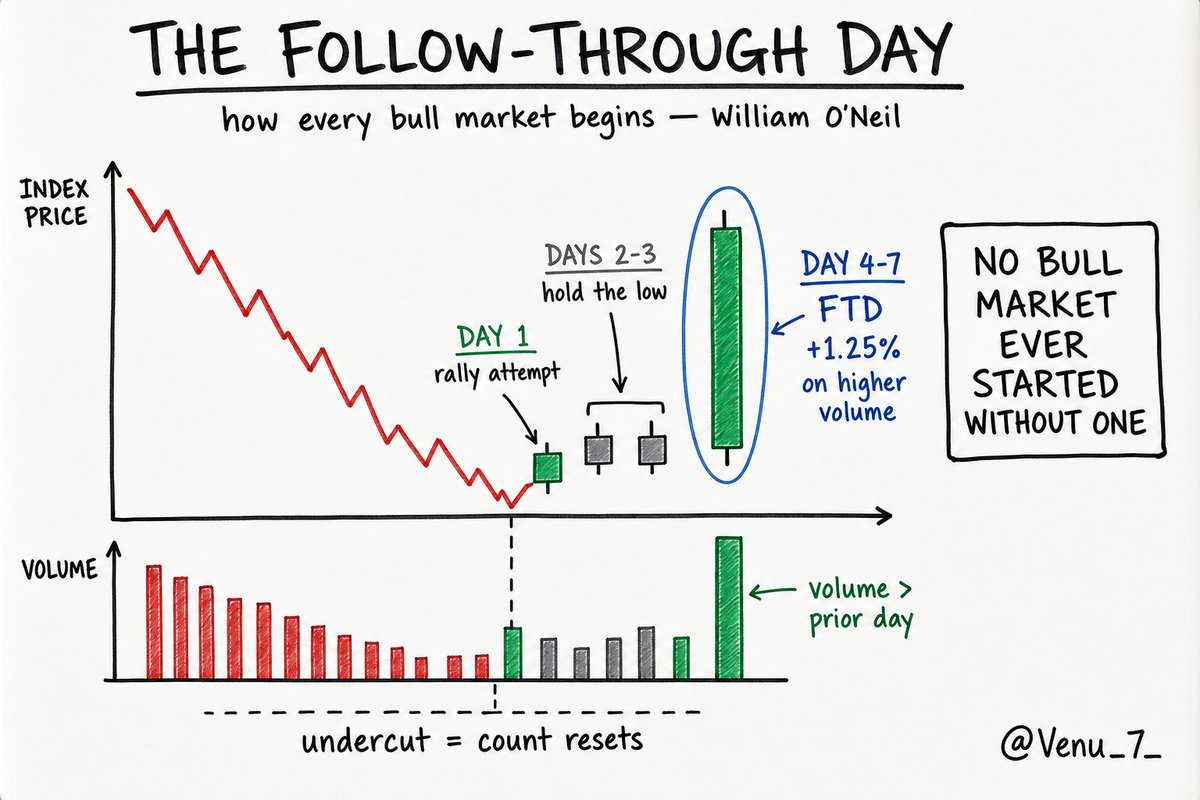
Since $QQQ just printed a gap-up candle, the next thing I'll be watching is the Follow-Through Day (FTD).
One of William O'Neil's most important rules for confirming a market bottom.
How it works:
- Market is in a correction. The first day an index closes higher = Day 1 of a rally attempt.
- Days 2-3 don't need to be up. The rally stays alive as long as Day 1's low holds.
- Then on Day 4-7, watch for one major index (S&P 500 or Nasdaq) to gain 1.25%+ on volume higher than the day before.
That's the follow-through day. Downtrend over. Confirmed uptrend.
The rules that matter:
- Not every FTD works - many fail
- But no bull market has EVER started without one.
- Undercut Day 1's low -> the count resets
- FTDs after Day 10 carry lower success rates
What to actually do on an FTD:
Don't go all in. Buy starter positions in leading stocks breaking out of sound bases. If the rally is real, they work - and you add. If it fails, you're barely exposed.
O'Neil's whole point: you don't predict bottoms. You confirm them.
Corrections are for building the watchlist. The FTD tells you when to use it.
This is when AI and technology will bottom. This is when I'll go big.
I will update you every day as new data comes in.
I'm checking $SMH, $XLK, and $DRAM to align.
If your dad sells his house the year before he dies, the IRS taxes the profit
If he dies owning it, the entire tax bill evaporates. Legally. Overnight
It's called the step-up in basis and it has quietly saved wealthy families more money than almost any rule in the tax code:
How capital gains normally work: your dad bought the house in 1989 for $60,000. It's worth $360,000 now. If he sells, the IRS sees a $300,000 gain and taxes a chunk of it
But if he DIES owning it, the tax code resets the clock. His heirs inherit the house at its value ON THE DATE OF DEATH. The basis "steps up" from $60,000 to $360,000. The $300,000 of profit that built up over 35 years disappears from the IRS's books completely
You inherit, sell it next month for $360,000, and owe tax on the gain since the date of death: roughly zero
Now watch how many families burn this by accident:
Mistake 1: aging parents sell the appreciated house to "simplify things" before they pass. They just volunteered for the exact tax bill that dying with the house erases
Mistake 2: parents add the kids to the deed while alive, or "gift" the house outright. A GIFTED house keeps the parents' old $60,000 basis. The kids inherit the full 35-year tax bill along with the keys. The single most common well-meaning move is the single most expensive one
The right sequence, and it costs almost nothing:
1. Parents keep the house in their name
2. A transfer on death deed (about 30 states, one recorded page, $50-$100) names who gets it, skipping probate entirely
3. Heirs inherit at the stepped-up value, sell whenever, keep the money
One more layer: in community property states, when one spouse dies, the SURVIVING spouse can get a step-up on the whole house. A widow selling after her husband passes may owe nothing on decades of growth
The difference between the right order and the wrong order of the same events is often $50,000-$100,000
If your parents own an appreciated house, this is a this-month conversation. One page of paperwork, done over coffee
Book a funding call or apply for mentorship, link in bio
APPLE WANTS YOU TO THINK YOU NEED TO PAY FOR ICLOUD STORAGE EVERY MONTH.
YOU DON'T.
IOS DEFAULTS SECRETLY HOARD GIGABYTES OF JUNK DATA UNTIL YOUR PHONE FILLS UP.
HERE ARE 5 SETTINGS TO STOP THE DRAIN:
The average rotation lasts 201 days. We're only 42 days through the average. 4 months left to go (mid-October) if history repeats, or maybe even sooner.
This has happened 9 times since 2000. And every single time, money came back to tech.
Here's how long each rotation lasted:
• 2025 Tariff Rotation: 70 days
• 2024 Small-Cap Surge: 28 days
• 2022 Rate Hike Cycle: 280 days
• 2021 Reopening Trade: 182 days
• 2018 Q4 Selloff: 84 days
• 2016 Trump Election: 56 days
What brings tech back every time:
- Fed pivot
- earnings beats that reset the growth narrative
- growth in cyclicals slows and investors rotate back to secular growers
This is the time to position yourself and buy low. Rain or shine, keep investing. Don't ever worry about red short-term.
I promise you, you'll be just fine and laughing next year. Don't be a coward.
2026 is tracking very closely to 1968, 1978, and 2007.
• July - choppy
• August - choppy
• September - grind higher
• October - peak
• November - sell-off
• December - choppy
If we ignore seasonality and just follow the past movements, the markets will remain flat for the next 6 months.
Google just dropped a 1-hour course on agentic engineering from scratch:
00:00 – How to build your first AI agent
08:24 – Build agent memory (short, persistent, long)
28:34 – Agentic loops, long-running AI agents
40:04 – How to build MCP (MCP vs API)
1:00:22 – Multi-agentic systems
This 1-hour watch will replace 10 paid agentic courses on the internet.
Bookmark this. Watch this weekend.
This Indicator has told you when to BUY and SELL in every market the last 30 years
Listen and Follow this if you want to become Rich from the stock market.
Since 1996, every major $VIX spike above 40 has been followed by a positive 3-year $SPY S&P 500 return.
The VIX is one of the best sentiment indicators I use.
Here’s how I use it:
1) VIX <20 → Overconfidence
• Markets feel calm
• Bull markets often live here
• Stay selective
2) VIX 20–30 → Rising Volatility
• Volatility is increasing
• Expect larger swings
• Focus on quality setups
3) VIX 30–40 → Fear
• Corrections are often underway
• Historically, strong forward returns have often followed
4) VIX >40 → Panic
• Rare occurrence
• Historically one of the best long-term buying zones
• Start buying positions, not panicking
We are currently in “Trim Positions” zone. This means to hold winners and trim positions in them.
This will be your guide moving forward. Keep this with you. Do not lose it.
This will make you millions in the stock market. Save this so you ALWAYS know what will happen.
One of my secrets is always monitoring HEAVY truck sales.
When the economy turns weak, companies are the first to react by lowering spending and procurement, causing heavy logistics to decrease. Conversely, when economic conditions improves, the purchase of trucks would rebound. It's that simple.
When truck sales are above 0.47M (top quartile):
1. economy is running hot
2. start playing a bit more defensive
3. raise quality in your portfolio
When truck sales are between 0.25M and 0.47M:
1. normal range
2. stay the course
3. hold your winners
When truck sales crash below 0.25M:
1. the economy is bottoming
2. get aggressive
3. this is where generational wealth is built
Right now?
Truck sales are at 0.43M. 73rd percentile. Not in the danger zone yet.
Costco doesn't have prices. It has a code. And almost nobody shopping there today can read it.
You walk past a stack of the same protein bars every week at $16.99. Then one week it's $12.97 and you have no idea if that's a real deal or just a coincidence. You buy it anyway, hoping. Meanwhile the guy next to you is grabbing five packs like he knows something you don't.
He does.
A longtime warehouse employee explained exactly how Costco's tag system works — the tiny numbers and symbols printed on every single price sign that tell you, in advance, whether something is full price, about to go on clearance, or about to disappear from the store forever.
Their take: "Costco never announces a sale. It just changes two digits on a tag. If you don't know what they mean, you're paying full price standing right next to someone paying half."
Here's how to actually read a Costco tag 🧵
This is all you need to time the stock market. Save this. Screenshot it. You will need it.
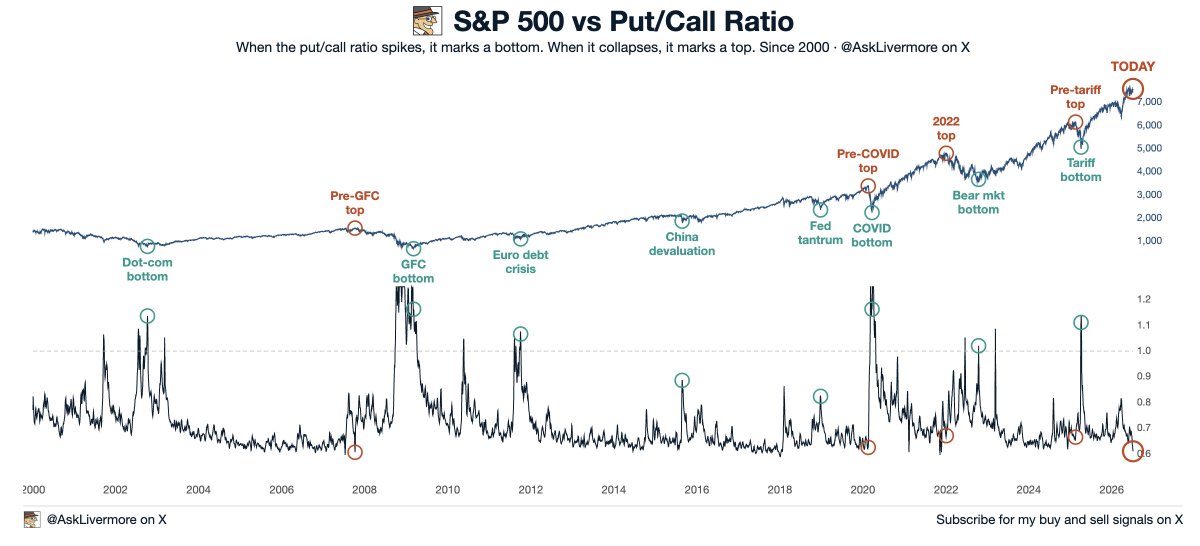
The put/call ratio tells you when everyone is panicking and when everyone is too comfortable.
Every single time the put/call ratio spiked above 1.0 since 2000, it marked a generational buying opportunity:
- Dot-com bottom (2002)
- GFC bottom (2009)
- COVID bottom (2020)
- Tariff crash (2025)
Every single time it collapsed below 0.70, a pullback followed:
- Pre-GFC top (2007)
- Pre-COVID top (2020)
- 2022 top
- Pre-tariff top (2025)
Right now? The put/call ratio just hit 0.61, the lowest since December 2020. That means options traders are the most bullish they've been in nearly 6 years.
Does that mean sell everything? No.
But it means this is the time to stay balanced, not all-in into one sector. The best buying opportunities will come soon, stay patient.
When everyone is greedy, be cautious.
When everyone is fearful, be aggressive.
My friend made $2 million last year by running his own quantitative trading system.
No MIT. No Stanford. No hedge fund background.
I asked him how he built the strategies from zero.
He sent me a course that was never supposed to get out. A quant researcher walks through 3 full strategies from data to backtest.
You won't find anything better about building quantitative strategies like hedge funds than this.
I watched it last night.
Halfway through, I realized building hedge fund strategies is embarrassingly simple.
Bookmark this & read the self-improving trading agent guide in the article below.
• 00:00 - algorithmic trading basics
��� 15:25 - quant strategy 1
• 2:05:08 - quant strategy 2
• 2:28:08 - quant strategy 3