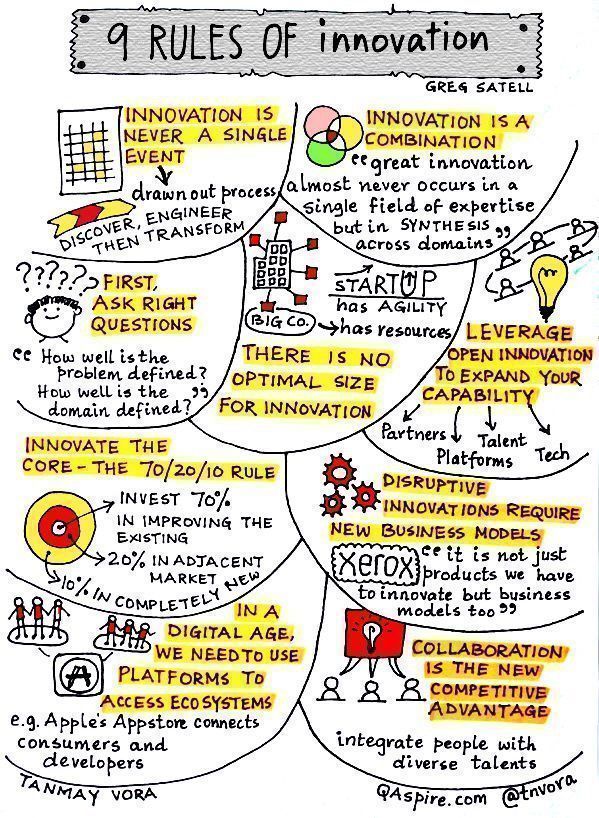
Chesbrough defined open innovation as: “a paradigm that assumes that firms can and should use external ideas as well as internal ideas, and internal and external paths to market, as the firms look to advance their technology ”(2006)
Firm-level models can be useful for firm strategy and implementation, as long as managers tailor them to suit their particular circumstances. By using models in this way, firms can help clarify key innovation variables and processes, and develop a distinctive innovation strategy.
The five generations innovation model reflects a evolving academic knowledge rather than empirically observed changes, they lack of explicit theoretical bases and usually innovation is treated as an isolated process.
The essential feature of innovation is rule-breaking rather than identifying
and pursuing rules or patterns.The appropriate model will not only depend on the sector and the particular innovation challenge, but also on the history, experience and capability of the firm in question
Many of the models tend to imply there is one ‘best practice’ model to follow. The evidence shows that there can be no standard textbook for innovation. Innovation not only depends on firm culture and context, but also leadership, ingenuity and vision.
Digital innovation includes activities of initiating (triggers, opportunity identification, decision‐ making), developing (designing, adopting), implementing (training, incentives), and exploiting. (Digital innovation: a review and synthesis, Kohli R, Melville N 2019)
@FerGonzo igual meter a algún empresario o autónomo, de los normales, ese 99% que no son IBEX 35, estaría bien para entender cuál es el origen del problema