The reason most IoT projects end up routing through the cloud isn't because it's better.
It's because it's the only architecture that reliably works when your devices don't have static IPs.
That constraint is shaping an entire industry. Worth asking if it should.
In the 80s, asset prices were rising, times were good. Same with the early 2000s. We know how both of those stories ended — farm crisis and housing crisis, respectively.
Those are just 2 examples, but greed, shortsightedness, arrogance, and “this time is different” ideology tend to recur regardless of the asset.
I just don’t get how more people don’t feel this way about AI/GPU given the similarities.
Just wrapped Day 1 at DevWorld Amsterdam.
Met incredible builders, had sharp conversations, and one thing is clear: developers are actively looking for better infrastructure, stronger privacy, and systems that actually scale.
Day 2 let's gooo!
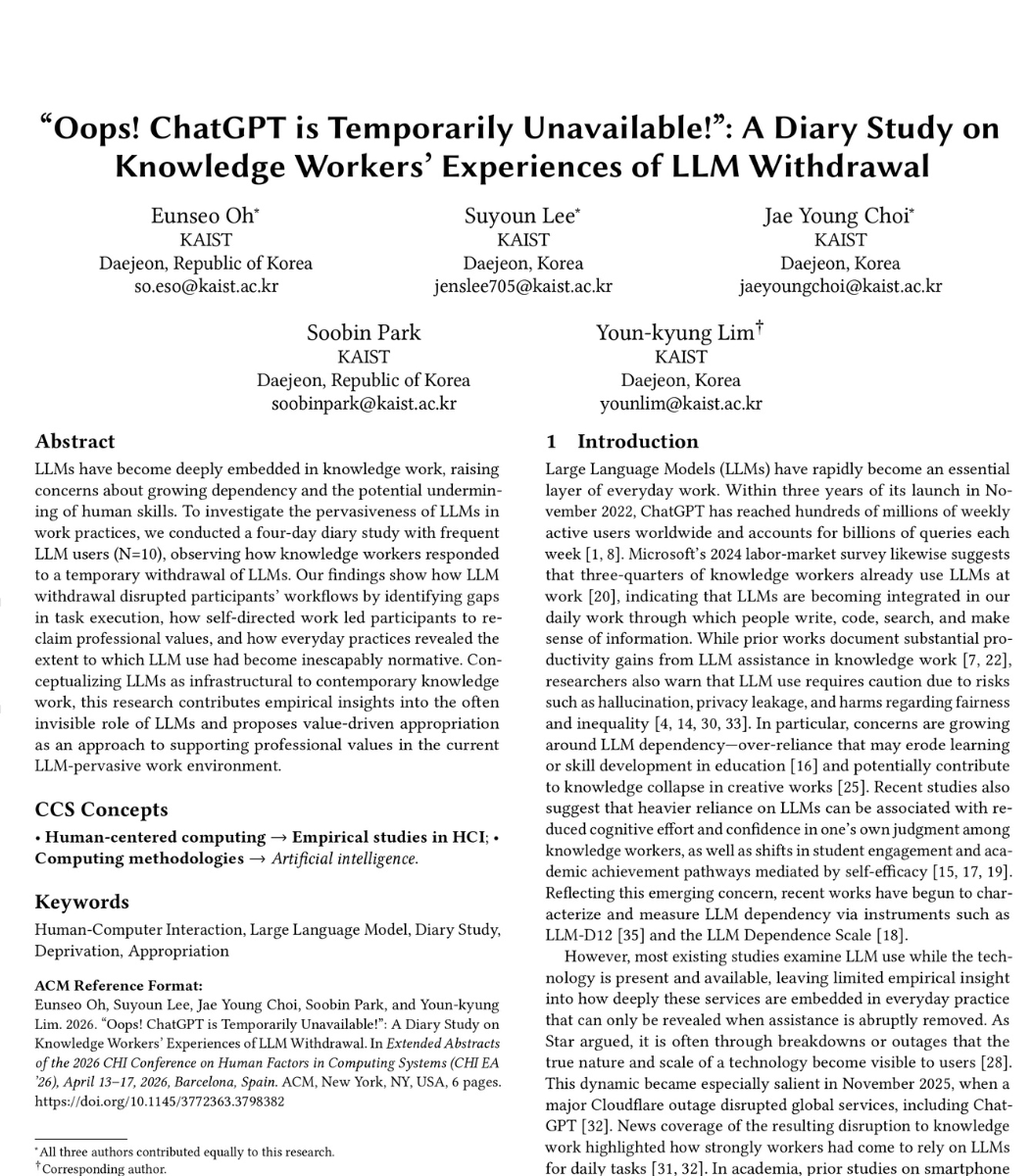
🚨SHOCKING: Researchers took ChatGPT away from workers for 4 days.
They couldn't ask coworkers for help. They described talking to another human being as a burden.
Here is what they found.
Researchers conducted a four-day diary study on 10 knowledge workers who frequently use ChatGPT. They removed access to all LLMs completely and documented everything that happened.
The disruption was immediate.
Workflows broke down. Participants found gaps in their ability to execute tasks they previously handled with AI. Without the tool, they realized how many parts of their process had quietly been handed over to the machine.
But the most disturbing finding wasn't about productivity.
It was about people.
When participants needed help during the withdrawal, they refused to ask coworkers. They described asking another human being for assistance as a social burden. They assumed their colleagues would find it tiring and burdensome.
One participant said they avoided asking people questions because they feared being seen as a "finger prince" - a Korean slang term for someone who burdens others with easily searchable questions.
They would rather switch between different AI services, from ChatGPT to Grok, than have a conversation with the person sitting next to them.
ChatGPT didn't just become a tool. It replaced human interaction entirely. And when it was taken away, these workers had forgotten how to reach out to each other.
The researchers described LLM use as "inescapably normative." The participants didn't even realize how dependent they had become until the AI was gone. It had woven itself so deeply into their daily routines that its absence felt disorienting.
But here is what nobody expected.
When forced to work without AI, participants started reclaiming professional values they had lost. They reconnected with their own thinking. Some found that human help was actually more useful than AI had ever been.
One participant said that if the withdrawal had lasted a year, "discussions between people would be more active."
Four days without ChatGPT and they remembered what it felt like to think for themselves.
The question is whether the rest of us ever will.
The value of fact-based knowledge has plummeted in the age of information, whereas the value of reasoning, discernment, pattern-recognition, and connection-making has skyrocketed.
I grew up loving Apple. Vividly remember walking out of the Apple Store with my dad probably 15 years ago and saying to him, “wow, they are so ahead of their time.” That was right at the end of the Jobs era, I was 11, and I had an utterly standard experience. Everyone left feeling that way.
Apple has uniquely relied on the Halo effect — the human psyche likes to apply broad, sweeping “good” or “bad” labels to things — and for a long time, this has served Apple very well. I was young at that time, but to me, everything they did was blessed.
In the last few years, the bugginess of their software has started to shift my opinion ever so slightly. I still think Apple is supreme in a lot of ways, but no longer do they uphold the same standard of absolute perfection in their OS logic. Some recent design decisions have been questionable at best, too.
Add to that their lack of AI investment. When the LLM mania first began, Apple received a ton of criticism for not jumping on the bandwagon. It felt, in combination with their standards slippage, like a definitive blow to their reputation. At the time, it didn’t feel like a choice they made, it felt like a choice that was made for them. They just didn’t have the talent to compete.
I then remember some analysis in 2024 about the impending doom of the company given Warren Buffet barely included Apple in his annual letter.
All of these things were noted.
The thing is, now that we’re a few years into the age of AI, I can say confidently that I think Cook et al. were on the money for not trying to overly invest into AI and integrate LLMs into their OS. Look what it’s done to Microsoft. Look what it’s done to… well, everything. I’m now looking back to 2023/2024 and thinking Apple may have hedged their bets correctly.
This feels like an extremely critical time for one of The Magnificent 7 to reestablish dominance and grow their lead again, or risk falling back in with the pack it’s been leading for so long. Their halo is a bit crooked.