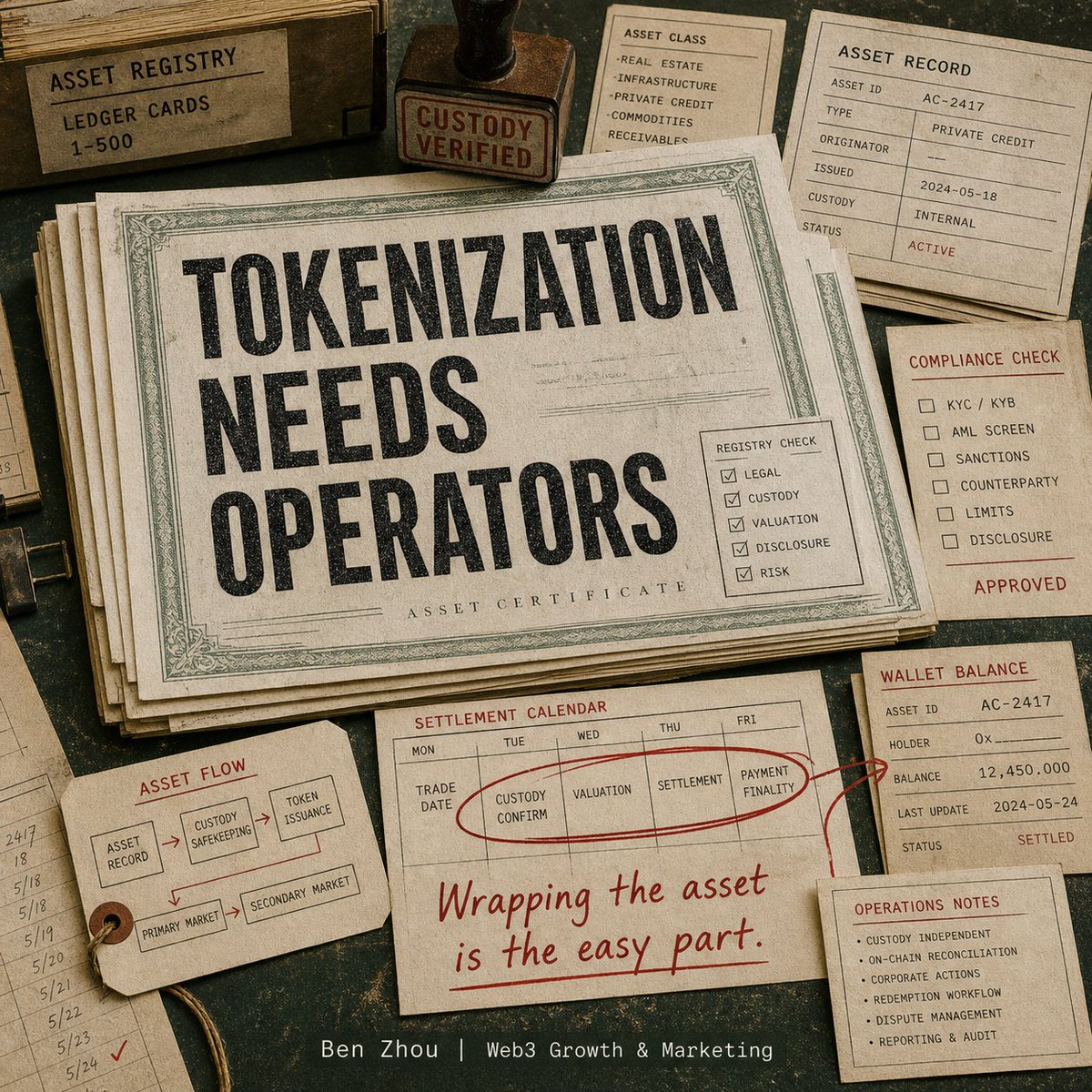
Tokenization is getting treated like a wrapper problem. I think that misses where the work actually is.
Putting an asset on-chain is the clean demo.
The messy part is custody, redemption, reporting, secondary liquidity, investor onboarding, and what happens when someone needs to exit on a bad week.
RWA founders should spend less time saying "institutional grade" and more time showing the boring flow: subscribe, settle, hold, redeem, reconcile.
The asset is not the product. The operating loop is.
#Tokenization #RWA #CryptoOperators #OnchainFinance
Prediction markets make fandom less polite.
Polymarket's 2026 World Cup market is sitting around hundreds of active markets and billions in volume. That is not just people "engaging with sports." It is people pricing their bias in public.
This matters for crypto growth because the wallet action comes before the loyalty story.
A user takes a position, watches the odds move, checks injury news, argues with strangers, then comes back because their money made the match personal.
Most communities try to manufacture belief first.
Markets make users reveal it.
#PredictionMarkets #WorldCup2026 #MarketPsychology #CryptoRewards
India's USDT premium is a better crypto adoption signal than half the "mass adoption" charts people share.
When users pay extra for USDT, they are not buying a narrative. They are buying access, speed, and a dollar balance they can actually move.
For operators, the lesson is uncomfortable: stablecoin growth is mostly distribution work. Local liquidity, ramps, banking friction, merchant acceptance, OTC trust.
A campaign can create demand. It cannot fix a broken supply route.
#Stablecoins #CryptoGrowth #IndiaCrypto
#Web3Ops
One KOL mistake I still see: teams buy reach from creators who talk to traders, then measure the campaign like they reached users.
Traders click fast. They join fast. They also disappear fast when the chart stops paying them.
If the product needs deposits, swaps, quests, or repeat wallet actions, I would rather have 20 smaller creators with ugly but sticky audiences than 3 big accounts that create a one-hour candle.
The clean report says impressions, clicks, CPM.
The useful report shows which cohort came back after rewards ended, and which one only came for the screenshot.
#KOLMarketing #CryptoGrowth #Web3Marketing #UserRetention
July 1 has USA vs Bosnia, Mexico vs Ecuador, England vs DR Congo, and Belgium vs Senegal on the World Cup schedule.
One day, four completely different audience maps.
This is where crypto teams usually get lazy. They run one global campaign, translate the copy, reuse the same KOL brief, then wonder why the Telegram is full but the wallet data is thin.
A fan in Mexico City, a diaspora user in London, and a casual bettor in California do not enter the funnel for the same reason.
Localization is not language. It is knowing which emotion gets someone to connect a wallet today.
#CryptoMarketing #CommunityBuilding #Web3Ops #WorldCup2026
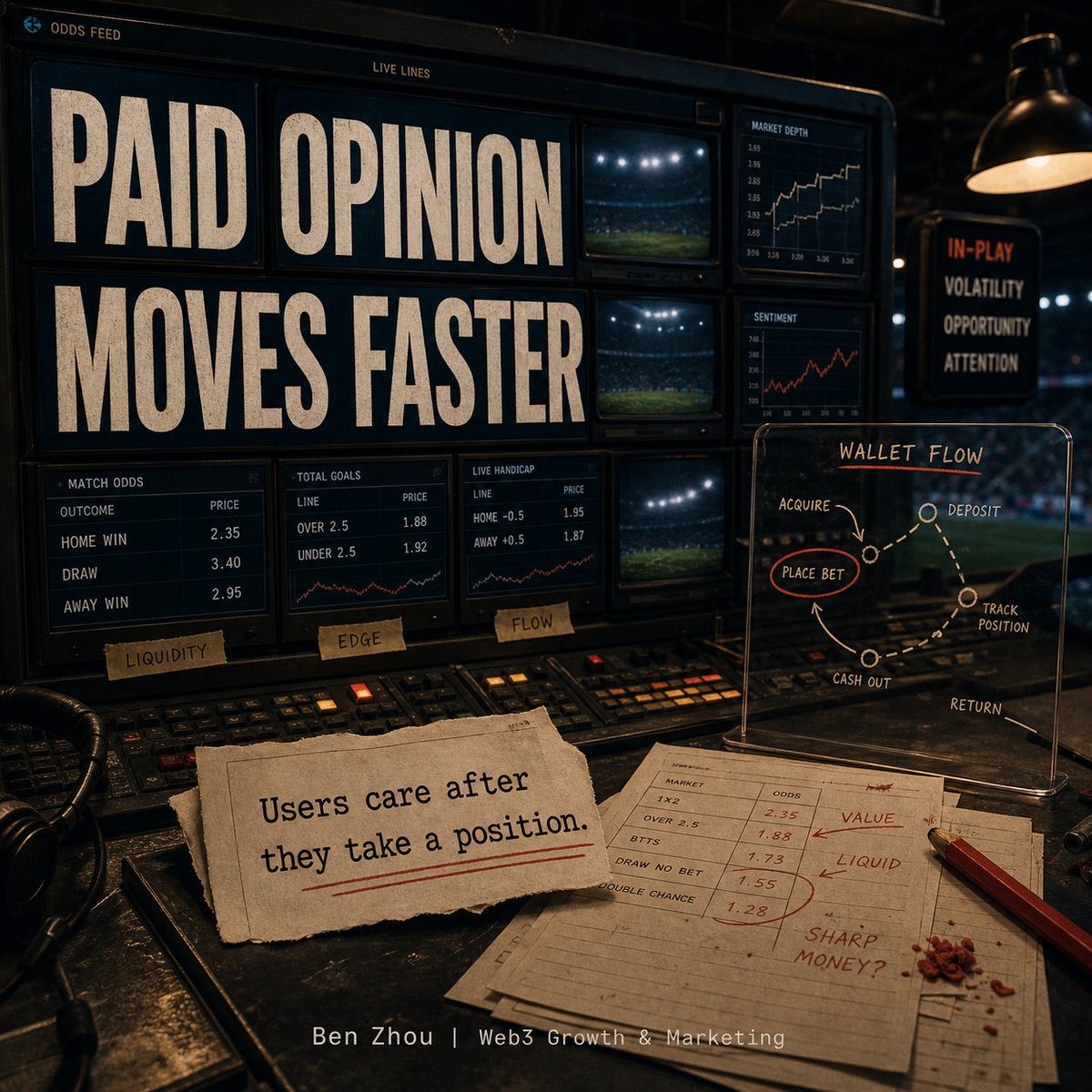
Prediction markets are making fandom brutally readable.
Polymarket's World Cup page shows 225 active markets and over $3.7B in volume, with France around 33% on the winner market today.
That sounds like culture. It is closer to paid opinion.
The useful operator lesson is not "sports fans love crypto." It is that people will connect wallets when the product gives them a live reason to change their mind. Injury news, penalties, bracket movement, odds moving every few minutes.
Most crypto apps ask users to believe before they behave. Prediction markets flip it. First the user takes a position, then they start caring.
#PredictionMarkets #WorldCup2026 #CryptoGrowth #Web3
After a loud TGE, the dangerous part is how smart everyone suddenly sounds.
KOLs repost charts. Community mods screenshot green candles. Founders start reading Telegram like product feedback.
Then incentives cool down and the room gets honest. Fewer questions about roadmap. More questions about unlocks, listings, market maker depth, and why the chart looks tired.
A launch gives you noise to manage. The first quiet week tells you whether people came for the product, the allocation, or the exit liquidity.
I trust the quiet week more.
#TokenLaunch #FounderLessons #CryptoOperators #Web3Game
Stablecoin volume is starting to look too clean for marketers to quote without context.
Q1 reports put total stablecoin transaction volume above $28T, with bots driving around 76% of activity. Retail-sized transfers below $250 fell 16%.
That is the operator lesson: volume can be real and still useless for your campaign.
When I look at a stablecoin growth push, I care less about total transfers and more about boring behavior: second deposit, balance held after fees, same wallet returning after the incentive ends.
If your dashboard cannot separate arbitrage flow from human intent, you may be optimizing for a machine that was never going to become a user.
#Stablecoins #OnchainData #CryptoGrowth #Web3Ops
World Cup knockout days are a clean reminder that attention is rented.
On June 29, Brazil vs Japan, Germany vs Paraguay, and Netherlands vs Morocco all sit on the same global attention rail. Every brand wants the spike. Most crypto teams would buy it, drop a quest, and call it community growth.
I’d rather see what happens 48 hours later.
Did the fan connect a wallet twice? Did they keep a stablecoin balance? Did they come back without rewards pushing them?
Matchday can fill the top of funnel. It rarely proves belief. The ugly metric is post-event silence.
Suggested hashtags
#Web3 #CryptoMarketing #WorldCup2026 #CommunityBuilding
A moderator who answers the same bridge question 40 times knows something the product dashboard doesn’t.
Analytics may show a completed transaction.
The moderator sees the hesitation before it: users worried about the network, the gas token, the destination address, and whether their funds have vanished.
Teams often file this under “community support” and move on.
That repeated confusion is product data. Tag it, count it, and send the exact wording back to product.
By the time churn appears in the weekly dashboard, the Discord team has usually been watching it happen for days.
#CommunityBuilding #UserRetention #Web3UX #CryptoOperators
I’ve watched projects celebrate a global exchange listing, then discover that almost nobody in their target market used that exchange.
There was volume on day one. Market makers handled that part.
What never appeared was local demand: no regional deposit growth, weak fiat access, barely any native-language search activity, and no community habit around the trading pair.
A recognizable exchange logo looks good on the announcement graphic. It can still be the wrong distribution channel.
Before paying for another listing, check where your actual holders fund accounts and where they already trade.
#ExchangeListing #CryptoMarketing #MarketExpansion #Web3Operators
Stablecoins are getting treated like a product category. I think the bigger fight is over default placement.
A Wharton report put stablecoin market cap just under $315B. Circle also reported daily transaction volume rising from $1T to $4T after the GENIUS Act passed.
Once a stablecoin becomes the default collateral on an exchange, the default balance in a wallet, or the easiest settlement asset for merchants, switching gets annoying.
Most users will not compare reserve structures before every transaction. They’ll use what is already liquid, integrated, and redeemable inside the product.
That default position is the moat.
#Stablecoins #DigitalAssets #CryptoGrowth #Tokenization
I’ve sat in KOL launch rooms where 30 creators posted within ten minutes, using the same screenshot and almost the same wording.
The dashboard looked great for an hour. The timeline looked bought.
The brief was too controlling. Give creators enough proof to make the claim in their own words, plus clear boundaries around what they cannot say.
If every post sounds like it came from the same Telegram admin, the audience prices it as an ad immediately.
Synchronized reach can create a spike. It rarely creates belief.
#KOLMarketing #CryptoMarketing #Web3Growth #CryptoOperators
Users don’t lose faith suddenly.
They reprice trust slowly.
First they stop replying in Discord.
Then they stop joining calls.
Then they stop defending the project in public.
Then one day the founder says “sentiment changed,” as if it happened overnight.
It didn’t.
In tokenized communities, trust leaks through small unanswered moments: delayed updates, vague treasury language, missed roadmap dates, confusing incentives, and price action nobody wants to discuss.
The chart is usually the last place the damage becomes visible.
Operators should watch behavior before sentiment turns into narrative.
#MarketPsychology #CryptoCommunity #Web3Growth #CryptoOperators
AMAs don’t build trust.
Follow-up after hard questions does.
I’ve seen teams run polished AMAs, answer the easy prompts, skip the uncomfortable token questions, then wonder why the community still feels cold.
Crypto users notice avoidance faster than founders think.
If someone asks about unlocks, liquidity, treasury runway, product delays, or market-maker behavior, the answer does not need to be perfect.
But it needs to exist.
Trust is not built when the host says “great question.”
It is built when the team comes back with specifics after the call.
#CommunityBuilding #CryptoMarketing #Web3Operators #Tokenomics
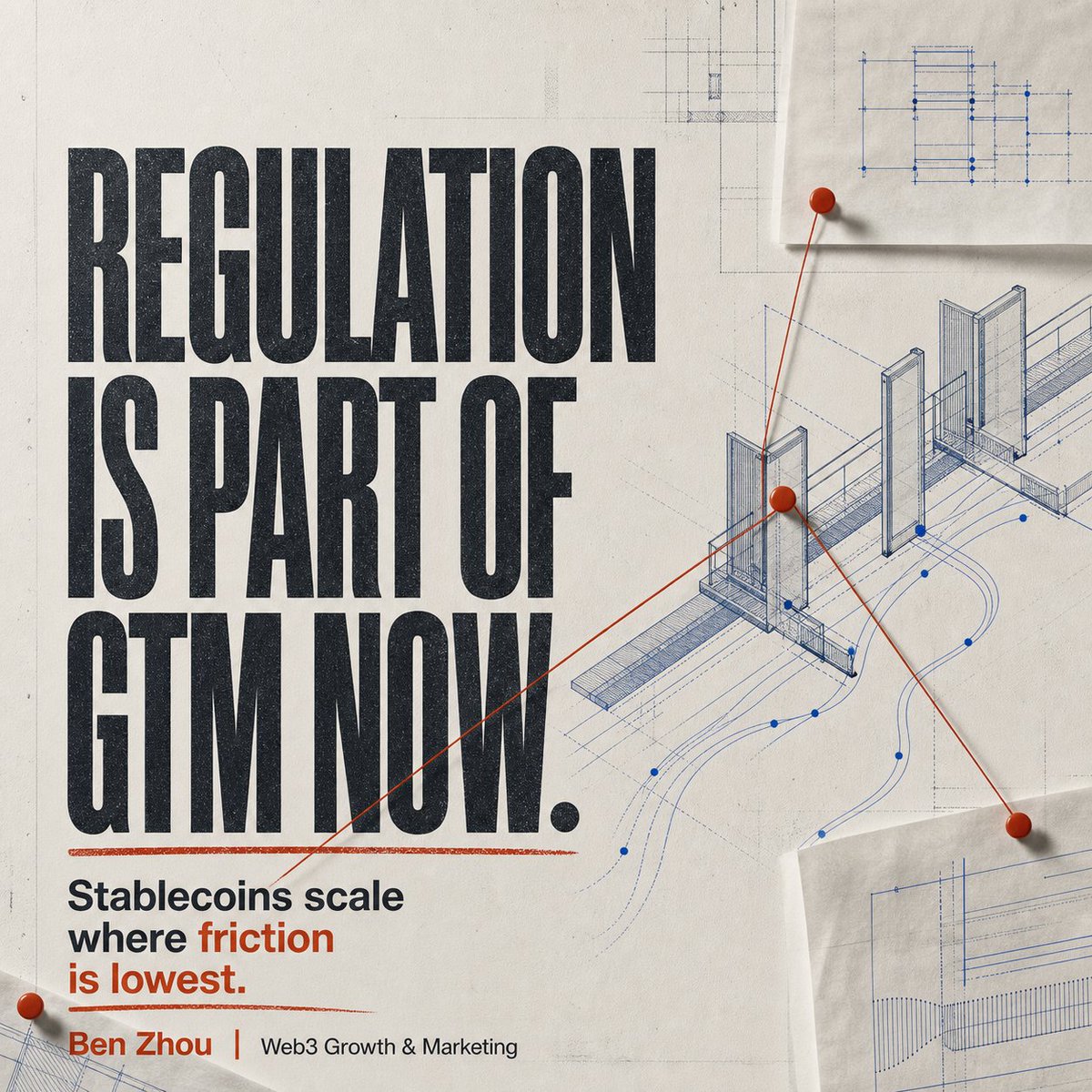
Regulation is part of GTM now.
The Bank of England softening its stablecoin proposal is not just a policy update. It is a reminder that stablecoin growth will follow the lowest-friction path.
Issuers will optimize around reserve rules, redemption access, issuer caps, banking relationships, and payment partner comfort.
That means growth teams can’t treat regulation as a legal department problem anymore.
For stablecoins, compliance design affects distribution.
If your product is harder to hold, redeem, integrate, or explain than a competing rail, users won’t care that your thesis is cleaner.
They’ll use the rail that works.
#Stablecoins #CryptoRegulation #Web3Growth #DigitalAssets
Fundraising can distort operator judgment.
After a good round, some founders slowly start optimizing for investor updates instead of user behavior.
The roadmap becomes more impressive. The language gets more institutional. The announcements get cleaner.
But the community gets less specific.
Fewer real users. More narrative maintenance.
I’ve seen this pattern in crypto more than in any other market because token expectations, exchange pressure, and investor signaling all collide in public.
The cap table is not the customer.
If your product decisions sound better in a monthly update than inside a user conversation, something has already drifted.
#CryptoFounders #OperatorNotes #Web3Startups #FounderPsychology
User education is not content volume.
I’ve seen Web3 teams publish 20 explainers, run 5 AMAs, and still lose users at the first product action.
The issue was not lack of content.
The issue was that nobody could repeat the value back in plain language.
In crypto, this matters more because the user has to trust a wallet, sign a transaction, move funds, bridge assets, or hold a token through volatility. Confusion has a financial cost.
A good education loop does not make users feel informed.
It makes them confident enough to act.
If your users cannot explain why the product matters without copying your tagline, your marketing has not landed yet.
#CryptoMarketing #UserEducation #Web3Growth #ProductMarketing
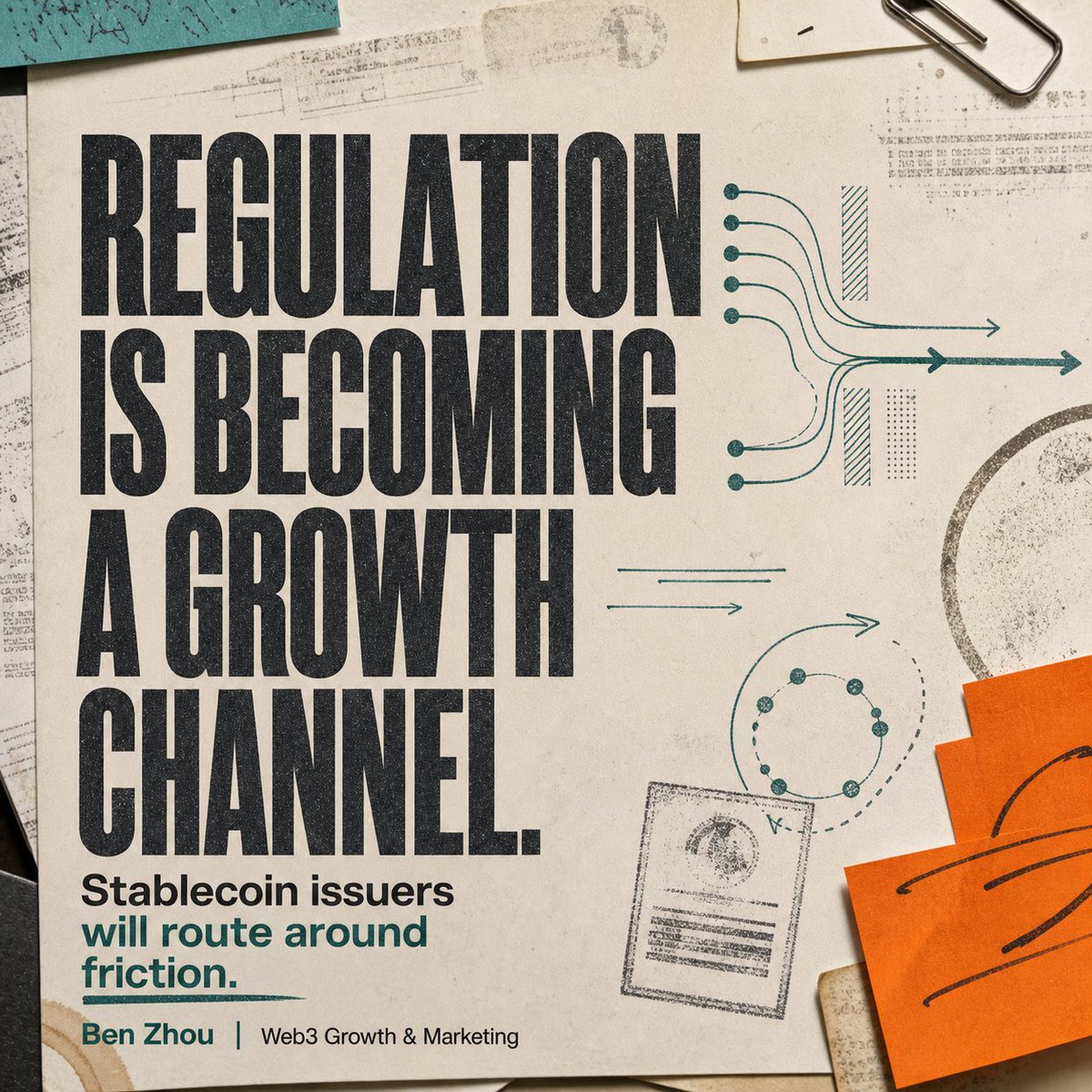
Regulation is becoming a growth channel.
The Bank of England just softened its stablecoin proposal after industry pushback: no more individual/business holding limits, a temporary £40B issuer cap, and lower central-bank deposit requirements.
That sounds like policy detail. It is really distribution strategy.
Stablecoin issuers will go where redemption, reserves, banking access, and payment use cases are easiest to scale. If one jurisdiction makes the product clunky, liquidity simply routes somewhere else.
Crypto founders should pay attention.
Regulation is no longer just a legal risk. It shapes where users, exchanges, market makers, and payment partners decide to operate.
The growth team that understands policy friction will move faster than the one only watching CT sentiment.
#Stablecoins #CryptoRegulation #Web3Growth #DigitalAssets
Crypto founders like to say token price is “up to the market.”
It isn’t that simple.
Price is part of the product experience.
It changes community behavior, support volume, KOL sentiment, governance participation, and whether new users trust the project enough to deposit capital.
Founders cannot control the chart. But they do control unlock design, treasury communication, liquidity planning, market-maker incentives, and the expectations created before launch.
Ignoring price is sensible.
Ignoring the systems that shape price is negligence.
#CryptoFounders #TokenLaunch #MarketPsychology #CryptoOperators