Wall Street is paying less attention to the Magnificent 7:
Monthly mentions of the "Magnificent Seven" across news stories on the Bloomberg terminal are down to ~1,400, near the lowest since Q4 2023.
This marks a -70% decline from the Q1 2024 peak of ~4,300 mentions, which came shortly after the term was introduced in 2023.
A similar pattern occurred with the "FANG" and later "FAANG" labels, originally referring to Facebook, Amazon, Netflix, and Google before Apple was added.
Monthly mentions of "FANG" and "FAANG" surged to a record ~2,800 in Q4 2018.
Subsequently, they dropped -82%, to just ~500 mentions by early 2020.
Investor attention has shifted away from the Mag 7.
South Korean retail investors are turning to US stocks amid domestic market turmoil:
Retail investors from South Korea bought +$4.6 billion worth of US stocks in July, the largest monthly total since January 2026.
This marks a +627% MoM increase and follows -$469 million and -$940 million in sales in April and May, respectively.
July purchases were also well above the +$2.7 billion monthly average recorded in 2025, a year when South Korean retail investors more than tripled their purchases of US equities from 2024.
As a result, South Korean retail investors bought more US stocks last month than domestic equities for the first time since February.
This comes as the KOSPI Index has dropped -33% from its June peak, with ~75% of the decline driven by the 2 largest chipmakers, Samsung and SK Hynix.
US stocks are benefiting from South Korea's market downturn.
BREAKING: Berkshire Hathaway has begun deploying the $397.4 billion cash pile that Warren Buffett accumulated for 14 consecutive quarters.
Details include:
1. Instead of continuing stock sales, Berkshire was a net buyer of equities in Q2 with $19.8 billion in net purchases
2. Berkshire now holds $364.7 billion in cash and cash equivalents
3. The company invested $10 billion in Alphabet, $GOOGL, during Q2 in addition to acquiring Taylor Morrison Home for $6.8 billion
4. Berkshire bought $23.5 billion of equity securities during in Q2 and sold $3.7 billion in the same period
Berkshire Hathaway appears to be leaning bullish again.
BREAKING: US corporate profits before tax as a % of GDP are up to a record 14%.
This ratio has nearly doubled since the 2008 Financial Crisis.
This also exceeds previous peaks of ~13% posted in 1951, 2010, and 2011.
Meanwhile, US corporate profits after tax as a % of GDP are up to ~11%, also an all-time high.
By comparison, this figure averaged ~5% between 1980 and 1995.
This comes as nominal profits after tax have surged +101% since the 2020 pandemic, to a record $3.62 trillion.
US corporations are more profitable than ever.
This is absolutely incredible.
Corporate America is currently on pace for the biggest earnings beat EVER recorded.
S&P 500 companies are beating earnings per share estimates by an aggregate +29.2%.
To put this into perspective, the 5-year average stands at +7.0%, which is already historically high.
In other words, S&P 500 companies are now beating already high expectations by ~4.2 TIMES the 5-year average.
On top of this, the blended net margin for the S&P 500 is up to 16.9%, also an all time high.
Even if you removed Alphabet’s $98 billion gain from unrealized equity investments and Amazon’s $53 billion gain from Anthropic, S&P 500 earnings growth would STILL be +32.0% year-over-year.
We are in the midst of the largest investment boom in history.
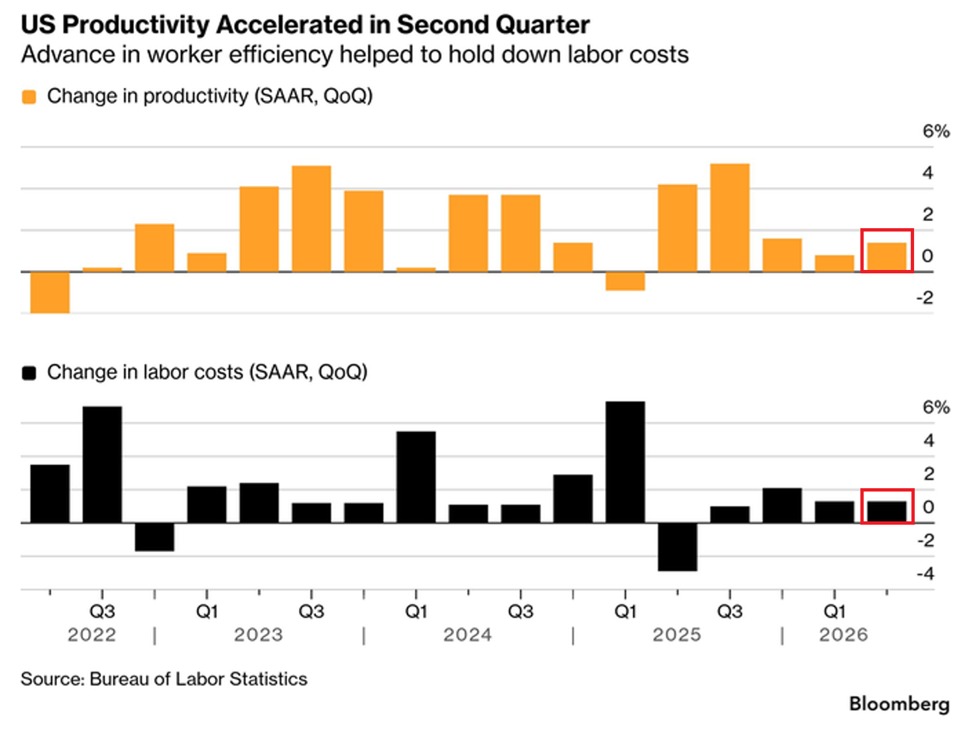
US productivity growth is accelerating:
US labor productivity rose +1.4% annualized rate in Q2 2026, more than double the +0.6% expected.
This follows an upwardly revised +0.8% increase in Q1, marking the 5th consecutive quarter of productivity gains.
At the same time, US manufacturing productivity jumped +1.9%, driven by a +4.6% surge in output, the strongest increase since Q4 2021.
However, these productivity gains came at the expense of workers, with inflation-adjusted compensation falling -3.2%, the largest quarterly decline since Q4 2022.
Meanwhile, unit labor costs, which measure how much a company pays workers to produce one unit of output, rose just +1.3% last quarter, well below the +2.1% expected.
The productivity boom is gaining momentum.
BREAKING: The S&P 500 closes at the highest level on record, up another +3.6% this week.
The S&P 500 added +$2.5 trillion in market cap this week.
Most people don't realize how big of a growth wave we are currently experiencing.
So far, with 88% of S&P 500 companies reporting earnings, the index has posted +50.4% growth in earnings year-over-year.
To put this into perspective, the already astronomical expectation of +23.1% growth has been more than doubled.
This will mark the 2nd consecutive quarter of earnings growth above +25% and the 7th consecutive quarter of double-digit earnings growth for the S&P 500.
The last time growth was this strong was in Q2 2021 as the US economy emerged from the pandemic and $4+ trillion in stimulus was handed out.
We are arguably in the midst of the biggest technological revolution in US history.
The data is absolutely insane.
@nicksortor@MattWalshBlog as long as interest rates are high, the housing market isn't going to move much.
there is much pent up demand for buy and sell.