📢#NeSy 2024: 18th International Conference on Neural-Symbolic Learning and Reasoning (https://t.co/rZna4T7wXd). Barcelona, Spain. September 9-12, 2024.
Deadline full papers: April 12, 2024.
@AvilaGarcez@jeublanc@NeSy_City
The heretofore silent majority of AI scientists and engineers who
- do not believe in AI extinction scenarios or
- believe we have agency in making AI powerful, reliable, and safe and
- think the best way to do so is through open source AI platforms
NEED TO SPEAK UP !
New paper with Simon Odense on the semantics of neurosymbolic systems:
https://t.co/HZMVmbKJPi
Many approaches fall into the same semantic framework...
The desired model behaviour will be reflected in the updated model parameters. This is accomplished with the use of Logic Tensor Networks as an approach for deep learning from data and knowledge in fully differentiable fuzzy logic.
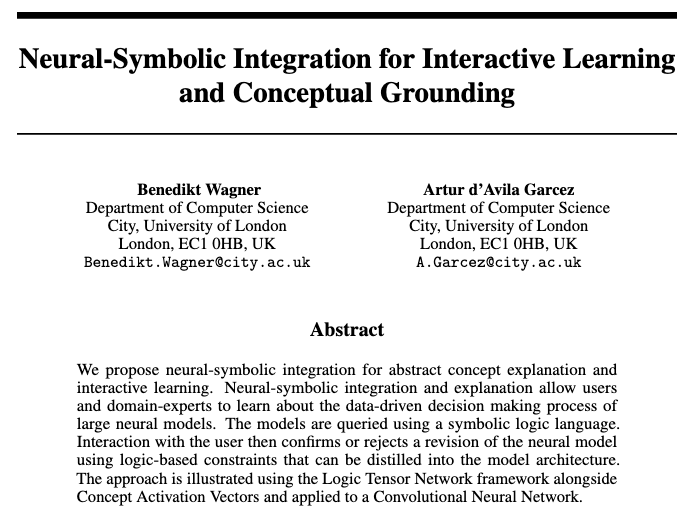
Happy to introduce you to our latest work on taking a neural-symbolic approach to explainable AI with @AvilaGarcez published at NeurIPS 2021 Workshop on Human and Machine Decisions,
https://t.co/W6qB44GzWJ
In addition, the concepts may be used to impose new constraints onto the neural network, such as: the model should only recognise all horse-like objects with stripes as being zebras as long as the stripes are black and white.
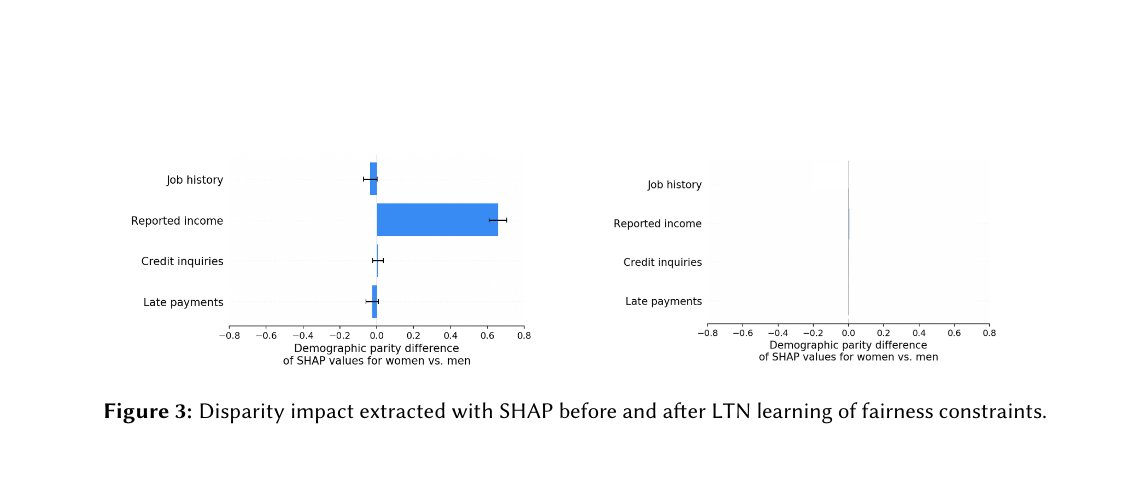
We compare against fairness-based methods on 2 common notions of fairness across 3 three datasets.
While the appropriateness of such notions are being discussed, the approach is adaptable and model-agnostic as LTN serve as a framework to complement explainability techniques
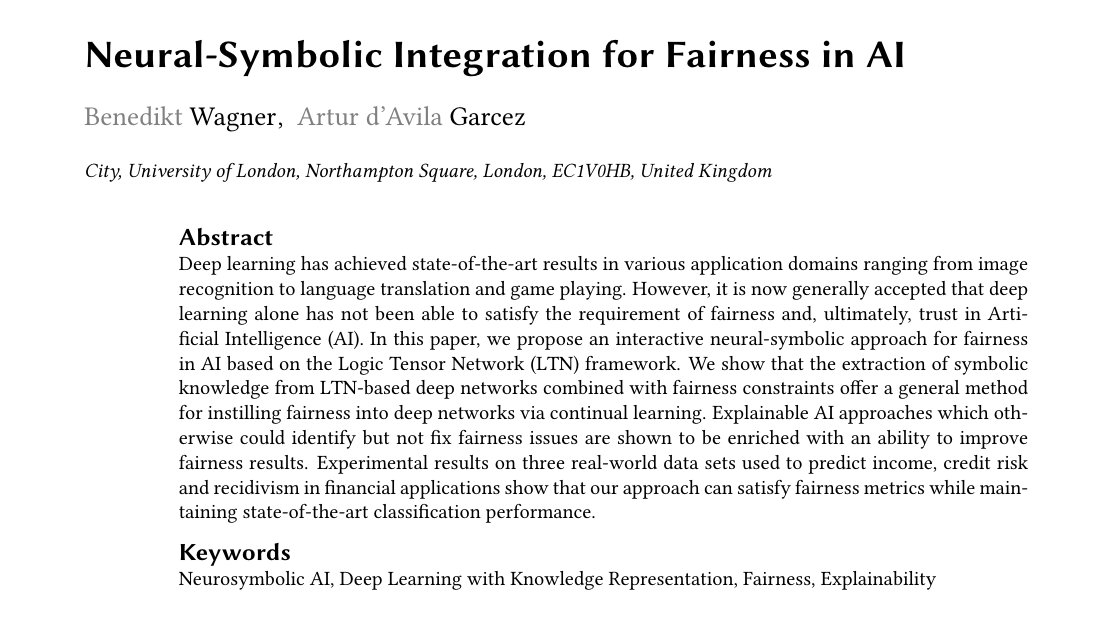
Happy to announce that our work (w/ @AvilaGarcez) on “Neural-Symbolic Integration for Fairness in AI” has been published at the AAAI 2021 Spring Symposium, AAAI-MAKE 2021: https://t.co/Ik4Xt1TTI1
The Neural-Symbolic integration allows to not only better understand the decision-making process but also to intervene and act on extracted knowledge.
We use First-Order-Logic constraints to adress these unwanted biases while retaining high predictive performance.