Material success is NOTHING if the integrity of your Soul is compromised.
Financial freedom can only come as a reflection of inner freedom.
Otherwise, it's worthless.
We live in an era where temptations are rampant. Every day you find yourself at a crossroads, which asks you to choose which path to follow:
1) The path of homologation, made up of shortcuts, compromises, altered authenticity, uncomfortable comparisons that lead you to act in a way that is not consistent with your deepest inner voice.
"Adapt just a little, kneel even for a moment, and everything you desire will be yours...".
The temptation is strong, continually fueled by comparison with others. As they say, the grass is always greener on the other side.
If your Soul's mission is to change the status quo, every time you bend over and ignore its voice to enjoy some comfort, your Soul suffocates and retreats on its own planes.
This path is a shortcut to misery, because you are confusing the cause (inner freedom) with the effect (happiness and success).
The material world may be generous in the short term to those who kneel before it, but this always comes with a price to pay. A higher price than you imagine.
There is no amount of money that can fill a hole in your consciousness.
2) The path of integrity, walked with a straight back, paved with 'NO's, both received and said.
It is a difficult path, for a few, as often those who follow it cannot even enjoy the results of their efforts in the same incarnation.
It is the path of selfless service, the only way to trace a path that does not yet exist.
It is NOT a shortcut on the material level, but it is certainly the short way on the spiritual level.
If you decide to travel it, know that a literally superhuman effort will be required of you.
It depends on your ability to discern and say no to everything you don't feel deeply aligned with.
The devil's temptations to Jesus in the desert are the perfect example, and the fact that he resisted is not to be taken for granted.
When financial freedom comes as a reflection of this integrity, then you can truly enjoy it, because there is no hole in your consciousness that needs to be filled, and on your deathbed you will have the priceless feeling of having fulfilled your duty and destiny.
To walk this path requires unshakable Faith, and very few succeed.
Yet, all the great men of the past have this in common: the uncompromising perseverance in following the voice of their own Soul without being distracted by the noise of matter.
PLUG-IN AIR FRESHENERS: THE HIDDEN LIVER ENERGY DRAIN BEHIND THAT ROOM SCENT
The fragrance industry sells plug-in diffusers, scented candles, and aerosol sprays as harmless. Government safety testing only checks for sudden airway damage on a single day, not the slower cost of continuous exposure.
A study measuring the air inside homes running fragrance diffusers found total chemical levels swinging from 30 to over 5000 micrograms per cubic meter across three days, exposure that rarely causes an obvious symptom but sends a steady stream of fat-soluble chemicals into the bloodstream for the liver to process, one molecule at a time, for as long as the diffuser runs.
How your liver breaks down fragrance chemicals
Phthalates, added to help scent linger, cross straight from lungs to bloodstream when inhaled, skipping the gut's filtering entirely. The liver breaks these down into reactive byproducts, then neutralizes each one by attaching an individual sugar tag before it can be flushed out in urine.
Lab tests on human liver tissue found these byproducts grip their processing enzyme tightly, meaning a heavy fragrance load turns this into a repetitive, resource-draining job rather than a quick filter.
Where the estrogen story needed correcting
It's tempting to assume fragrance chemicals clogging this detox pathway directly block estrogen clearance too, since the same enzyme family handles both jobs. One study complicates that: the specific enzyme fragrance chemicals compete hardest for isn't the one that clears active estrogen.
A broader screening test across fifteen different phthalates found this same clogging pattern showing up widely across the enzyme family, yet when researchers tested these byproducts directly against the separate enzymes that actually do clear estrogen, the effect was negligible. That distinction matters: blocked clearance would mean estrogen building up, not falling, and real-world data shows it falling instead.
The more likely explanation sits earlier in the process, in how the hormone gets made rather than how it gets cleared: fragrance byproducts are known to stress the same cellular machinery estrogen is manufactured with, though only at doses well above ordinary home exposure, so this remains a plausible mechanism rather than a proven one.
What the human data shows
Postmenopausal women with double the urinary phthalate marker had estrogen levels 5.9 to 9.1 percent lower across different analysis models in one national health survey, though that finding didn't survive correction for testing multiple hormones at once, so it belongs in the worth watching category. Premenopausal women showed no change.
The exposure data itself is more solid: women who use perfume carry close to three times the urinary concentration of one breakdown product compared with non-users. Higher levels of these same breakdown products have been linked to lower semen quality in men, though findings across studies are mixed.
Removing the ongoing chemical source, keeping the liver's energy and carbohydrate reserves well stocked, and getting enough of a couple of key minerals are the levers with the most direct support behind them.
What the evidence does not show
No trial has directly measured this liver energy cost in a real home. It's inferred from how the enzymes work. The mitochondrial damage seen in high-dose lab work doesn't represent ordinary home exposure. And one lab measurement found competing substances suppress this enzyme's processing of fragrance byproducts by 64 percent, a figure that hasn't been independently repeated, so treat its exact size as suggestive rather than precise.
The detailed practical application, from the right carbohydrate pairing to the mineral routine, is in the attached Part 2 and the bullet action points are in Part 3.
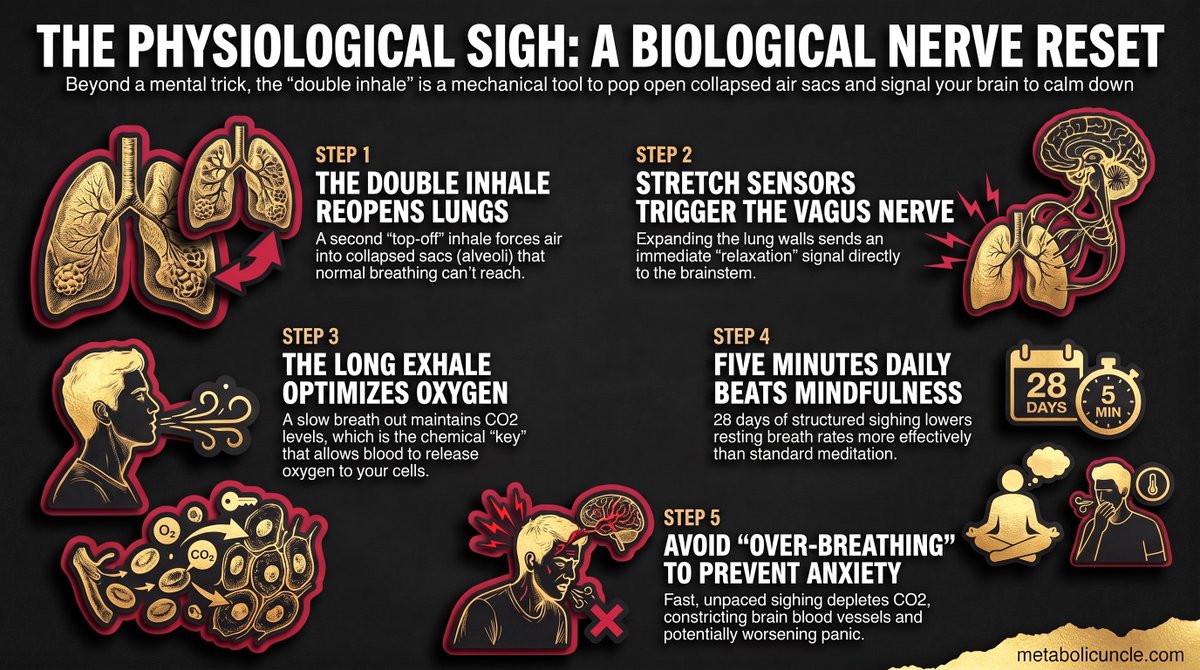
THE DOUBLE INHALE: HOW TWO QUICK BREATHS RESET YOUR LUNGS AND CALM YOUR NERVOUS SYSTEM
Sit at a desk for a few hours, breathing shallow and quiet the way most focused work makes you breathe, and thousands of the tiniest air sacs in your lungs start to collapse under their own surface tension.
One normal breath can't reopen them. It takes a specific kind of extra push, and your body already has a built-in move for generating it: two quick inhales through the nose, stacked on top of each other, followed by one long exhale out through the mouth.
Most psychology treats this move, sometimes called the physiological sigh, as a mental trick. Take two breaths, focus on the exhale, calm your mind through conscious attention. Large reviews pooling 785 participants across 12 breathwork trials do confirm small to moderate drops in self-reported stress and anxiety, so the calming effect is real.
But treating it as a purely mental exercise misses what's actually happening in your lungs and blood while you do it, and that gap matters, because not every version of "sighing more" produces the same result.
Here's the physical mechanism mainstream models skip over. A first inhale fills your lungs to roughly their normal working volume. A second, quick top-off inhale immediately after, without exhaling in between, forces an extra burst of air into lung spaces that are still tight from the first breath.
That stacked pressure is what a single breath can't generate on its own, and it's strong enough to physically pop open the collapsed air sacs that quiet breathing let close. The stretch this creates does two things at once. It triggers specialized lung cells to release surfactant, a protective fluid that lowers surface tension and helps keep those air sacs from collapsing again.
And it activates stretch-sensitive nerve sensors in the lung walls, which fire signals up the vagus nerve, your body's main relaxation pathway, straight to the brainstem. That stretch signal is what tells your calming nervous system to take over, and it's why heart rate visibly settles during the long exhale that follows.
Classic research on mechanical ventilation shows exactly what happens when this reset never occurs. Patients kept on breathing machines that delivered constant-volume breaths with no sighs built in developed a progressive 22 percent drop in blood oxygen and a 15 percent loss of lung flexibility as their air sacs collapsed over time.
Adding periodic deep sighing breaths back into the ventilation pattern reversed both problems immediately. Conscious people doing quiet desk work or sitting under stress lose lung surface area through the same basic process, just slower and less severe.
Separately, researchers measuring 43 healthy adults found that a spontaneous sigh following a stressful moment produced an immediate, measurable drop in shoulder muscle tension, confirming the stretch-to-relaxation pathway shows up in real bodies, not just in theory.
The exhale carries its own job, and it's just as important as the double inhale. Breathe out too fast and you strip carbon dioxide from your blood faster than your body can replace it. That matters because carbon dioxide isn't simply a waste gas your body wants gone.
It keeps blood vessels open and, through something called the Bohr effect, it's the chemical signal that tells your red blood cells to actually release the oxygen they're carrying into your tissues. Structured cyclic sighing paces the exhale to roughly double the combined length of the two inhales, which keeps carbon dioxide inside the healthy range of 38 to 42 mmHg instead of letting it crash.
Held in that range, your blood keeps releasing oxygen efficiently to fuel your cells' energy generators, the mitochondria, supporting both general cellular energy output and thyroid function.
Psychiatry has long recognized frequent, spontaneous sighing as a symptom of panic disorder rather than a treatment for it. Researchers comparing sighing patterns found that panic disorder patients sigh at more than double the rate of healthy people, 42 sighs an hour compared to 21.6, and those panic sighs are fast and unpaced rather than paired with a controlled exhale.
The result is chronic carbon dioxide depletion, with resting levels dropping to roughly 35 to 36 mmHg against the healthy 38 to 40 mmHg range in controls, which constricts blood vessels in the brain and actively worsens anxiety rather than relieving it. Structured and spontaneous-panic sighing look similar on the surface.
Chemically, they're doing opposite things to your blood gases, which is exactly the distinction that gets lost when breathwork is judged purely by how relaxed someone says they feel afterward.
That distinction matters most for people who feel anxious easily. In a trial of 34 adults, researchers found that instructed forced deep breaths failed to lower forehead muscle tension in participants with high anxiety sensitivity.
Those participants reported feeling mentally relaxed while their actual muscle tension stayed elevated, a direct mismatch between what someone believes is happening and what their body is actually doing.
Straining to pull in maximum air, especially into the upper chest and neck rather than the belly, recruits the very muscles that block the calming signal this technique depends on.
A single practice session shows real but limited benefits, and it's worth being precise about what it can and can't do. In a study of 81 patients waiting in an orthopedic clinic, a single four-minute audio-guided cyclic sighing session meaningfully reduced both pain intensity and pain unpleasantness.
That same single session produced no significant change in state anxiety compared to quiet waiting. Acute sighing works well as a fast physical pain disruptor. Lowering your baseline anxiety over time is a separate outcome that showed up only with sustained daily practice.
In a 28-day trial of 108 participants, five minutes of structured cyclic sighing daily lowered resting breathing rate significantly more than an equal dose of mindfulness meditation, and produced a larger daily gain in positive mood and energy, 1.89 points against 1.22 for mindfulness. That kind of durable shift in nervous system tone takes weeks of consistent, unforced practice, not a single session.
None of this technique is risky when it's done the way the research describes, but a few groups need to approach it carefully. If you have a diagnosed panic disorder, generalized anxiety, or high anxiety sensitivity, forcing the breath or pulling for maximum lung volume can backfire in exactly the way described above, leaving your body more physically tense even while you feel calmer in the moment.
Start gentler than the standard protocol and build up gradually rather than pushing for a full session on day one, and speak with a doctor or qualified mental health professional first if you have a diagnosed anxiety or panic disorder.
If you have a structural nasal airway issue, such as a deviated septum or a history of nasal polyps, take the second quick inhale gently rather than sharply to avoid straining the nasal passage, and check with a doctor before starting if you have any diagnosed breathing or airway condition.
Anyone who rushes the exhale and over-breathes can trigger hypocapnia, or critically low carbon dioxide, which shows up as lightheadedness, tingling in the fingers, or a spike in anxiety rather than relief. If that happens, the fix is slowing down and softening the effort, not pushing through it.
The detailed practical application of remedies is in the attached Part 2 and the bullet action points are in Part 3.
YOUR PILLOW IS TOO TALL: HOW A THICK PILLOW BENDS YOUR NECK AND CUTS YOUR OXYGEN ALL NIGHT
Your throat has no bones or cartilage holding it open. From behind your tongue down to your windpipe, it is just a soft tube of muscle and tissue, held open only by muscle tone and the angle of your head and neck. Change that angle enough, and you change how easily that tube collapses.
This is exactly what a tall pillow does. A pillow in the 14 to 20 centimeter range pushes your head forward relative to your chest and holds your neck bent forward past 15 degrees for hours at a stretch.
Researchers studying this under anesthesia, a state that strips away muscle tone and shows the airway's raw structure, found that this forward bend shifts the pressure at which the airway collapses from a stable -0.4 cmH2O to a much more collapsible +3.7 cmH2O.
That is a 4.1 cmH2O swing in the wrong direction, and it moves your airway from a passage that stays open on its own to one that pinches shut under ordinary breathing pressure. Tilt the head back instead and the collapse pressure drops to a very stable -9.4 cmH2O. Turn the head to the side and you land at a neutral -2.6 cmH2O. Head position alone is doing a huge amount of work here.
Airway testing in real, awake people backs this up. Bending the neck forward measurably increases resistance to breathing, in both healthy sleepers and people prone to snoring. The physics behind this is brutal: narrowing a tube by just 20 percent raises the resistance to airflow through it by roughly 144 percent.
A small pinch in the throat does not create a small increase in effort. It creates a massive one. Every breath pulled through a bent neck becomes real work for your diaphragm, turning what should be passive, restful breathing into an overnight workout.
That extra work has consequences that reach far past the throat. Each labored inhale creates strong negative pressure inside the chest. Sensors in your neck pick up the resulting small drops in blood oxygen and small rises in carbon dioxide, and they respond by triggering stress signals that pull you out of deep sleep, often without you ever fully waking up or remembering it.
Clinical research on people with severe sleep apnea shows what this stress response looks like in its extreme form: a significant overnight rise in cortisol, a rise in free fatty acids released into the blood, and a rise in blood sugar.
Cortisol spikes push fat into the bloodstream and push the liver to release stored sugar, and this keeps your adrenal glands working instead of resting and interferes with the growth hormone release that is supposed to happen during deep sleep. Healthy sleepers with only mild airway narrowing from a tall pillow are not hitting these extremes, but the same stress machinery is being activated on a smaller scale, night after night.
The oxygen shortage also hits your cells directly. Mitochondria, the parts of your cells that turn sugar and oxygen into usable energy, need a steady oxygen supply to do that efficiently. When oxygen runs short, cells fall back on an emergency backup process called anaerobic glycolysis, which burns sugar without oxygen and produces lactic acid as waste.
In people with severe sleep apnea, this shows up as a measurable rise in blood lactate by morning. That rise is a direct signature of a body that spent the night short on oxygen and burning fuel the inefficient, stressful way. It lines up with the morning fatigue, heavy muscles, and brain fog that so many people simply accept as normal.
There is also a purely mechanical side to this. X-ray studies of healthy adults resting on a 20 centimeter pillow show the neck bending forward in a way that is easy to measure. The upper back angle, a marker called the T1 slope, jumps from a normal 12.9 degrees to a strained 28.8 degrees, and the neck's natural curve goes from a relaxed 10.3 degrees flat to an over-arched 17.4 degrees on the tall pillow.
At the same time, pressure mapping shows that going from a 110 millimeter to a 170 millimeter pillow increases pressure on the back of the head by 30 percent and on the neck by 186 percent. At that 170 millimeter height, pressure against the neck reaches 4.20 kPa, which crosses a real physiological line: it exceeds the roughly 4.0 kPa (30 mmHg) pressure inside your smallest blood vessels, the capillaries.
Push past that threshold and those tiny vessels get pinched shut, cutting local blood flow, causing soreness, and triggering the tossing and turning that keeps you from settling into deep, uninterrupted sleep.
One finding is worth sitting with because it cuts against the instinct to just push through fatigue with more effort or more supplements: in people with sleep apnea, resting metabolic rate, adjusted for muscle mass, comes out significantly higher than in people who only snore.
That is not a sign of a fast, healthy metabolism. It is a body running hot from the physical strain of fighting a partially closed airway all night, a stress response rather than a sign of good health.
None of this replaces medical care for diagnosed sleep apnea. The interventions described here address ordinary, mild airway narrowing from pillow height and neck position in people without a clinical breathing disorder. Elevating the head of the bed on its own has been shown to modestly help average breathing events, but standard medical devices like
CPAP remain the necessary treatment for anyone with diagnosed or suspected clinical sleep apnea, and the difference in effectiveness between the two is large. If you snore heavily, gasp or choke during sleep, have been told you stop breathing at night, or have any diagnosed breathing or cardiovascular condition, speak with a doctor before relying on pillow height or bed angle changes to solve the problem, and continue using any prescribed treatment.
It is also worth being honest about the limits of some of this evidence. The airway collapse numbers described above come from measurements taken under anesthesia, which shows the throat's passive structure but may overstate how easily it collapses in someone who is naturally asleep, since a conscious or naturally sleeping person still has some active muscle tone helping keep the airway open.
And going to the opposite extreme, sleeping completely flat with no pillow at all, is not a fix either: for side sleepers specifically, a flat surface forces the neck to bend sideways toward the mattress and creates its own high muscular strain.
The core fix does not require any special equipment or a clinical diagnosis. It comes down to two things: giving the neck a pillow height that supports its natural curve instead of bending it forward, and letting gravity help keep the throat open by raising the whole bed frame rather than just stacking pillows.
The detailed practical application of remedies is in the attached Part 2 and the bullet action points are in Part 3.
Don't be surprised when your intuitive feelings prove true and beautiful things serendipitously happen to you
God has so much in store for us all.
Take heed. Give thanks. And love well
The way will reveal itself to you in direct relation to your willingness to listen
ERYTHRITOL: THE SUGAR FREE SWEETENER THAT MAKES YOUR BLOOD CLOT FASTER
Drink a glass of water with thirty grams of erythritol stirred into it, and within a few hours your blood carries more than a thousand times as much of this sweetener as it did before you picked up the glass. Your blood sugar barely moves. Your insulin barely moves. That single fact is why erythritol earned a reputation as one of the safest sugar substitutes on the market.
The tests that built that reputation checked one thing only: does this substance spike blood sugar or insulin. Erythritol and xylitol pass that test easily, because human cells don't carry the enzymes needed to break either one down for energy. Mainstream reviews treat that inability as a virtue, since a molecule your body can't use can't raise glucose either.
Digestive comfort added to that reputation. A large fifty gram dose of xylitol causes severe stomach distress and watery diarrhea in most people, the kind of reaction that makes an ingredient hard to sell. Erythritol doesn't do that.
Smaller doses of twenty and thirty five grams leave people free of any digestive symptoms at all, because erythritol gets absorbed in the small intestine rather than sitting in the gut and drawing in water the way xylitol does. That easy absorption got read as another safety signal, on the logic that a smoother gut experience means a gentler compound overall.
A sweetener that slides through the gut wall without friction moves straight into the bloodstream instead of being partly held back the way xylitol's poor absorption holds much of its load back in the gut. Once erythritol is in the blood, a compound your cells cannot burn for fuel doesn't just disappear quietly.
It sits there as raw, unmetabolized load, and that load makes your blood clotting cells stickier and weakens the ability of your blood vessels to produce the gas that keeps them relaxed.
Your blood clotting cells are called platelets. In a healthy resting state they stay smooth and quiet as they move through your vessels, using constant, energy-hungry pumps to keep their internal calcium levels extremely low.
When a vessel wall is actually damaged, a chemical signal tells the platelet to release that stored calcium all at once. The calcium surge changes the platelet's shape, triggers it to release clotting signals, and makes it stick to other platelets to seal the injury. This system only works because it stays off until it's needed.
Foreign sugar alcohols circulating at high concentration interfere with that calcium switch. They make platelets release calcium more readily in response to ordinary, low-level signals, which lowers the threshold at which a platelet decides to clump.
In large studies that tracked heart patients over three years, people with high blood levels of erythritol and xylitol had a significantly higher rate of heart attacks and strokes. In direct clinical tests, healthy adults who drank thirty grams of erythritol showed a sharp rise in platelet stickiness and clotting activity within hours.
Thirty grams of xylitol produced the same kind of platelet activation in separate healthy volunteers. Because neither compound can be burned for cellular energy, this isn't a side effect that fades once the sweetener clears. It's a direct chemical priming of the cells whose entire job is knowing when to fire.
The lining of your blood vessels tells a parallel story, and researchers have traced it down to the vessels feeding your brain specifically. These endothelial cells normally burn real carbohydrate for fuel, and that steady energy supply lets them manufacture nitric oxide, the gas that relaxes vessel walls and keeps blood cells from sticking to them.
Expose these brain blood vessel cells to erythritol in a lab for just three hours, and cell-damaging free radical molecules nearly double while nitric oxide output drops by twenty percent. The oxidative stress changes the regulatory switches on the enzyme that makes nitric oxide and turns its output down.
Less nitric oxide means stiffer vessels and more surface stickiness for exactly the platelets that erythritol has already made trigger-happy, right at the barrier that protects your brain's own blood supply.
One detail complicates the story, and it's worth sitting with rather than smoothing over. A short trial gave diabetic patients thirty six grams of erythritol daily for four weeks and found improved blood flow and reduced central pulse pressure, the opposite of what the platelet and endothelial data would predict.
The likely explanation is that erythritol acts as a weak, direct antioxidant in the short term, buffering some oxidative stress on contact. But a molecule that cannot fuel a cell's own energy production can't sustain that buffering, and it does nothing to stop the platelet sensitization happening at the same time.
A four week improvement in one measurement doesn't cancel out a mechanism that's actively wearing down your clotting system in the background.
The cleanest evidence for all of this comes from a head to head comparison. Healthy volunteers drank either thirty grams of erythritol or thirty grams of ordinary glucose dissolved in water. The erythritol drink caused blood levels of the sweetener to spike and significantly increased clotting activity.
The glucose drink, at the identical thirty gram dose, caused zero increase in clotting activity. Glucose gets fully broken down inside your cells into energy, carbon dioxide, and water, a complete oxidation that fuels the very cellular pumps platelets depend on to stay calm. Erythritol just sits in the blood, unusable, doing none of that work.
There's a further wrinkle worth knowing. When blood sugar runs chronically high, the body actually manufactures its own erythritol internally through a stress pathway. That means some of the observational link between blood erythritol and heart attack risk could reflect pre-existing metabolic distress rather than the sweetener itself, since people with poor blood sugar control would show elevated erythritol either way.
This doesn't erase the direct clinical evidence of platelet activation after a measured erythritol drink. It does mean the three year cohort studies, which only observed people rather than testing them directly, can't fully separate cause from correlation on their own.
The lab evidence on free radicals and nitric oxide has its own limit. Those tests exposed isolated brain blood vessel cells to erythritol in a dish for three hours, not a full circulatory system with active blood flow. Living vessels might buffer some of that stress better than cells sitting in a static lab environment, though nobody has run the comparison directly.
One group faces a clearly elevated risk here. Healthy kidneys clear seventy eight to eighty four percent of a single erythritol dose from the body within twenty four hours, so most of the load does eventually leave.
That clearance is far less reliable in anyone with reduced kidney function, and it's also less protective for people who consume these sweeteners multiple times a day rather than as an occasional treat, since a new dose can arrive before the last one has fully cleared.
If you have any diagnosed kidney condition, or you suspect your kidney function is impaired, talk to a doctor before making major changes to your sweetener intake, and don't assume the numbers above apply the same way to you.
None of this means panic over an occasional trace amount. It means the sweeteners marketed as the safest possible sugar replacement carry a cardiovascular cost that standard blood sugar testing was never built to catch.
The fix runs in the opposite direction from what keto marketing suggests: give your cells real, oxidizable carbohydrate they can burn, support your vessel lining with the right nutrients, and keep your blood volume and gut properly maintained, and the platelet priming and nitric oxide loss described above have far less to work with.
The detailed practical application of remedies is in the attached Part 2 and the bullet action points are in Part 3.
You are not responsible for the world's problems. You do not have to carry them on your mental plate. The mainstream media tries to push the world's problems onto you, saying, "Carry these. They're for you," but any attempt to hold the world's issues will drain you of your life force.
CCOOKED TOMATO PASTE DELIVERS FAR MORE USABLE LYCOPENE THAN RAW TOMATOES
A raw tomato looks like a health food and in many ways it is one. But its most talked about compound, lycopene, is barely available to your body in raw form. Lycopene is the pigment that gives tomatoes their red color, and it sits packed inside rigid plant cells wrapped in tough fiber walls made of pectin and cellulose.
Human digestion has no enzymes built to break those walls open. So raw lycopene mostly rides through the gut still trapped inside its fiber cage, and very little of it ever reaches the bloodstream.
Heat changes this completely. Simmering a tomato into paste or sauce ruptures those plant cell walls and lets the lycopene spill into the surrounding fat, where the body can actually reach it. Cooking does something else too.
Raw lycopene molecules are straight and rigid, a shape that resists dissolving in digestive fluids and tends to clump together instead. Heat bends some of these straight molecules into a curved shape that dissolves far more easily.
Your own gut cells finish this bending job during digestion, converting close to a third of the straight lycopene into the curved form before it moves into the lymph system. Cooking simply gives that process a head start by opening the cell walls first.
Fat plays a second essential role. Lycopene only dissolves in fat, not water, so it needs to be packaged into tiny fat carriers called mixed micelles before it can cross the gut wall. Eating cooked tomatoes with fat triggers a hormone called cholecystokinin, which tells the gallbladder to release bile.
That bile is what builds the micelles that ferry lycopene across the intestinal lining. Once those micelles reach the gut wall, lycopene still needs specific receptor proteins on the surface of gut cells to actually pull it inside.
Research in cells and animals found that blocking these receptor proteins cut lycopene absorption by up to 60 percent, while increasing the number of these receptors led to a tenfold increase in blood lycopene, which shows just how much of this process happens at the cellular level and not only in the stomach.
Human feeding studies confirm all of this with real numbers. Tomato paste produced 2.5 times higher peak blood lycopene and 3.8 times more total absorption than raw tomatoes eaten with the same amount of fat. Ten days of cooked tomato juice raised blood lycopene while raw tomato juice did not raise it at all.
Cooking tomatoes with olive oil specifically produced an 82 percent increase in straight lycopene and a 40 percent increase in curved lycopene in the blood, while the same tomatoes cooked with no fat at all failed to raise straight lycopene levels whatsoever. A study on tomato salsa found that adding fat produced 4.4 times more lycopene absorption than the same salsa eaten fat free.
Just one week of eating cooked tomato products doubled blood lycopene and lowered markers of fat oxidation in the blood, and ten weeks of tomato paste cooked with olive oil reduced skin redness from UV exposure by 40 percent.
Olive oil holds up well under this kind of gentle cooking, and the reason is worth understanding. Its single double bond is genuinely vulnerable to high, dry heat, but simmering tomatoes is wet cooking, and the water in the sauce caps the temperature at the boiling point of water, well below what damages olive oil.
On top of that, the lycopene, beta carotene, and polyphenols already present in the tomato, together with the vitamin E naturally in olive oil, act as a protective shield during cooking, neutralizing oxidative stress before it can reach the oil itself. This same gentle process pulls more nutrition out of the tomato than dry cooking would.
Traditional slow simmering of tomatoes, garlic, and onion in olive oil, the technique behind a classic sofrito, has been shown to draw fat soluble carotenoids like lycopene, along with water soluble polyphenols such as naringenin, ferulic acid, and quercetin, out of the tomato flesh and directly into the oil, where they become easier for the gut to extract.
This is the same chemistry behind traditional Italian, Greek, and Spanish tomato and olive oil recipes that home cooks have simmered for generations without knowing why they worked.
Raw tomatoes still earn a place in a healthy diet. They are roughly 94 percent water, rich in potassium, and carry heat sensitive vitamin C that cooking reduces by 15 to 30 percent. Their organic acids also support healthy stomach acid.
The part that can cause trouble is the skin and seeds, which contain rough fiber and plant proteins called lectins that can irritate a sensitive gut lining. Peeling and seeding a raw tomato removes that irritation while keeping the hydration and nutrients intact, which is exactly how high end European kitchens have always prepared raw tomato dishes.
It is worth being precise about what the evidence does and does not show. A 21 day study found that eating tomato puree raised lycopene levels without changing the overall antioxidant capacity of the blood as a whole. This is not a contradiction.
Lycopene leaves general circulation quickly and settles into cell membranes and cell nuclei, where it protects fats and genetic material from damage in a localized way rather than acting as a blanket effect across the bloodstream. In that specific setting, daily tomato puree reduced DNA damage in immune cells by 33 to 42 percent, a real and measurable protective effect.
Lycopene is not a standalone cure for anything, either. A study of 26 men with prostate cancer found healthier tissue after taking lycopene before surgery, but the accompanying 18 percent drop in a related blood marker did not reach statistical significance, so it belongs in the diet as a supportive nutrient rather than a treatment.
A word of caution belongs here too. People with true, diagnosed nightshade allergies or extreme histamine sensitivity should skip concentrated tomato paste, since cooked tomato concentrates carry active amines that can trigger a reaction. People with severe, hyper reactive autoimmune conditions may find it useful to temporarily avoid nightshades altogether as a diagnostic test.
For nearly everyone else, choosing deep red, fully ripe tomatoes resolves the nightshade worry on its own. Tomatoes contain a compound called alpha tomatine, chemically distinct from the solanine found in potatoes, and unripe green tomatoes hold onto it as a natural defense, accumulating up to 500 milligrams per kilogram.
As a tomato ripens to deep red, the plant degrades this compound by up to 99 percent, and what little remains is poorly absorbed, binding to cholesterol in the gut and simply passing through the body.
For general joint stiffness or mild reactivity, that natural ripening combined with standard preparation is usually enough on its own.
The detailed practical application of remedies is in the attached Part 2 and the bullet action points are in Part 3.
@MetabolicUncle@davidvenitas Agreed, in summer it feels like it’s more about something fresh, like a pasta or rice salad not much of a big juicy steak.
@shnufalo_ Background “grey lines” look like something was spilled.
Colors are okay but a bit similar.
Also, the colors give me a clean and healthy product vibe but isn’t it a little like many other brands?
Being from Mexico, can’t you use something from your culture and legacy?