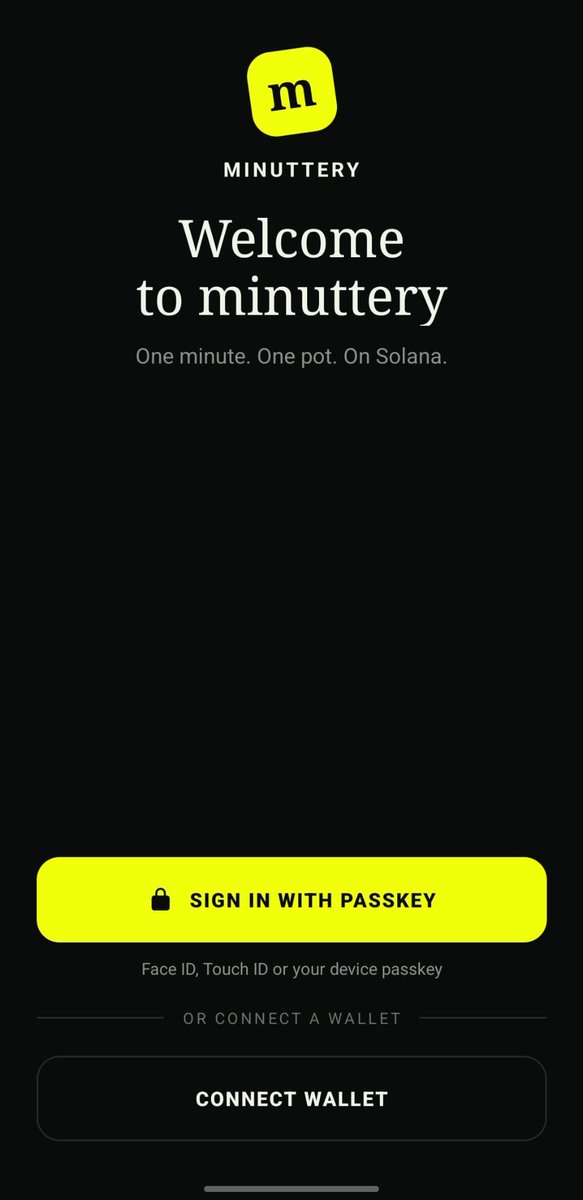
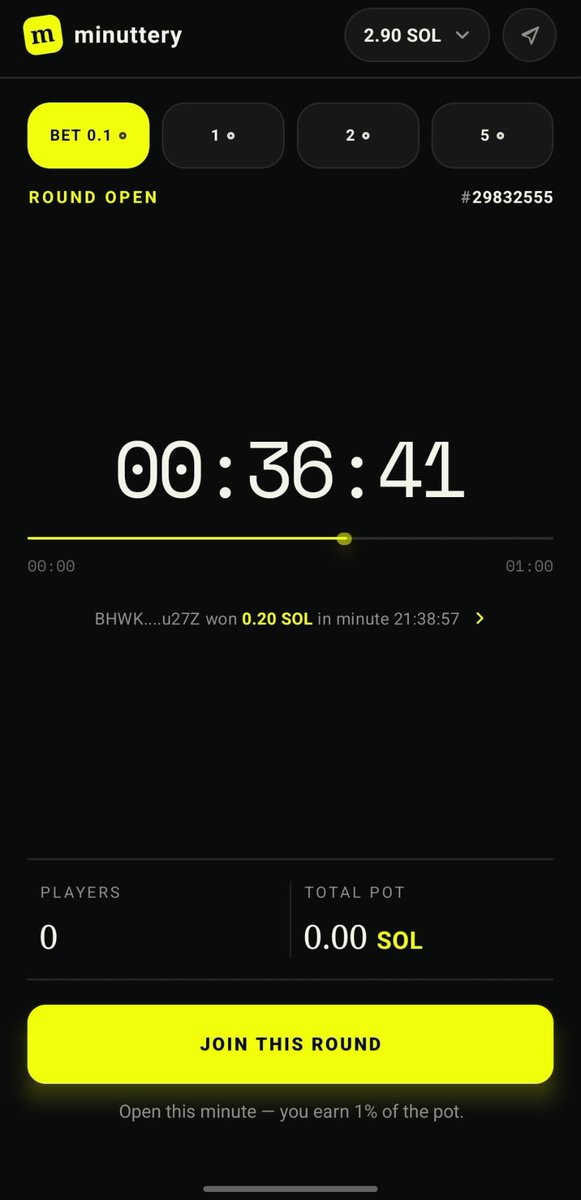
Well, I finally abandoned the commit-reveal model and moved to verifiable ECVRF entropy for my 60-second Solana betting game, using @blueshift solana-ecvrf after @L0STE_ ’s writeup.
@minuttery is a 60-second Solana betting game. You put in at least 0.1 SOL. When the round closes, one winner is selected from verifiable ECVRF entropy — no external randomness API.
An off-chain bot operator generates the ECVRF proof. The program verifies it on-chain and settles the round. If no proof arrives, players can refund.
Verification is cheap enough for a 60s loop. Already fast on Devnet. Mainnet needs Agave 4.3 / sol_sha512 from @anza_xyz. Building toward .@colosseum.
Cooking up this weekend the @minuttery Android app, adding extra features to drive downloads on the Solana dApp Store @solanamobile. Almost ready for the
@marinonchain This is what users want: zero friction, a sleek UI, and seamless navigation through payment options. People have the money; they just don't want to deal with clunky interfaces
@OPOnSOL@Mikkke_crypto@solana_devs I’m such a newbie with confidential transfers. I still can’t wrap my head around the idea of “hiding” something on a chain :/
@marinonchain I've been here since 2021, when all the NFT collections were called somethingsol or solasomething. Lots of giveaways, free airdrops, and rugs too.
@nikkideyy@solana I know the feeling. I kind of envy people who can walk into any country without a second thought. I always have to prove everything — and at airport immigration the fear still hits.
The key that can move SOL is born in the browser and, in our current code, sits there for the session which can be compromised.
Friction goes back to connect → approve. Worse onboarding. Better threat model.
If you know a way to cut that friction without deriving Ed25519 in the client, let me know.