Sometimes I get stuck in my own head and fall into the trap of overthinking.
But the thing that always pulls me out: awe.
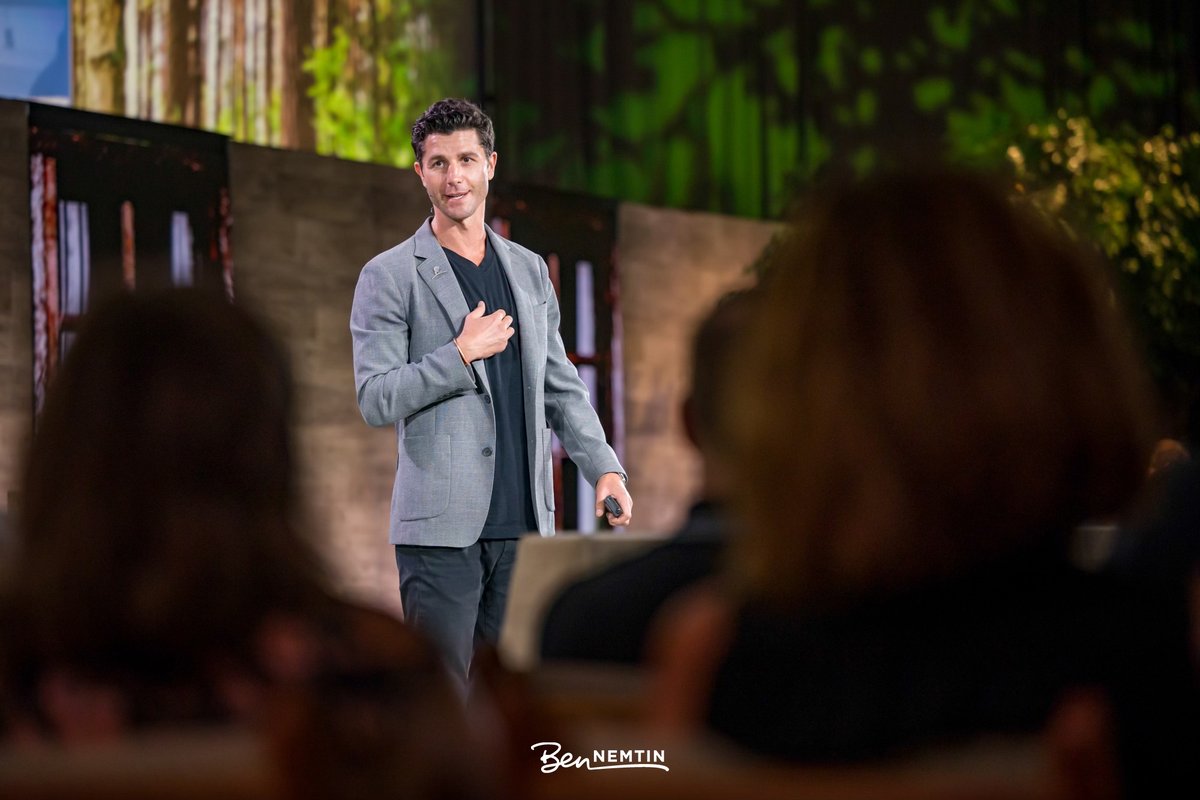
This past weekend I had a keynote in Vail and brought the family. We went hiking in the mountains and my problems immediately felt small.
Professor Keltner, the director of the Berkeley Social Interaction Lab, often talks about how awe and wonder can transform your life.
The gist is that when you're stressed, your world shrinks.
Your inbox feels like your whole life.
Your entire future feels like it rides on one conversation.
So, you try to think your way out.
You plan and replay and analyze, again and again and again...
But no matter how many times you repeat that cycle, you still find yourself stuck inside the same tiny world where every problem overwhelms you.
Awe opens a window. A huge sky. The ocean. A mountain. Someone being unexpectedly kind.
For a second, your brain remembers: You're not the whole story. And your problems shrink back to scale.
The next time you're stuck in your head, look at the sky (but not the sun) for 60 seconds.
Try anything that makes you feel small in the best way.
It won't solve your problem, but the perspective can help it stop being the size of your whole life, because (even if it sometime feels like it) it never is.
There’s a strange thing that happens when we get close to something that matters.
The conversation we need to have.
The risk we need to take.
The work we keep putting off.
Fear shows up.
And when it does, our instinct is often to move away from it.
This is avoidance.
The problem is that the breakthrough you want is, more often than not, buried in the task you're avoiding.
This is because, as modern anxiety research teaches us, avoidance isn't necessarily a side effect of fear, rather it's an engine that keeps our fear running.
As mentioned, when you feel threatened by something and avoid it, your distress drops.
And while you might feel better in the moment, your brain registers this avoidance as a reward.
The trap is that when you let the fear stop you from taking that action (that you probably know, deep down, you really should be doing), you've just taught yourself that you can't confront the situation.
Worse still, you've made it harder to face this fear the next time.
To put it more succinctly: The relief itself is the trap.
The solution lies in teaching yourself that you can feel anxious, you can feel fear and doubt and anxiety and still do the thing.
Each time you do this, you generate new evidence that tells you (and your body) that you can feel the fear and move past it.
Because you can.
You can create that evidence.
But it can only be done by doing the thing you're afraid of.
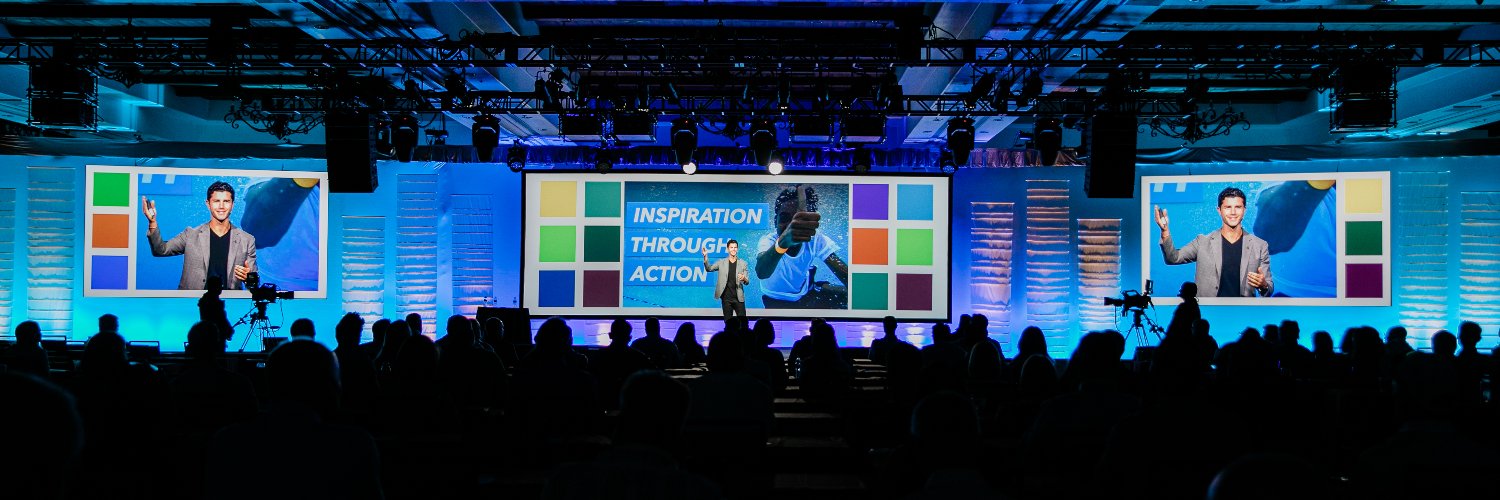
I’m so excited to be a part of LEAD Conference Canada this year.
I rarely get the opportunity to speak at public events, and the fact that this is back home in Canada makes it extra special.
If you can make it, I’d love to see you there.
https://t.co/ZR6C5EhUDM
You’re probably not burned out from big problems.
You’re burned out from tiny ones you ignore.
It’s not the breakup.
It’s not losing the big client.
It’s the traffic.
The spam call.
The small argument you never reset from.
These “little hassles” don’t feel dangerous…
but they quietly stack all day long.
And your body keeps score.
A Berkeley study found that these daily hassles predicted people’s physical health a year later better than major life events.
Why?
Because your stress system was built for short bursts.
Threat → cortisol spike → action → reset.
But small, constant stress never lets you reset.
So it lingers…
20 small hassles a day = 7,000+ stress hits a year.
That shows up as:
Less patience.
Worse sleep.
Weaker immune system.
And eventually… it spills onto the people you care about most.
So here's what I've realized:
You can’t control the big things in life.
But you can control how you handle the small ones.
What does that look like?
Pause before you react.
Don’t assume the worst in people.
Let small things stay small.
Ask: does this deserve my energy?
Or just smile, and treat it all like a game.
Because over time…
It’s not the big moments that shape your life.
It’s how you respond to the little ones.
The longest running study on happiness followed 3000 people since 1938, and they found two massive contributors to human happiness.
It’s not more money.
More status.
More wins.
Or more proof that their life is working.
The biggest drivers of happiness were not fame or achievement.
It came back to two things:
Your health.
And your relationships.
If you take care of your physical health, your life gets better.
Move your body.
Eat food that loves you back.
Sleep.
Get checked before something’s wrong.
Don’t treat your body like it is disposable.
Even small efforts matter.
Just 15 minutes of exercise a day has been linked to lower risk of death and a longer life.
Physical activity also lowers the risk of cognitive decline and dementia.
And then there’s connection.
Good relationships do more than make life fun.
They keep you steady.
They hold you accountable.
They help you through hard seasons.
They make you healthier.
They may even help you live longer.
So much of what we chase is hidden in the basics.
Take care of your body. And stay close to good people. That’s the formula.
Keynotes in Laguna, Dallas and Savannah this week. And after nearly a decade of this work, it honestly just keeps getting better.
I now bump into people that saw me speak years ago and I get to hear them excitedly share items they’ve crossed off their lists ... dreams they’ve achieved with loved ones … or see them light up as they share a story of finally doing the thing that scared them.
I love hearing these stories, and I’m grateful to have one the best jobs in the world.
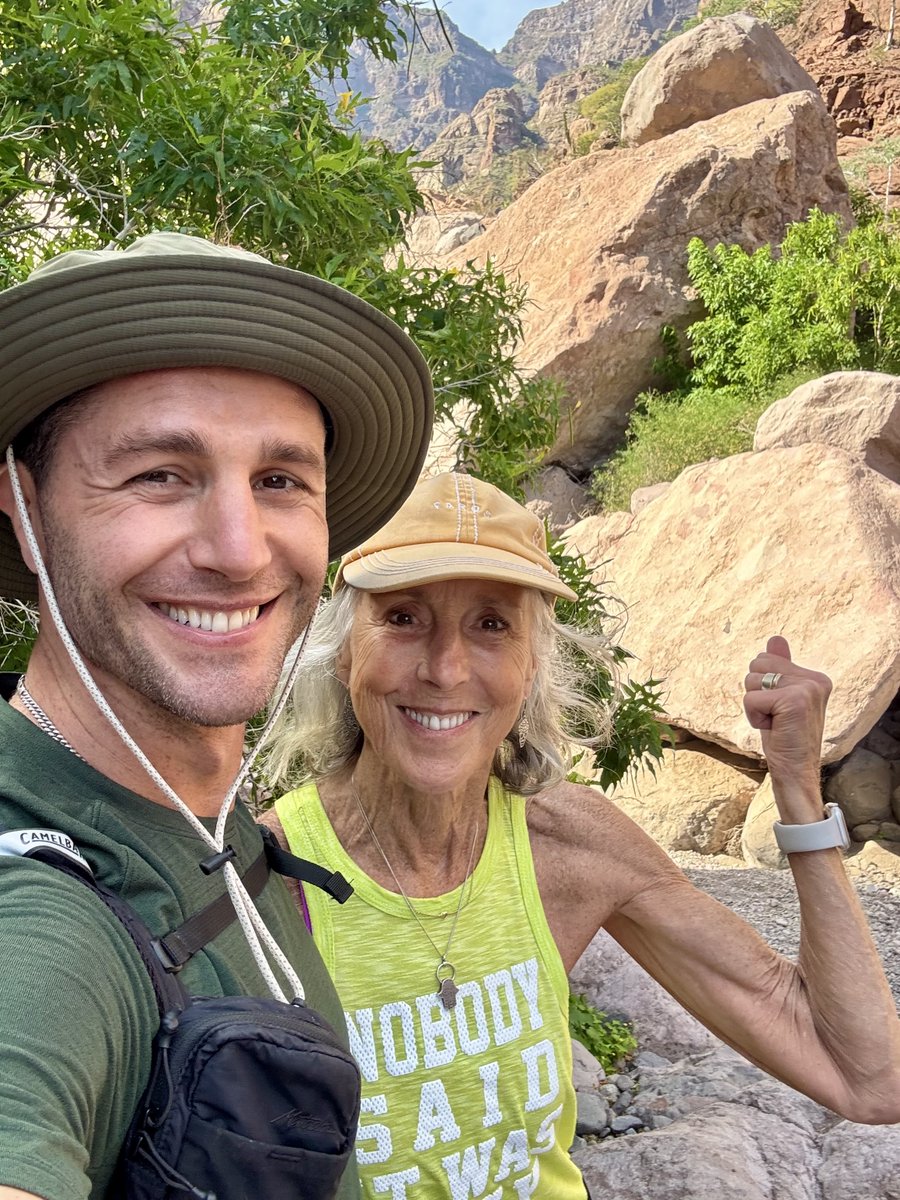
I was with my parents in Mexico recently, and I asked my mom if she wanted to go for a hike.
I thought we’d get some sunshine, take a few photos, grab lunch…
Instead, halfway in, we hit a slot canyon… with a rope.
The only way forward was to pull yourself up a sketchy set of rocks, then do this awkward sideways traverse across boulders,
If you slipped it was a 10 to 20 foot drop. The rope was basically the only “plan,” and we’d have to traverse it again on the way back.
I looked at my mom and asked if she wanted to keep going.
She didn’t hesitate. Her answer was yes! She’s 76, so I went with the classic logic: you only live once.
We got across the first section, no problem. The second part was the weird one.
You had to wrap your body around the rock in this super uncomfortable way, and the consequences felt… very real.
Struggling with that section myself, I was about to suggest we turn around when I noticed my mom was already halfway across.
We made it past that section (phew), and helped her up the last section with the rope. We’d made it through.
The rest of the hike was beautiful.
But I was secretly dreading the way back.
Because if a climb is hard on the way up, it’s usually worse on the way down.
Correct.
The traverse on the way back was brutal. There were a couple moments where I was genuinely scared. I kept telling myself, “We made a huge mistake.” But we also happened to be running out of daylight, so it wasn’t like we could just hang out and workshop our feelings.
My mom scraped her knee crossing back, but she made it (double phew). I walked back to the car in this weird daze, thinking, Wow… that could’ve been bad.
I asked her what she thought about the hike, expecting a “Thanks for the trauma. Never again.” But she just smiled and said, “It’s my favorite thing about being here. It’s so challenging… and uplifting.”
That’s my mom in a nutshell. The most positive person I know.
And it hit me: perspective changes everything.
Same hike. Same rocks. Same rope.
Totally different internal story.
I was doom and gloom. She saw the upside.
And I think that’s the part we often forget in real life too.
Two people can go through the exact same week at work, the same hard situation, the same pressure…
And they can have completely different experiences.
That doesn’t mean we ignore what’s hard. It just means our interpretation becomes the filter for our reality.
And that filter shapes your health, your happiness, your relationships… and how you show up for the people around you.
What happens matters.
But how you carry what happens matters too.
It’s a simple truth but it’s life-changing when practiced.
Be like mom :)
Most people waste years waiting to feel ready.
They tell themselves they just need more clarity. A little more research. A better plan. Then they’ll finally start.
But that’s the trap…
You don’t start because you feel confident. You feel confident because you start.
There is no perfect time. There is no moment where fear disappears and everything clicks into place.
The truth is, readiness is a myth. It is something we use to protect ourselves from discomfort.
When a goal feels big, your brain locks onto the gap between where you are and where you want to be. That gap feels overwhelming. So you stall. You scroll. You plan. You think about it so much that you convince yourself you are making progress, even though nothing is actually moving.
But belief does not come from thinking harder. It comes from proof. And proof only comes from action.
You do not need a breakthrough. You need a small win. One move that tells your brain, this is real.
Send the email. Make the call. Do the first workout. Write the messy first page.
That small step shifts something inside you. It changes the question from “Can I do this?” to “What’s the next step?”
Stop waiting to feel ready. Start moving, and let your confidence build from there.
As we move through life, we absorb beliefs about who we should be.
These can come from family, friends, social media, culture... the list goes on.
These beliefs aren't always bad, but they're also not necessarily what we actually want.
They might align with our true selves, but they might not.
The trouble is that, if we're not careful, we may find ourselves pursuing goals, maintaining relationships, or making choices based on someone else's idea of success and happiness instead of our own.
And, let me tell you, there is so much magic to be found when you align yourself with who you truly want to be. Your potential and performance, in work and life, will grow.
Now, this alignment is something you continuously work on. And the more you practice, the more aligned you'll become with your true self.
To practice, pay attention to when you feel energized, and what makes you lose track of time.
When do you feel like you? When do you feel in flow?
Does your chest tighten when you imagine one future and open when you imagine another?
Our bodies often know our truth before our minds catch up.
You already know more than you think you do. You just have to give yourself permission to listen.
On days like this, I regret putting The Bucket List Journal in a box 😂
I kid.
I love when these journals get in people’s hands… and as they continue to get into the world, more and more stories filter back to me about how the journal sparked a buried idea or gently nudged someone to take action toward something meaningful that resulted in a changed life.
Anytime you force yourself to sit alone and think about what you truly want (versus what others want for you), good things happen.
This means you’re one step closer to the true you. And that’s where the magic happens.
Ok, icing my right hand now.
Last week, we welcomed @BenNemtin as a guest speaker at our All-Company Meeting. You may recognize him from MTV’s “The Buried Life.” Ben shared his message of possibility, purpose, and taking action with employees. Thank you for joining us and sharing your wisdom, Ben!
Most people think sharing your goal is cringe.
But hiding it is what keeps you stuck.
When you take action in public, it does something weird. It gives other people permission to try.
And then they give you a reason to keep going.
I posted this year that I want to get in the best shape of my life. My DMs filled up with people saying they were doing it too.
A few days later, I wanted to skip the gym.
Then I remembered all the people who just committed with me.
So I went.
That’s the loop. Your courage becomes their possibility. Their possibility becomes your fuel.
This week I gave a keynote for @AceHardware, and on each table was a card that had two spaces: one for a professional dream and another for a personal one.
During my talk, I gave the audience one minute to write down a goal in each category, and I asked them to share their dreams on a Dream Wall outside the auditorium.
As I watched people add their dreams to the wall, something began to happen. Strangers started to talk, pointing at each other's cards and sharing stories. And as they connected, they increased their chances of their goals coming true.
Research found that when you write down your dreams and share your progress you're significantly more likely to achieve your goals than when you keep them in your head.
This is because when you write them down you're forced to stop and think about what you actually want.
Most of us skip this step. We have a goal, but we're too caught up in the day-to-day to pause to ask ourselves what we really want, what we're working toward, and how we're going to get there.
The Dream Wall works because the more you share your goals, the more accountability you feel, the higher the chances are that you'll achieve them.
It really works. Yesterday I just shared on Instagram that 2026 is the year I get in the best shape of my life. Today I didn’t feel like working out, but I remembered that I shared I would, I felt accountable and I went to the gym.
Keep sharing your dreams, it moves you toward them.
Over a year ago, Carla saw me speak to a group of hospital leaders, and last week I got an email that was simply a link with the words…
“I finished :)"
I clicked the link and it took me to the book she'd just published.
I sent her a hearty congratulations, and when I asked her how it felt, she said that she couldn’t even describe the immense satisfaction she felt when she finally completed the draft and then again when she held her book in her hands for the first time
Carla went on to explain that starting her bucket list was a driving force behind her achievement, and that she’d started 2025 with three main goals:
1. publish a book,
2. lose 30 pounds, and
3. secure monthly speaking engagements.
Then she wrote something that surprised me:
“I’m thrilled to say that I’ve managed to achieve all three.”
She shared that losing 30 pounds was a fantastic journey, and how it felt amazing to stop yo-yoing with her weight throughout the year.
She told me that even when she hit a few plateaus, she never regained the weight.
She proved that she can do hard things.
That’s it right there.
Once you prove to yourself that you can do hard things, your sense of what’s possible expands forever.
How do you do hard things?
First, figure out what you want so you can live intentionally.
Set a timer for 60 minutes, put your phone in another room, and write down what you actually want. Then circle the one to three things that matter most right now and write the next tiny steps you can take in the next 48 hours.
I promise you that one hour will pay you back all year long.
It’s the first week of January. Now is the time.
Here’s to a meaningful 2026!
If you’re not a fan of New Year’s resolutions, here’s my take: I’m a fan of anything that forces you to pause and get honest about what you actually want.
It’s way too easy to live on autopilot instead of intentionally.
So if resolutions aren’t your thing, try this instead:
Choose one goal you want to achieve in 2026 (not ten, just one).
Write it down somewhere you’ll see every day (built-in accountability).
Share it with friends, family, or followers (more accountability).
Ask someone to check in on your progress or be your accountability buddy (even more accountability - notice the pattern?).
There are no deadlines on dreams. That’s why accountability is the secret.
Lose 112lb. Find my biological father. Write a country song that plays on the radio.
These are all dreams I’ve seen happen first hand.
Now that I've been speaking for 8 years, I run into people who have seen me speak and they often share stories of how they were inspired to go after and achieve their dreams.
I’m always moved when I hear these stories, so I curated some of the most powerful accomplishments on my website, because when we read of someone's success, the impossible starts to seem... possible.
So, now that 2026 is around the corner, what’s one dream you've been putting off?
Borrow belief from these stories, and let their courage become your possibility.
Write your goal down. Spend two minutes thinking of 3 easy steps you can take in the next 48 hours. Then commit to those steps, and keep going.
Momentum will start to build, and "someday" will become "done."
(The link to people's accomplishments is in the comments.)