¿Qué es el Hipercampo y por qué ocupa un lugar tan importante en las ideas de Jacobo Grinberg? En este video exploramos una de las propuestas más fascinantes y controvertidas del investigador mexicano.
What remains of the human being when the physical body dies?
The senses show only the body returning to nature.
The intellect collapses with the organ that sustains it.
If we limit knowledge to these instruments, death looks like a doorway into nothing.
But what if the problem is that our ordinary instruments of knowledge are simply incapable of perceiving what comes next?
The soul can either suppress the mystery of its existence or begin strengthening its own inner powers of perception.
Dr Steiner describes this as a long discipline:
A thought is chosen.
It is held deliberately.
Repeated with increasing intensity.
As an act of will that gives the inner life greater density and independence from external impressions, memories, distractions.
The goal is not fantasy.
The more chaotic the soul becomes, the less capable it is of distinguishing perception from self-created imagery.
Inner life must become sober, exact, disciplined.
And this may take years.
Then something remarkable can occur:
The soul experiences itself without relying on the senses or the ordinary intellect.
It may happen during sleep, yet with a clarity no dream possesses.
Images may appear — lightning, movement, forces — but they are symbolic garments around something the ordinary mind cannot name.
The essential insight is this:
The soul can perceive without the physical body.
And when it does, the boundary between “inner” and “outer” shifts.
The world is no longer outside you.
It streams through you.
You experience yourself woven into its activity.
Yet within this living field, something distinct reveals itself:
the etheric body —
not a substance, but a body of formative forces, the principle of growth, organization, vitality.
The physical body is what the senses show.
The etheric body is what becomes knowable when consciousness surpasses the senses.
Self-knowledge is not thinking more thoughts about yourself.
It is discovering that the human being is larger than what the senses present.
The first mystery is death.
The second is realizing that the boundary of death may be a boundary in perception.
The real question is not:
“What happens to me after death?”
but:
“What can I know of myself when the senses are no longer the measure of reality?”
That is where genuine self-knowledge begins.
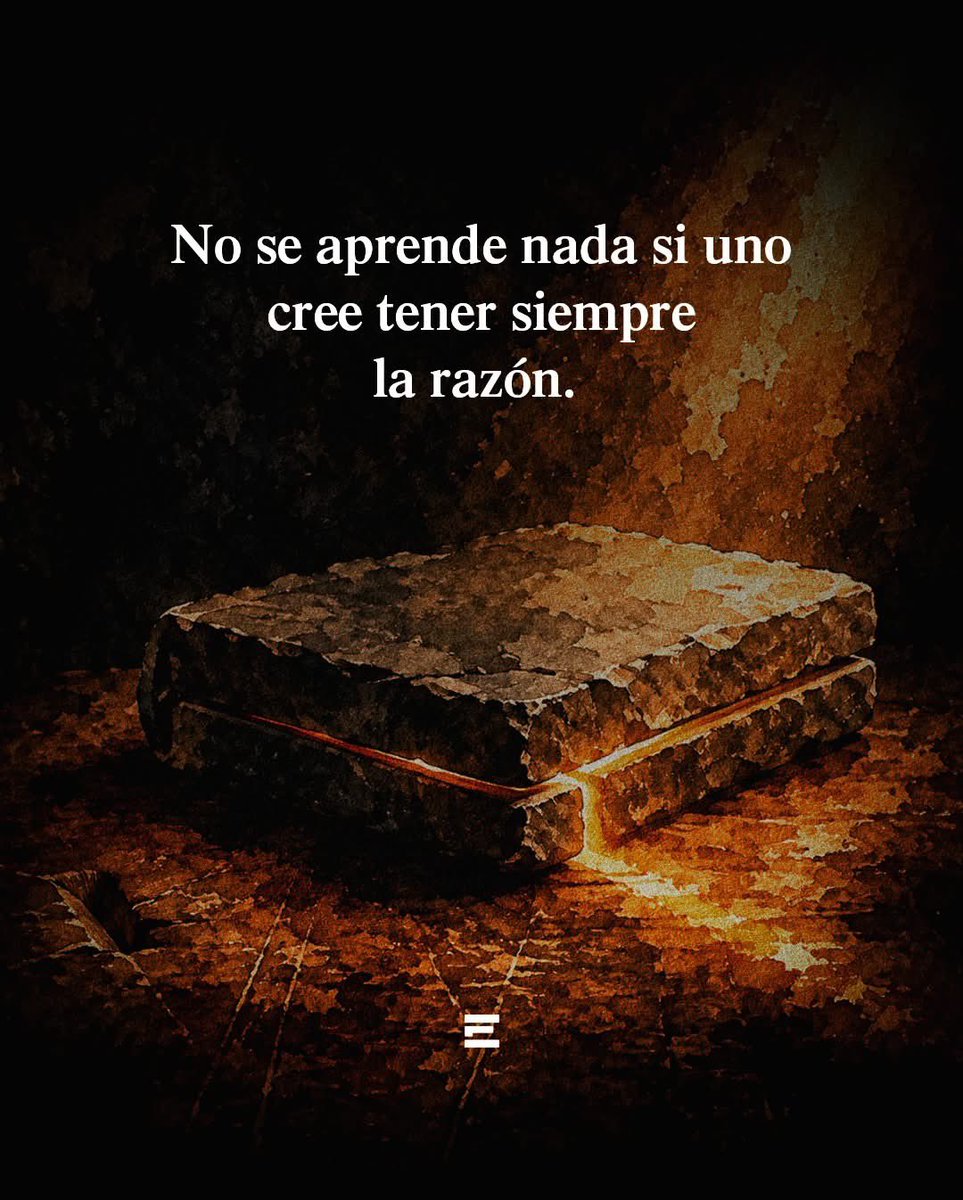
Cuando necesitas tener la última palabra, dejas de escuchar. Cuando crees que ya lo sabes todo, cierras la puerta a nuevas ideas, experiencias y lecciones.
La sabiduría de la vida nos recuerda: reconocer que puedes estar equivocado no te hace débil. Te hace lo suficientemente humilde para seguir creciendo.
Escucha opiniones diferentes. Acepta una crítica cuando sea justa. Cambia de opinión cuando descubras algo que no sabías. No tienes que defender una idea solo porque alguna vez la creíste.
Y aquí viene la parte más importante: no busques tener siempre la razón. Busca entender, aprender y mejorar.
Porque una mente que necesita tener la razón en todo...
termina aprendiendo mucho menos de lo que podría.
Dijo una vez Don Quijote de la Mancha:
"El ser humano se esclaviza por el lujo y las vanidades, persiguiendo riquezas como si en ellas encontrara la dicha.
Mas no advierte que, cuanto más tiene, más teme perderlo, y en esa angustia se le escapa la verdadera felicidad.
Porque la dicha no está en el oro ni en la opulencia, sino en la brisa que acaricia el rostro, en la risa sincera de un amigo, en el pan compartido con gratitud.
¡Necio es aquel que busca en lo externo lo que solo el alma puede hallar!
La vida sencilla es el mayor tesoro, y quien la comprende, es el más afortunado de los hombres."
Aquí puedes aprender a ganarte muy bien la vida con X: https://t.co/zo84kONZf7
We should be conscious beings by now and we are still reacting like sleepwalkers.
Humanity is not developing as quickly as it should —especially in consciousness and spiritual perception.
This isn't “failure.”
It's delay.
Every epoch carries a task.
The Consciousness Soul epoch, beginning around 1413, calls humanity toward:
clear self-awareness, inner freedom, moral imagination, and the ability to meet the Christ impulse consciously rather than through external authority.
But humanity hasn't taken up this task.
Technology races ahead.
Spirit lags behind.
Ahriman accelerates material civilization while human beings remain inwardly asleep.
Machines grow more powerful while moral imagination remains undeveloped.
The danger isn't “less spirituality.”
It's s a widening gap between our technological capability and our level of consciousness.
Dr Steiner says this delay is why humanity struggles to perceive new spiritual impulses — including the Christ in the etheric.
The spiritual world hasn't withdrawn.
We simply aren't awake enough to receive what is being offered.
If we refuse inner development, materialistic consciousness hardens.
Social life becomes mechanized.
Technology becomes domination instead of freedom.
And the consequences reach into future human incarnation itself.
Yet evolution must remain free.
Humanity cannot forced to awaken.
That freedom slows development — but makes real development possible.
An individual who awakens moral imagination, self-knowledge, and spiritual perception contributes not only to personal growth, but to the evolution of humanity itself.
Anthroposophy exists because evolution continues — while humanity sleeps.
We are not lost.
But we are behind.
Wake up.
Human freedom depends on it.
Who was Dr. Rudolf Steiner?
A man who dedicated his entire life to showing that the spiritual world can be known with the same rigor as science — and paid an extraordinary price for it.
Born on 27 February 1861, Steiner grew up living in two worlds at once.
Outwardly, the quiet son of a railway employee. Inwardly, a child who perceived reality with an unusual clarity that never left him.
Geometry became his first proof that truth exists independently of the senses.
Perfect forms could be grasped inwardly before they were ever seen outwardly.
That realization became the foundation of everything that followed.
He questioned priests about life, death, and the soul, yet found that conventional religions could not reach the depth of what he already perceived.
Yet he loved Christian liturgy.
He felt its symbols pointed toward a living spiritual reality buried beneath dogma.
As a young man he immersed himself in Goethe and Schiller, while remaining an outsider to ordinary social life.
His notebooks filled with symbolic sketches and imaginative forms that would later reappear in the architecture of the Goetheanum.
By fifteen he was tutoring other students simply to survive, unknowingly developing the clarity that would later captivate thousands.
His mission became unmistakable:
To reunite scientific thinking with spiritual reality.
Modern humanity had perfected the study of the external world while forgetting the inner dimensions of existence.
Steiner sought to build a bridge between them.
His years in Weimar were decisive.
Through Goethe’s way of observing nature, he discovered that disciplined perception could be extended beyond the senses into the spiritual world. This became the seed of Anthroposophy.
Berlin tested everything.
He lived through poverty, isolation, ridicule, and profound inner struggles.
He described confronting forces that tried to harden human thinking into lifeless abstraction.
Those years forged the strength that sustained his later work.
With Christianity as Mystical Fact, Steiner presented Christianity not as a collection of dogma, but as the central event of cosmic evolution — the moment the spiritual world entered earthly history in full reality.
He joined the Theosophical Society simply because it was one of the few places willing to listen.
But he refused blind belief.
He refused to replace one dogma with another.
When his own spiritual research diverged from theosophical teachings, separation became inevitable.
Anthroposophy was born from direct spiritual investigation, later compared with ancient wisdom only to reveal their deeper harmony.
Together with Marie von Sievers, Steiner published the foundational works of the movement, renewed art of speech, created the Mystery Dramas, inspired eurythmy, and conceived the Goetheanum — architecture as spiritual knowledge made visible.
His insights eventually gave rise to Waldorf education, biodynamic agriculture, anthroposophic medicine, and an entirely new understanding of the human being's place within the cosmos.
Everything emerged from one conviction:
That the invisible can be approached with discipline, clarity, and conscious experience.
Steiner raised human understanding to the Spirit and united it with the spiritual being of the cosmos.
Marie Steiner called this “the greatest human deed.”
He was hated with all the demonic power of which hell is capable — yet he answered every misunderstanding with Love.
After his death on 30 March 1925, Marie Steiner wrote that he became free to continue his work from the other side.
IT WAS NEVER ABOUT FINDING THEM
There is a kind of connection that does not begin with a dramatic meeting. It starts much quieter, as a subtle pull that keeps showing up in the background of ordinary days. Two people can live completely separate lives, yet still feel the same invisible thread drawing their attention again and again. The search was never the point. Awareness was.
This is the truth many only understand later. For anyone who has felt that strange sense of recognition without fully knowing why, this is the reminder that the real journey was never about chasing someone down. It was about learning to notice the quiet force that was already connecting you all along.
THE ANCIENT ROOTS OF RESILIENCE
True strength is forged in the deep, quiet places of endurance, far away from the fleeting noise of the world. Just like ancient stone carved to withstand the test of centuries, our inner character is shaped by every trial we navigate and every hardship we overcome.
True power does not shout; it stands firmly rooted in self-respect, patience, and unwavering resolve. When you honor your personal journey and trust the wisdom earned through lived experience, you build an unshakeable foundation that nothing can dismantle.
Stand tall in your truth, honor your history, and let your quiet resilience carry you through any storm.
✨🙌🏿💫
The Akashic records (sometimes called the Akashic chronicle or “Book of Life”) are a concept from Theosophy, Anthroposophy, and related esoteric/New Age traditions.
They are described as a non-physical, universal compendium or energetic archive that records every event, thought, word, emotion, intention, and experience of all beings across past, present, and potential future - essentially a cosmic library or “memory of nature.”
The term derives from the Sanskrit ākāśa (आकाश), meaning “ether,” “sky,” “space,” or “atmosphere.” In Hindu philosophy and Ayurveda, akasha is the fifth element (alongside earth, water, fire, and air).
Isaac Casaubon (1559–1614) was a leading classical scholar and philologist of the late Renaissance and early modern period.
In 1614 he published a major work that included a decisive critique of the dating and authenticity of the Corpus Hermeticum.
Casaubon’s Arguments:
Using rigorous philological analysis of the Greek text (working from editions such as that of Adrien Turnèbe), Casaubon demonstrated that the Corpus Hermeticum could not date from the remote Egyptian past (before Moses or even earlier.
Key points:
• Language and style: The Greek vocabulary, syntax, and philosophical terminology belong to the early centuries of the Common Era, not to archaic or classical Greek. The texts lack the expected “patina of antiquity” and instead resemble the Greek of the New Testament period and later.
• Anachronisms: References to figures or concepts (such as the sculptor Phidias) that post-date any supposed ancient Egyptian Hermes; dependence on post-Platonic and Stoic/Neoplatonic ideas.
• Christian parallels: Numerous doctrinal and verbal similarities with the Bible and early Christian writings, which Casaubon interpreted as evidence of borrowing or forgery by later (post-Christian) authors rather than genuine ancient prophecy. He viewed the texts as a mixture of Platonic philosophy and Christian ideas, not pure Egyptian wisdom.
Casaubon concluded that the philosophical Hermetica were products of the early Christian era (roughly the 2nd–3rd centuries CE), composed in a Hellenistic (Greco-Egyptian) milieu, and not translations of primordial Egyptian revelations. He regarded them as essentially forged or pseudepigraphic works.
@shebelut Coño Shebe, que manera de postear incauteces. El jugador que está mostrando un nivel sostenido es Newton Williams. No puedes ser conclusivo por un resultado.