Dr. PhD in Ethics. Fascinated by true and false contradictions. Be precise. Specify. What is your motto? What can you honestly claim? My home is my castle.
~~A short note about us today~~
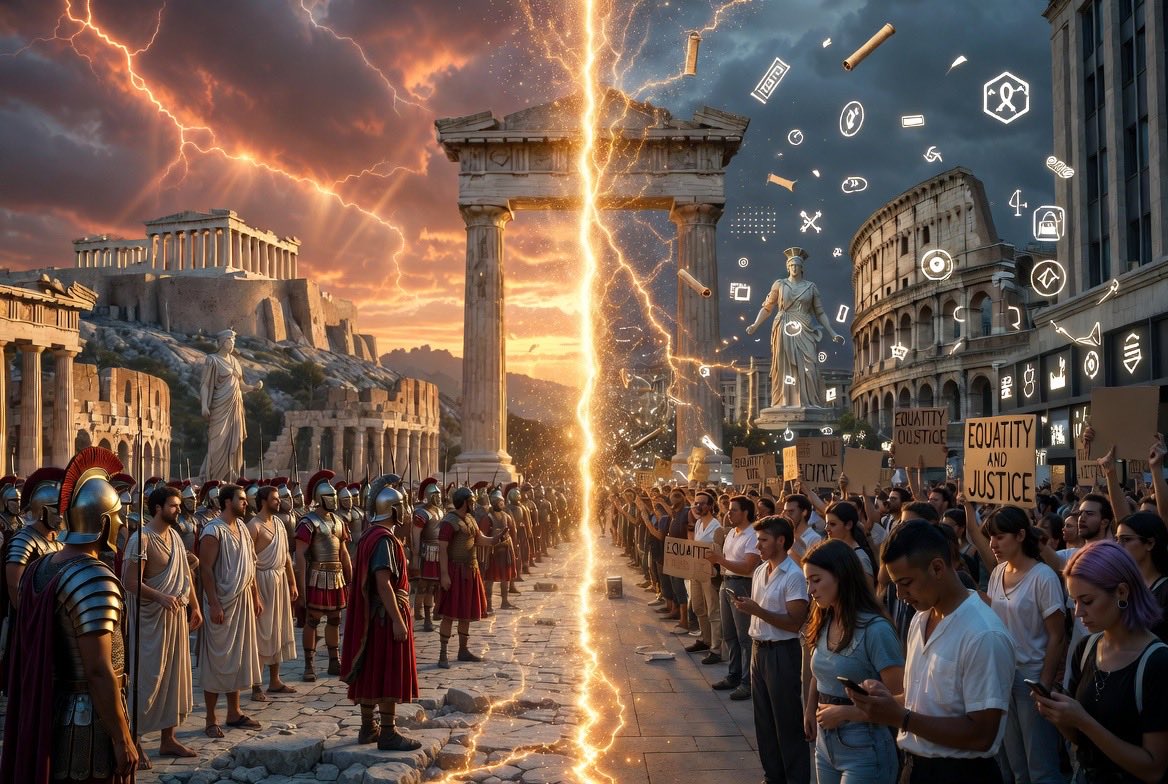
The contemporaries, poor things, demand that what is unique, strange, and born of a world long dead be refashioned according to modern values and sensibilities, so that instead of learning how men and women experienced and saw the world 3000 years ago they may dissolve it into the plasma of the present, where cultural blood transfusions give no offence, insofar as ancient prejudices are washed away in the torrent of endless adaptations and remakes, and every life, every story, every world is rewritten for the comfort of feelings that must be protected at all costs lest the poor contemporaries be offended and equality itself be disturbed by some relic of an older and sterner philosophy.
@carolmswain Somebody with a life experience outside of the traditional political perimeters and who could improve the discourse of courage and loyalty.
@oss_romano Far too much South Americanism in the Vatican. First with the late pope Francis and now with pope Leone. How about focusing on capitalist northern countries?
But is it really communism that is gaining ground in some some American states with large Muslim populations—such as Michigan, Minnesota, & Texas—& in cities like New York?
Or is “communism” being used as a label for something else? The U.S. Constitution protects freedom of religion, but it does not specifically protect communism as such. If there are social or political changes taking place, perhaps the real question is what is driving them, rather than simply calling them communism. It could be religion expansion.
👉That’s the issue worth examining.
I read your article with great interest. I have to say, however, that the comparison between Lincoln and Zelensky worries me a bit. You may have been too optimistic. I understand your wishes, and your sense of solidarity with Ukraine.
In my view, though, Lincoln was was fighting a civil war within his own country. The issue was preserving the Union, not resisting foreign conquest. Communication was slow, & replacing experienced generals with favoured ones could be done without provoking the intense public scrutiny that exists today.
In my view—Ukraine faces a very different reality. The fact that people have taken to the streets to challenge President Zelensky’s decisions shows that military leadership is now subject to immediate public and political accountability.
You are right to to say that Ukraine needs both Fedorov and Syrskyi. The question, however, is: to what end? One represents the digital battlefield, the other the conventional one. But strategy matters too and it needs personnel & feasible ideas.
Given that Ukraine’s allies appear increasingly absorbed by their own domestic problems, President Zelensky may need to rethink his strategy. If countries struggle to address fundamental issues such as securing their own borders, the political resolve behind their support for Ukraine cannot simply be taken for granted.
You write that “President Zelensky should not, as we must not, lose sight of the eventual aim, which is victory.”
I say—But what does victory mean? Lincoln was not pursuing victory for its own sake; he was pursuing the preservation of the Union. That distinction is fundamental. Perhaps the real question is not how Ukraine wins, but what kind of political outcome can credibly be called victory. It may ultimately prove closer to Lincoln’s idea of unity than to military triumph.
Let me unpack Martha Nussbaum’s apparently compelling claim.
Knowledge, a positive value, is said not to guarantee good behaviour. In other words, knowledge alone cannot prevent people from acting badly. At some point, its positive value reaches its limits.
Ignorance, by contrast, is presented as a virtual guarantee of bad behaviour. Here, too, ignorance cannot protect people from themselves.
But this is where the the symmetry breaks down.
Ignorance is not invariably a negative condition. Recall John Rawls’ “veil of ignorance”: by asking individuals to ignore their own social position and interests, it provides the very conditions for impartial justice. In that context, ignorance is not a defect but a moral resource.
Conversely, knowledge is no guarantee of good behaviour, just as ignorance is no guarantee of bad behaviour. In both cases, what ultimately matters is moral judgment. Knowledge and ignorance may influence conduct, but neither determines it. But perhaps it’s is moral luck, rather than moral judgement, that preserves people’ good behaviour.
I wish you luck — 🍀 — but are you sure it’s your best option?
I’m of two minds. On the one hand, I think children need to spend time with other children to develop their social skills & nurture their curiosity, even if the school environment is less than ideal.
On the other hand, home education was common before compulsory schooling and helped educate many members of the middle and upper classes. However, those children often grew up in social circles where their future status & career prospects were less dependent on navigating the broader social world.
Put yourself in your children’s shoes. Would you have wanted to spend your childhood at home day after day? Would you have become the person you are today if you had been homeschooled? If your answer to both questions is “no,” then it might be better to consider this first homeschooling as a kind of experiment and to stay open to possible changes. That would help you navigate possible disappointment and also give your children a fair choice.
Reporting an emeritus professor to the police over conduct that many would regard as entirely normal raises dramatic questions about academic culture at Cambridge.
It also raises concerns about whether some individuals are able to invoke police intervention in situations that would ordinarily be addressed through discussion or established university procedures.
Cambridge University’s silence raises serious questions about its integrity. The University’s executive leadership has important questions to answer—first and foremost, whether they were aware of the facts &, if so, why they did not address them openly.
~~ Judges or juries?~~
Politicians do not ordinarily ask randomly selected members of the public to decide complex questions of public policy. Decisions about taxation, immigration, constitutional reform, or medical regulation are made by elected representatives advised by specialists. If expertise is considered indispensable in these fields, why should it be considered unnecessary when deciding guilt or innocence in serious criminal cases?
The people is no expert. Jurors are not experts. Why then have them express opinion on cases that require expertise? If Britain had had a judges system, Lucy Letby may be free now, while in other instances, rapists & thieves would be in prison. And illegal migration wouldn’t exist.
Imagine a hospital in which, instead of a qualified physician diagnosing your illness or performing an operation, your treatment was decided by twelve randomly selected citizens whose knowledge of medicine came from social media, documentaries, & conversations with AI. Most people would reject such a system immediately. Yet in criminal trials we routinely entrust decisions of equal gravity to juries rather than legal professionals.
Why should justice be any different?
@CasaLettori@Vale22046@Paolosantagata5@AlmiraUva@gori_magnani@Rebeka80721106@AutieriFlora Ne hanno combinati di guai anche gli artisti, va là! Se sapesse quanta follia, oggi, viene fatta passare per verità nel mondo dell’arte & dell’intrattenimento, forse sarebbe stato più cauto. Ma ai suoi tempi era facile sentirsi cool… Vorrei vedere lui a convivere con la follia.
@paris_critical As history has proven innumerable times, & as the preachers of contemporary absurdity—& their followers, above all in politics—have been proving ever since those innumerable times.
What an entangled relationship between a person suspected of cheating (where the suspicion alone should arguably be sufficient grounds for suspension until all the relevant facts have been assessed).
A university that appears to have forgotten the principle of primum non nocere (there are many forms of harm) &, in situations such as this, seems to prioritize ideology over humility.
And a police force that appears to decide whom to believe rather than consistently following established best practices. Their approach may be motivated by generosity, but one may reasonably ask whether that is the role of the police.
Why should they attack his government? What do they care about that desperate government? They have enough on their hands to get their governments going within this EU which is incapable of even preparing for the most foreseeable problems such as fire (as old as Europe) water and heat!
I don’t think, Commission President, that innovation can be directed by a political body. Innovation depends on entrepreneurs, doers, & risk-takers. It requires a mindset that grows in the garden of freedom, with the confidence that good ideas will be supported rather than constrained.
If you want to unleash innovation, you need to step back & free European businesses from a system of taxes, subsidies, and regulations through which governments attempt to direct industry. Industrial R&D is virtually nonexistent in Europe compared with other leading economies.
Innovation does not flourish under the EU’s five-year planning cycles.
Delirious conversation. Nothing new on the Morgan front—the same rattling men talking like a broken record about their favourite topic as they’ve been doing since October 2023. Conveniently leaving out that a few months ago a Spanish judge decreed that foreigners arriving at Ceuta and demanding refuge cannot be removed bc it’s Spanish land? Do you think that the inadequate living on Tictoc and instagram—who exhorted the Moroccans and other countries’ migrants stack there—to go to Ceuta are familiar with geopolitics? That they know what the world looks like? That they know the world besides their devices and small environments?
Are we really expected to believe that so many people have been born into the wrong body that laws must be rewritten, dedicated medical clinics established, & medical training overhauled to accommodate this belief?
Is the number of people claiming gender dysphoria or gender incongruence truly so great that it justifies such sweeping legal, medical, and social changes?
Have policymakers rigorously examined the evidence before implementing these changes? Have they considered whether, in accommodating these claims, they may be doing so at the expense of women’s rights, privacy, and protections?
In my view, these are legitimate questions that deserve careful, evidence-based answers rather than assumptions or ideology.
The Oxford Union; DEI-related hiring controversies at Cambridge; Harvard is not much different. Add to that the concerns about growing antisemitism in some humanities programmes, along with similar controversies across other Ivy League and Russell Group institutions. What a fall from grace for institutions once celebrated as towers of wisdom & learning—now, to many, little more than the shadows of what they once were.
The rule of oppression:
5 + 5 = 9 for the people
5 + 5 = 11 for the party in charge
A more practical example—
The crown princess of Norway (who has climbed Mount Epstein), has a criminal son.
He has been convicted of rape and other crimes, yet he has been sentenced to house arrest—in his parents’ palace.
Can a democratic justice system, founded on the principle that everyone is equal before the law, truly uphold that principle when some people expect to be seen as &!treated differently from everyone else?
Really—House arrest in an ordinary home is one thing. House arrest in a palace is quite another.