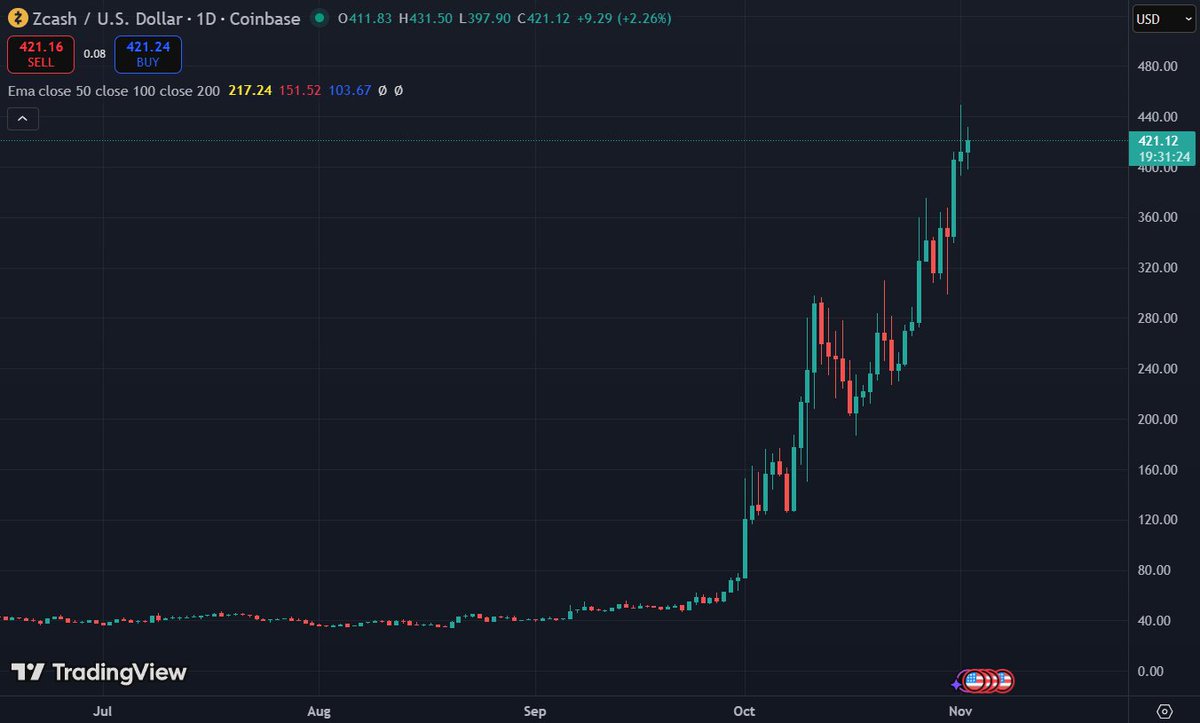
I think using CT as any sort of signal for BTC is a mistake from here on out.
The participants on here are totally irrelevant for this asset now imo.
When an asset transitions into institutional ownership, social sentiment stops being alpha.
Crypto traders are stuck in an old world pattern matching retail PA, which is very understandable, as it what they know, and worked very well in the past.
But if all the data shows Bitcoin is dominated by institutions now then I would argue that the PA will look very different.
So what we have now is:
Volatility compression, longer macro cycles, and tighter correlation to real rates and macro flows, not sentiment-driven "chart breakouts".
New article up on fixing crypto engagement
If you need a review let me know, as X is slashing tons of people into spam
If you get wrecked as a small account in the new X algo update you might be posting too much about web3
look at the "KOLS" saying you're gonna get dumped on by other "KOLS" for buying $ZEC since $100 to now $400, this is what you call the ultimate midcurve
sure it will start crashing down at some point of time and they will be like "i told you so"
whales and big money don't give a shit about what CT thinks, CT is just a small echo chamber where we speculate about prices but in reality have no impact to anything at all except low marketcap shitters
I’m a techno-optimist by default. I love technology.
It’s what makes us human. It’s how we evolve and survive as a species.
But techno-optimism has a twofold risk:
1) Optimism without pragmatism
No - just because you build it doesn’t mean they will come.
Too often, tech fails not because it’s bad, but because it’s early. Wrong form factor. Broken go-to-market. Requiring too much from the user.
The first cars were dangerous and unreliable.
The first smartphones were slow and niche.
What changed? Apple didn’t just make a phone - it bundled music, design, and intuition. Jobs understood human behavior as much as he understood technology.
Ken Kocienda, who built the iPhone keyboard, obsessed over how people actually type: imprecise, fast, emotional.
He realized forcing precision was the wrong goal. Instead, he built the illusion of it: even if you hit slightly off, the software predicted what you meant to type.
The magic wasn’t in accuracy - it was in confidence.
Typing on glass suddenly felt natural. You trusted the machine.
That’s the key: great technology meets people where they are, not where we wish they’d be.
2) Forgetting that human nature doesn’t change
As Morgan Housel writes in "Same as Ever," technology evolves, but people stay remarkably consistent. We still want to be respected, loved, and safe.
We still chase status, overestimate control, and tell ourselves stories that make sense of chaos.
We still get greedy in booms and fearful in busts.
Compounding - in money, relationships, or knowledge - always works the same way: small gains over time lead to massive results. Yet we’re still too impatient to wait.
The most successful builders know this. They design for what doesn’t change - the emotions, incentives, and stories that have driven humans forever - while leveraging what does change: the tools (technology).
Because while technology changes fast, people change slowly.
I’ll always bet on technology.
But I’ll never bet on human behavior changing.
Invert, always invert.
It's always rotki's fault.
- rotki's new release is broken can you please fix it?
- Thanks for the feedback. What's wrong? How can I help?
- I just installed new rotki version and my Kraken balances and history don't work. It shows errors for Kraken. Old release worked fine.
So good to see one of the most respected OG's of the space appreciate what @katana are building.
As DeFi Dad has said, one of the key aspects of katana is the assets on-chain are deployed into Morpho vaults on Ethereum and consistently earn yield within low risk, high-liquidity strategies.
This yield is then pushed to vbToken holders.
The katana flywheel in effect ⚔️
Privacy is necessary for an open society in the electronic age. Privacy is not secrecy. A private matter is something one doesn't want the whole world to know, but a secret matter is something one doesn't want anybody to know. Privacy is the power to selectively reveal oneself to the world.
If two parties have some sort of dealings, then each has a memory of their interaction. Each party can speak about their own memory of this; how could anyone prevent it? One could pass laws against it, but the freedom of speech, even more than privacy, is fundamental to an open society; we seek not to restrict any speech at all. If many parties speak together in the same forum, each can speak to all the others and aggregate together knowledge about individuals and other parties. The power of electronic communications has enabled such group speech, and it will not go away merely because we might want it to.
Since we desire privacy, we must ensure that each party to a transaction have knowledge only of that which is directly necessary for that transaction. Since any information can be spoken of, we must ensure that we reveal as little as possible. In most cases personal identity is not salient. When I purchase a magazine at a store and hand cash to the clerk, there is no need to know who I am. When I ask my electronic mail provider to send and receive messages, my provider need not know to whom I am speaking or what I am saying or what others are saying to me; my provider only need know how to get the message there and how much I owe them in fees. When my identity is revealed by the underlying mechanism of the transaction, I have no privacy. I cannot here selectively reveal myself; I must always reveal myself.
Therefore, privacy in an open society requires anonymous transaction systems. Until now, cash has been the primary such system. An anonymous transaction system is not a secret transaction system. An anonymous system empowers individuals to reveal their identity when desired and only when desired; this is the essence of privacy.
Privacy in an open society also requires cryptography. If I say something, I want it heard only by those for whom I intend it. If the content of my speech is available to the world, I have no privacy. To encrypt is to indicate the desire for privacy, and to encrypt with weak cryptography is to indicate not too much desire for privacy. Furthermore, to reveal one's identity with assurance when the default is anonymity requires the cryptographic signature.
We cannot expect governments, corporations, or other large, faceless organizations to grant us privacy out of their beneficence. It is to their advantage to speak of us, and we should expect that they will speak. To try to prevent their speech is to fight against the realities of information. Information does not just want to be free, it longs to be free. Information expands to fill the available storage space. Information is Rumor's younger, stronger cousin; Information is fleeter of foot, has more eyes, knows more, and understands less than Rumor.
We must defend our own privacy if we expect to have any. We must come together and create systems which allow anonymous transactions to take place. People have been defending their own privacy for centuries with whispers, darkness, envelopes, closed doors, secret handshakes, and couriers. The technologies of the past did not allow for strong privacy, but electronic technologies do.
We the Cypherpunks are dedicated to building anonymous systems. We are defending our privacy with cryptography, with anonymous mail forwarding systems, with digital signatures, and with electronic money.
Cypherpunks write code. We know that someone has to write software to defend privacy, and since we can't get privacy unless we all do, we're going to write it. We publish our code so that our fellow Cypherpunks may practice and play with it. Our code is free for all to use, worldwide. We don't much care if you don't approve of the software we write. We know that software can't be destroyed and that a widely dispersed system can't be shut down.
Cypherpunks deplore regulations on cryptography, for encryption is fundamentally a private act. The act of encryption, in fact, removes information from the public realm. Even laws against cryptography reach only so far as a nation's border and the arm of its violence. Cryptography will ineluctably spread over the whole globe, and with it the anonymous transactions systems that it makes possible.
For privacy to be widespread it must be part of a social contract. People must come and together deploy these systems for the common good. Privacy only extends so far as the cooperation of one's fellows in society. We the Cypherpunks seek your questions and your concerns and hope we may engage you so that we do not deceive ourselves. We will not, however, be moved out of our course because some may disagree with our goals.
The Cypherpunks are actively engaged in making the networks safer for privacy. Let us proceed together apace.
Onward.
you cant be bearish on prediction markets when polymarket is literally becoming a mainstream brand
its on tv every single day and quoted by the most influential people in the world
no other crypto use case is getting that level of real world attention rn