I strongly believe there are entire companies right now under heavy AI psychosis and its impossible to have rational conversations about it with them. I can't name any specific people because they include personal friends I deeply respect, but I worry about how this plays out.
I lived through the great MTBF vs MTTR (mean-time-between-failure vs. mean-time-to-recovery) reckoning of infrastructure during the transition to cloud and cloud automation. All those arguments are rearing their ugly heads again but now its... the whole software development industry (maybe the whole world, really).
It's frightening, because the psychosis folks operate under an almost absolute "MTTR is all you need" mentality: "its fine to ship bugs because the agents will fix them so quickly and at a scale humans can't do!" We learned in infrastructure that MTTR is great but you can't yeet resilient systems entirely.
The main issue is I don't even know how to bring this up to people I know personally, because bringing this topic up leads to immediately dismissals like "no no, it has full test coverage" or "bug reports are going down" or something, which just don't paint the whole picture.
We already learned this lesson once in infrastructure: you can automate yourself into a very resilient catastrophe machine. Systems can appear healthy by local metrics while globally becoming incomprehensible. Bug reports can go down while latent risk explodes. Test coverage can rise while semantic understanding falls. Changes happens so fast that nobody notices the underlying architecture decaying.
I worry.
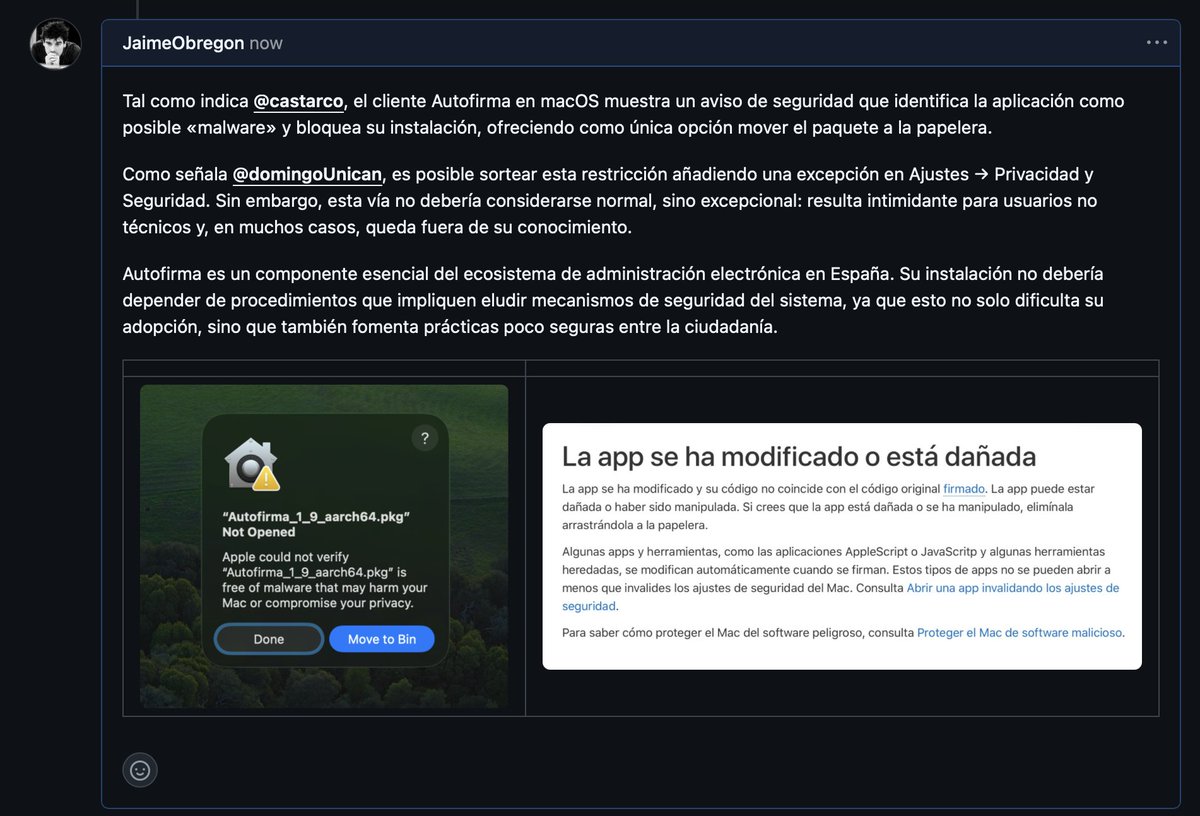
Ya había un «issue» abierto desde 2024; he añadido un comentario. ¡Esto es lo potente de desarrollar en abierto!: cualquiera puede aportar directamente al equipo técnico.
Si la Administración desarrollara siempre así, sus interfaces digitales serían mucho mejores.
Y un matiz: abrir el proceso no exige necesariamente publicar el código. Puedes tener repositorios con «issues» y comunidad aportando, incluso con código privado. No es lo ideal, pero es mucho mejor que la opacidad de la mayoría de los desarrollos públicos actuales.
Matin FalahManesh made "Profile Mover," a Maya C++ plugin that uses splines to drive character deformation instead of traditional weight painting. 🧩
See more: https://t.co/roTmAgmwTu
#maya#3dart
Three years since the first flight of Starship, the next generation is here. New ship. New booster. New engines. New pad and new test site. SpaceX engineers are working to solve one of the most difficult engineering challenges in history: developing a fully, rapidly reusable rocket
@angus_davidson@henningsanden What about if you install proxmox and virtualize both OS? One VM for windows, another for Linux. (If you want the GPU to be accessible to the OS you can only have one VM on at a time)
You can have shared storage too with SMB share.
Your Netflix "4K" stream and a 4K disc put the same number of pixels on your screen. But the disc version of a two-hour movie is about 70 gigabytes. The stream is about 14. Same pixels, roughly five times less data filling them.
You see it first in dark scenes. The stream doesn't have enough data to tell dark grey from black, so your TV just mashes it all into chunky blocks. Then you notice sunsets looking like a paint-by-numbers, with visible stripes where smooth color should be. Film grain is probably the biggest casualty. Directors add that slightly textured look on purpose to make movies feel cinematic. Streaming compression reads it as noise and wipes it. That's where the weirdly plastic, waxy look on a good OLED comes from.
One comparison I can't stop thinking about. A regular 1080p Blu-ray (the older HD format, not even 4K) pushes about 40 megabits of data per second to fill 2 million pixels. A 4K stream pushes 15-25 to fill 8 million pixels. Four times the pixels. Less data. A plain HD disc from 2008 can look sharper than a brand new 4K stream.
Sound is worse. Netflix sends "Dolby Atmos" audio at about 768 kilobits per second, compressed, with parts of the original permanently deleted. A disc sends TrueHD Atmos at up to 18,000, lossless, nothing removed. Up to 23x more sound data. If dialogue sounds flat when you're streaming, that's not your speakers.
Netflix is getting better at this. As of late 2025, 30% of their streaming runs on a newer compression method called AV1, the same picture at a third less data. They also strip film grain out before compressing, then rebuild it on your TV during playback. Saves over a third on file size for most content, and up to two-thirds for really grainy movies. The rebuilt grain looks solid.
The tradeoff won't go away, though. Netflix has to deliver a file that works over spotty rural Wi-Fi and gigabit fiber, adjusting quality frame by frame to whatever your connection can handle. A disc reads plastic. Same quality every time.
Awesome moment of FSD sentience today with an immediate reaction to a change in situation and then following a human cue (flashing brights) to immediately proceed. 🤯
@DotCSV Pronto podrás controlar qué quieres ver con lenguaje natural, imagino que podrás tener un tab en tu feed con todo el tema de IA fácilmente.
For me: algoritmo típico que te enseña con lo que interactúas.
Followers: feed cronologica de la gente que sigues
Feed custom de XYZ
...
‘Pirates of the Caribbean’ director Gore Verbinski says that some CGI in movies now is worse because of over-reliance on Unreal Engine
“People started thinking maybe movies can also use Unreal for finished visual effects. So you have this sort of gaming aesthetic entering the world of cinema”
(Source: https://t.co/TLbkIbyxTh)
Anduril CEO @SchimpfBrian’s biggest lesson from Palantir:
“This focus on talent. Everyone says it. In practice, it’s a lot more annoying than you’d think. Often the talented people are super opinionated, kind of aggressive, tell you you’re dumb. It doesn’t always feel good.”
“What Karp really recognized and drove at Palantir was this notion of: let’s have really brilliant people that are highly empowered to own problems. It’s probably the number one lesson in how we run things here.”