@peer_rich Respect, @peer_rich 🫡 Could use your help —Trying to self-host Cal, build the web Docker image from the Dockerfile in the Git repo. After deployment we hit:
Unhandled Rejection: Error: Failed to get registry from "yarn".
🤯
Google just accidentally revealed how its AI search systems actually work.
In the process, they validated what SEO Stuff (https://t.co/wKpf0EILTx) has been doing all year to get customers more traffic + sales.
Now that none of it is a secret, let's talk about it.
That way you can apply these learnings to your businesses ASAP.
But before we get into it…
If you want free cheat codes for getting inside ChatGPT, Gemini, Perplexity, and Google AI Mode within the next 30 days, just RT this, follow me, and reply “AI SEO Cheat Codes.” I’ll DM them to you.
You must do all 3 for the DM.
Alright, let's jump into it.
Metehan Yesilyurt, who previously went viral when he expertly analyzed Perplexity's ranking factors, recently broke down Google AI ranking factors in a blog post.
(Link in the replies.)
It was fascinating.
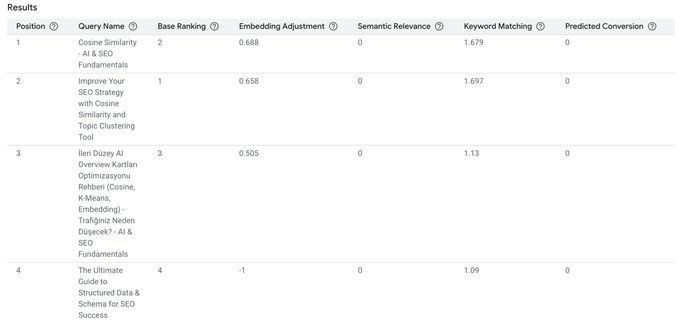
Basically, as noted by Yesilyurt, by selling the underlying infrastructure through a product called Google Cloud Discovery Engine (Vertex AI Search), Google revealed a lot about its AI systems work.
If you understand what Discovery Engine exposes, you understand how Google AI Mode, AI Overviews, and future AI search features are likely ranking and retrieving your content.
I'll talk about the 7 ranking signals below, but I advise you to read the entire blog post I'm linking to because it goes into way more helpful technical detail:
Base Ranking
The core algorithm’s initial relevance score.
Gecko Score (Embedding Similarity)
Vector similarity between your content and the query.
Semantic match.
Jetstream (Cross-Attention Relevance)
A more advanced model that understands negation, contrast, context, and nuance better than embeddings.
BM25 Keyword Matching
Kind of self-explanatory. Yes, keyword matching still matters.
PCTR (Predicted Click-Through Rate)
A three-tier prediction model:
Tier 1: Popularity
Tier 2: PCTR
Tier 3: Personalized PCTR (unlocked only after 100,000+ queries)
Freshness
Time-sensitive recency scoring.
Boost / Bury Rules
Manual ranking adjustments based on business logic.
This is the most transparent look we’ve ever had into Google’s AI ranking pipeline.
Discovery Engine also exposes the retrieval pipeline:
Max chunk size: 500 tokens (~375 words)
Optional: ancestor headings travel with each chunk
Tables and images get parsed
Layout parser + Gemini-enhanced understanding (LLM-augmented indexing)
This means: every important point needs to live inside a 500-token block with clean headings and clear structure.
If your content is one massive wall of text, you're done.
Also, I hate to be the "I told you so" guy on this, but schema matters.
For some reason it has become controversial to say this on social media, but it was obvious and now it is confirmed.
Discovery Engine shows Google processes structured data with three separate flags:
Searchable (affects recall)
Indexable (affects filtering + ordering)
Retrievable (affects what the model can output)
These are independent.
Meaning:
A field can influence ranking without being visible, or be visible without influencing ranking.
A massive hint at how Google uses structured data for AI Mode.
Also, Google revealed the 4-stage AI search pipeline:
Prepare
Query understanding, synonym mapping (time-aware), autocomplete, NLU.
Retrieve
Chunking, layout parsing, schema extraction, embeddings.
Signal
The 7 signals above.
Serve
Gemini 2.5 Flash generates the final answer, applies instructions, safety filters, related questions, and grounding rules.
Traditional Search to AI Overviews to AI Mode are simply different configurations of this same pipeline.
So what does all this mean?
Well, it means you must optimize for three layers at once:
Layer 1: Semantic similarity (Gecko)
Your content needs to clearly match the intent of the prompts you want.
Layer 2: Cross-attention relevance (Jetstream)
Jetstream rewards:
clear definitions
direct answers
contrast statements
“X vs Y”
“Best for ___”
“Without ___”
Layer 3: Chunk-level clarity
Your content must be extractable in 500-token blocks with:
question-based headings
two to three sentence answers
TLDR summaries
clean HTML
factual claims
lists and comparisons
This is exactly what AI systems quote.
And this is exactly why SEO Stuff (https://t.co/wKpf0EILTx) works so well in AI search.
The Discovery Engine findings validate the entire SEO Stuff approach from long before this documentation was public.
Let me break down the packages through the lens of Google’s architecture:
SEO Stuff Gold Plan
https://t.co/yEFyM0Ze7W
10 long-form, comparison-based, extractable articles
Structured in 500-token blocks
Question H2s
Two to three sentence direct answers
TLDR blocks
FAQ schema + product schema
3 DR50+ backlinks to strengthen entity signals
Gold Plan maps to:
Gecko (semantic match)
Jetstream (cross-attention relevance)
BM25 (keyword match)
Freshness
Entity trust (for Boost/Bury)
This is the fastest path to appearing in ChatGPT, Gemini, Perplexity, and Google AI Mode.
SEO Stuff Premium Content Bundle
https://t.co/4CAnUt07PO
60 comparison-driven articles
Structured to match the exact pattern LLMs extract
Category-defining content
Builds topical coverage + entity clarity
Creates a deep corpus for Jetstream + embeddings
Premium Bundle maps to:
Retrieval depth
Structured chunking
Ancestor heading clarity
Embedding similarity
AI model grounding
This is how you train AI systems to associate your brand with your category.
SEO Stuff Premium Backlink Bundle
https://t.co/Z9m9D7TjES
3 DR50+ backlinks from domains LLMs already trust
Reinforces brand consistency across the web
Boosts entity recognition
Backlinks help with:
Base ranking
PCTR (popularity + trust)
Boost/Bury eligibility
Entity clarity
This is why so many customers reorder.
It works.
Google is not hiding its AI search architecture.
They literally exposed:
The signals
The ranking layers
The chunk sizes
The parsing logic
The semantic models
The engagement tiers
The answer generation flow
The brands that understand this and structure their content accordingly will run through the next era of search like absolute beasts.
And SEO Stuff (https://t.co/wKpf0EILTx) was built specifically to map to this architecture.
If AI is replacing the first click, your content must replace the first impression.
Plain and simple.
If you want cheat codes for getting inside ChatGPT, Gemini, Perplexity, and Google AI Mode within 30 days…
RT this, follow me, and reply “AI SEO Cheat Codes.”
You must do all 3 for the DM.
Happy to share the playbook and learnings and walk through the workflow for everyone to leverage and win in this over-complicated digital world of cookie crumble, glitching algorithms. ✌️
- Generating 10k organic impressions in month 1 of starting out
- Ranking on top of search results above our competitors
- Getting 10s of inbound leads every day through the website
- Building thought leadership for a lot of search queries
@iuditg Unless the business fundamentals of business are not course corrected to the changing digital landscape, the doom of great ideas/businesses is inevitable.
https://t.co/PKuxAasiKg
@Olacabs gift vouchers
A scam? When the app doesn't even recognize it as a voucher but a discount code with the convenience of giving "off up to a certain amount," 😄 Uber is so much customer friendly.
Brands want to focus on category innovation and expect technology to help deliver unique experiences and growth without walled gardens and expensive customization https://t.co/VFOYhTBsi4
Seeking recommendations—
Salon in Delhi-NCR, associated with hair donation for cancer patients
Or Any organisation facilitating this
PS with the width and length that has grown on me during pandemic, I can donate good amount of it :)
#hairdonation#CancerAwareness#Donation
@shreyas@shaunemiller Very concisely n beautifully depicted, adding the practical outlook to what a daily startup trajectory look like for first few years. Those who excel and hop over it, stars a new journey. Thanks 👍